
Coiled Tubing Market and the Growing Demand for Well Maintenance
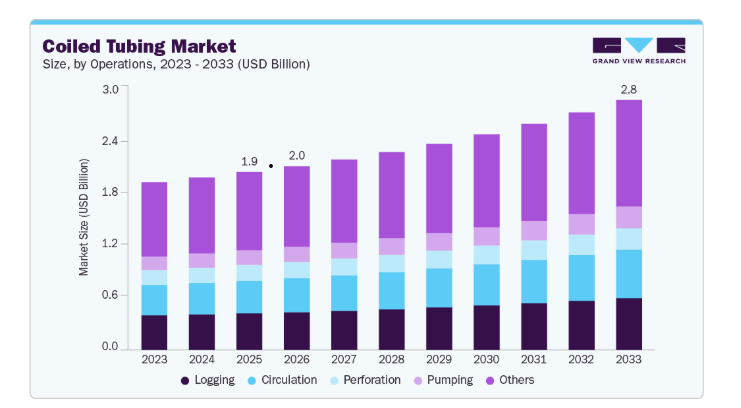
The coiled tubing market is entering a period where efficiency, well maintenance, and operational flexibility are becoming increasingly important across oil and gas operations. Coiled Tubing Market Valued at USD 1.9 billion in 2025, the market is projected to reach USD 2.7 billion by 2033, expanding at a CAGR of 4.5% from 2026 to 2033. But what is actually driving this expansion, where are the strongest opportunities emerging, and why are operators increasingly turning to coiled tubing for intervention activities?
What Is Driving the Coiled Tubing Market?
A major factor is the growing requirement to maintain production from mature oilfields. More than 70% of global oil output originates from mature fields, according to the IEA data cited in the market information. These fields require regular cleanouts, stimulation, gas lifting, and other intervention activities to sustain production.
Coiled tubing provides a cost-effective alternative to conventional workover approaches because operations can be performed without the same level of surface infrastructure or downtime.
At the same time, unconventional resources such as shale formations are creating additional demand. Horizontal and multistage fractured wells frequently require intervention, making the speed and flexibility of coiled tubing particularly valuable.
Download a free sample report or claim your copy of this full market intelligence report
Why Is Coiled Tubing Becoming More Important for Well Intervention?
The answer lies in what operators need from modern well-servicing operations.
Less downtime.: Coiled tubing can support intervention activities without requiring the dismantling of surface infrastructure.
Targeted operations.: It can be used for acidizing, scale removal, cleanouts, nitrogen lifting, cementing, and chemical injection.
Operational flexibility.: Its ability to work in horizontal and high-angle wells makes it suitable for unconventional reservoirs.
The well intervention & production segment is expected to record the fastest services CAGR of 4.6% from 2026 to 2033, highlighting the importance of these capabilities.
Which Operation Currently Holds the Largest Share?
Logging accounted for 20.6% of market revenue in 2025, making it the leading operation segment.
Why does logging matter?
Highly deviated and horizontal wells can make conventional wireline deployment difficult. Coiled tubing-conveyed logging allows operators to acquire information while circulating fluids and maintaining well control.
Technological developments are adding further capabilities through:
- Compact formation evaluation sensors
- Distributed temperature sensing
- Real-time telemetry systems
- Improved data acquisition technologies
These developments are helping make logging faster and more precise in challenging well environments.
Which Operation Could Grow Fastest?
Pumping is anticipated to register the fastest CAGR over the forecast period. The reason is its broad application across well intervention activities. Coiled tubing-assisted pumping can support acidizing, cementing, nitrogen lifting, and chemical injection while allowing fluids to be delivered at targeted depths.
This is particularly relevant for mature wells where selective stimulation is required to restore declining production. In unconventional reservoirs such as the Bakken and Permian basins, operators also use coiled tubing for post-fracturing cleanouts and matrix acidizing.
Where Is the Biggest Application Opportunity?
Offshore operations represent one of the strongest growth opportunities. The offshore segment is projected to expand at a 5.1% CAGR from 2026 to 2033, the fastest growth among applications.
Why?
Offshore wells are complex and expensive to drill and maintain. Operators therefore require intervention technologies that can minimize downtime while working within confined environments.
Coiled tubing provides a compact operational solution for:
Deepwater projects → well intervention → cleanouts → stimulation → logging
Growing activity in the Gulf of Mexico, North Sea, Eastern Mediterranean, West Africa, and other offshore areas is therefore creating additional opportunities.
Is Onshore Still Important?
Absolutely, Onshore operations remain a major part of the coiled tubing market because North America, the Middle East, and Asia Pacific contain large numbers of mature oil and gas fields. Coiled tubing is widely used for onshore cleanouts, acidizing, nitrogen lifting, stimulation, and hydraulic-fracturing-related activities.
Its ability to perform these tasks quickly and at relatively lower cost makes it particularly relevant in shale-rich regions where wells may require repeated intervention.
What Role Is Technology Playing?
Technology is expanding where and how coiled tubing can be deployed. Larger-diameter tubing, stronger materials, corrosion-resistant designs, real-time data transmission, and high-pressure capabilities are allowing equipment to operate in deeper and more challenging wells. Research supported by the U.S. Department of Energy has also focused on downhole tools and real-time data acquisition systems.
Why Does Offshore Growth Matter to the Market?
Offshore production accounts for nearly 30% of global oil output, according to the IOGP data cited in the source material. Projects in the Gulf of Mexico and Eastern Mediterranean are using coiled tubing for complex well-servicing requirements. Its compact footprint and operational efficiency can be especially valuable where large conventional rigs are difficult or expensive to deploy.
The anticipated increase in offshore exploration and production activity therefore provides an important growth pathway for coiled tubing suppliers and service providers.
What Could Limit Market Expansion?
Growth is not without challenges. Setting up and maintaining coiled tubing units requires substantial capital investment, which can create barriers for small and mid-sized service providers. Extreme well conditions can also challenge conventional systems. Very high temperatures and pressures may require upgraded materials and equipment.
Another factor is crude oil price volatility. Lower oil prices can reduce drilling and well-servicing activity, which directly affects demand for coiled tubing services.
Which Region Leads the Market?
North America held the largest regional position in 2025. The region benefits from extensive shale activity, mature oilfields, horizontal drilling, and established oilfield-services infrastructure. The U.S. market is particularly supported by activity across shale plays and mature fields, while offshore operations in the Gulf of Mexico provide another source of demand. But growth is not limited to North America.
Asia Pacific: China, India, Indonesia, and Australia are seeing increasing exploration and production activity. Government initiatives aimed at strengthening domestic energy development are supporting demand for well intervention services.
Europe: Mature North Sea fields require regular intervention. Coiled tubing is being used to reduce operating costs and maintain production.
Latin America: Brazil's offshore pre-salt developments and increasing foreign investment are creating opportunities for efficient offshore well services.
Middle East & Africa: Saudi Arabia, the UAE, and Kuwait are investing in mature-field recovery, increasing the requirement for cleanouts, stimulation, and nitrogen lifting.
Who Is Competing in the Coiled Tubing Market?
The competitive landscape includes companies such as Tenaris, Sandvik AB, AMETEK Inc., AMARDEEP STEEL, Baker Hughes, HandyTube LLC., and NOV.
Tenaris offers products for workovers, drilling, logging, perforating, and stimulation, while Sandvik manufactures seamless stainless steel and nickel alloy tubes used in well intervention, chemical injection, and control-line applications.
Competition is increasingly influenced by material performance, fatigue resistance, pressure capabilities, corrosion resistance, and the ability to support demanding downhole operations.
What Does the Market Outlook Look Like?
The coiled tubing market is moving alongside the broader need to extract more value from existing wells while supporting new unconventional and offshore projects.
With the market projected to grow from USD 2.0 billion in 2026 to USD 2.7 billion by 2033, demand will remain closely connected to well intervention, mature-field maintenance, offshore development, technological advancement, and the economics of oil and gas production.
The central market question is therefore no longer simply whether coiled tubing will be used. It is how effectively newer technologies can expand its role across increasingly complex well environments.
About us:
Grand View Research, a market research and consulting company, provides syndicated research reports, customized research reports, and consulting services. Grand View Research database is used by the world's renowned academic institutions and Fortune 500 companies to understand the global and regional business environment. Our database features thousands of statistics and in-depth analysis on 46 industries in 25 major countries worldwide.

 English
 Arabic
 French
 Spanish
 Portuguese
 Turkish
 Dutch
Dutch
 Italiano
 Russian
 Romaian
 Portuguese (Brazil)
 Greek
Greek
