
Carbon Fiber Reinforced Plastic Market Trends Shaped by Fuel Efficiency
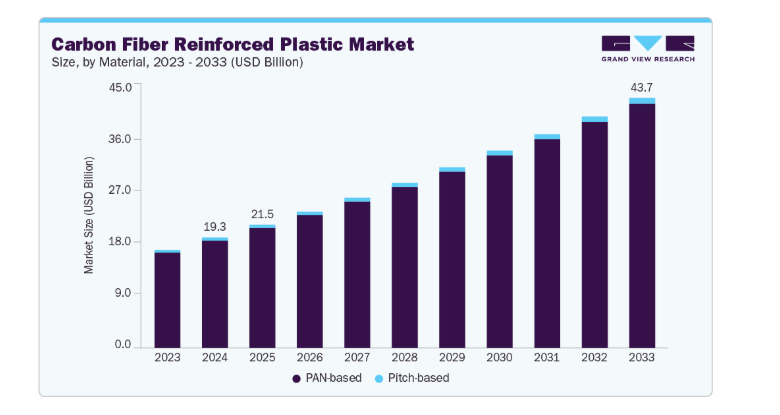
A material once associated mainly with high-performance aerospace and specialized applications is moving into a much broader industrial role. Carbon fiber reinforced plastic is increasingly being considered wherever manufacturers need lower weight, high strength, improved efficiency, and better performance. This transition is creating strong momentum across automotive, aerospace, wind energy, and other industrial applications. The global Carbon Fiber Reinforced Plastic Market was valued at USD 19.3 billion in 2024 and is projected to reach USD 43.7 billion by 2033, expanding at a CAGR of 9.2% from 2025 to 2033.
What Is Changing Inside CFRP Manufacturing?
The material itself is only one part of the transformation. Manufacturing processes are also evolving.
Companies are investing in:
- Automated fiber placement
- Automated tape laying
- Faster curing technologies
- Automated preform layup
- Thermoplastic processing
- Real-time manufacturing improvements
- Localized production
- Recycling and material recovery
These developments are intended to reduce cycle times, improve repeatability, and make CFRP more practical for higher-volume applications. This matters because production economics have traditionally been one of the biggest obstacles to broader adoption.
Download a free sample report or claim your copy of this full market intelligence report
Two Materials, Different Performance Priorities
PAN-Based CFRP
PAN-based carbon fiber accounted for 97.38% of market revenue in 2024 and is expected to grow at a CAGR of 9.3%. Its established processing characteristics, consistent mechanical performance, and familiarity among OEMs make it an important choice for structural applications, automotive lightweighting, and industrial uses.
Pitch-Based CFRP
Pitch-based carbon fiber is projected to grow at a CAGR of 7.5%. Its appeal comes from properties such as high stiffness, thermal conductivity, and high modulus performance. These characteristics support specialized applications in aerospace, defense, and thermal management. So, while PAN dominates the market, pitch-based carbon fiber continues to address applications where specific performance characteristics justify its use.
The Product Story Is Changing Too
Thermosetting CFRP held the largest product share at 74.43% in 2024. Its established qualification pathways, long-term mechanical properties, and fatigue resistance make it particularly relevant in aerospace and industrial applications where performance certainty is critical. But another segment is gaining momentum.
Thermoplastic CFRP → 10.3% projected CAGR
Thermoplastic composites can be reheated, welded, rapidly joined, repaired, and potentially recovered more easily than traditional thermoset systems. These characteristics are especially attractive for high-volume automotive manufacturing and next-generation aerospace programs. The competition between these material systems is therefore increasingly connected to manufacturing speed, assembly economics, repairability, and circularity.
Aerospace Still Sets the Performance Benchmark
Aerospace accounted for 61.30% of market revenue in 2024 and is projected to grow at a CAGR of 9.9%. The industry's continued demand for lightweight and fuel-efficient aircraft is supporting CFRP adoption. At the same time, manufacturing innovations are targeting the historically high cost of aerospace-grade carbon fiber composites. The aerospace sector therefore remains a major foundation for the market, while other industries are creating the next layer of volume.
Automotive Is Becoming a Major Growth Engine
The automotive segment is expected to expand at a 10.3% CAGR through 2033. The reason is straightforward: vehicle manufacturers need to balance performance, efficiency, emissions, and weight.
CFRP can support this transition through its strength-to-weight characteristics. As pollution-control requirements become more stringent and manufacturers focus on fuel-efficient vehicles, composite materials are gaining greater attention. The opportunity is particularly important as CFRP moves toward applications where higher production volumes require faster and more economical manufacturing methods.
The Sustainability Question
CFRP's growth also comes with an important challenge: production cost and energy intensity. High manufacturing costs remain a major barrier, particularly in price-sensitive applications. Recycling infrastructure is also limited, while recovering carbon fiber economically remains challenging. This is creating another innovation pathway.
Lower-cost precursors + recycling + reuse + hybrid material architectures
Research into precursors such as lignin and scalable recycling processes could broaden the available feedstock base. Hybrid structures combining carbon fiber with lower-cost materials may also help manufacturers achieve required performance without carrying the full cost of CFRP. Circularity is consequently becoming part of the commercial discussion rather than remaining only an environmental consideration.
North America Leads, Europe Accelerates
North America accounted for 38.98% of global revenue in 2024, making it the largest regional market.The region benefits from demand across aerospace, automotive, defense, and wind energy. U.S. aerospace modernization and electric vehicle programs are supporting composite demand, while efforts to strengthen domestic supply chains are encouraging investment in local production.
Europe, meanwhile, is expected to register the fastest regional CAGR of 9.8%. The presence of major aircraft and automotive manufacturers, combined with demand from aerospace, defense, and wind energy, is strengthening the European market. Aircraft production and services are also contributing to CFRP demand.
Asia Pacific Brings Scale to the Market
Asia Pacific is developing through a different growth pathway. China, Japan, South Korea, and India are contributing through manufacturing scale, industrial development, electric mobility, renewable energy, and advanced materials research.
China's manufacturing base and investment in wind and electric vehicle supply chains create opportunities for higher-volume CFRP consumption. Japan and South Korea continue to emphasize process innovation and higher-value applications.
The region's growing focus on precursor diversification and localized recycling also points toward efforts to bring CFRP into more cost-sensitive market segments.
Mexico Adds Another Growth Opportunity
Mexico's carbon fiber reinforced plastic industry is expected to grow at a substantial 10.2% CAGR from 2025 to 2033. This growth reflects the broader expansion of composite applications and manufacturing capabilities. As manufacturers seek greater efficiency, automation, and improved production economics, regional production capabilities can become increasingly important for serving automotive and industrial demand.
Companies Shaping the Competitive Landscape
The market has a high growth stage and slight consolidation, with established companies playing an important role in technology development and commercialization.
Key companies include:
DowAksa
Cytec Solvay Group
Toray Industries, Inc.
SGL Group
These companies are part of a competitive environment focused on improving CFRP performance, reducing manufacturing costs, expanding applications, and supporting sustainability.
The Bigger Market Shift
The carbon fiber reinforced plastic market is ultimately being shaped by a broader industrial question: How can manufacturers achieve higher performance without carrying unnecessary weight or escalating lifecycle costs?
CFRP provides one answer, but wider adoption depends on making that answer economically scalable.
As automation improves, thermoplastic systems expand, recycling technologies develop, and manufacturers move toward localized supply chains, CFRP is increasingly positioned to move from specialized applications into higher-volume markets.
With the market projected to reach USD 43.7 billion by 2033, the next stage of growth will depend not only on demand for carbon fiber, but on how effectively the industry turns advanced material performance into scalable, economical, and increasingly circular manufacturing.
About us:
Grand View Research, a market research and consulting company, provides syndicated research reports, customized research reports, and consulting services. Grand View Research database is used by the world's renowned academic institutions and Fortune 500 companies to understand the global and regional business environment. Our database features thousands of statistics and in-depth analysis on 46 industries in 25 major countries worldwide.

 English
 French
 Spanish
 Portuguese
 Deutsch
 Turkish
 Dutch
Dutch
 Italiano
 Russian
 Romaian
 Portuguese (Brazil)
 Greek
Greek
