
QuickBooks Payroll Bank Connection Problems: Causes and Troubleshooting Guide
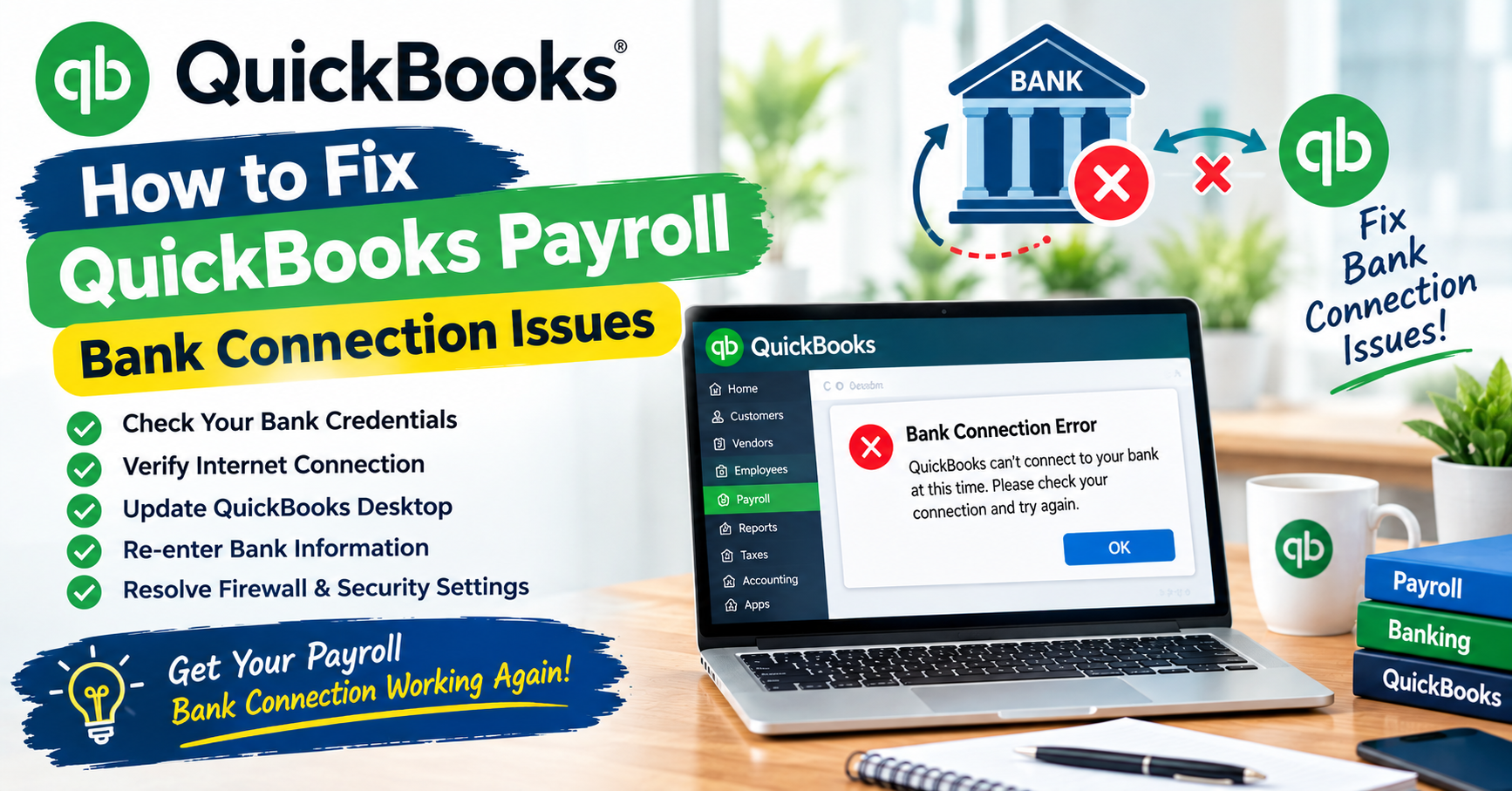
Bank connectivity plays an important role in efficient payroll management. When QuickBooks Payroll bank connection problems occur, users may have difficulty connecting a payroll bank account, downloading transactions, verifying banking information, or completing payroll-related tasks. A disconnected or unstable bank connection can also make it harder to keep financial records synchronized and up to date.
These problems can occur for several reasons. Incorrect banking credentials, temporary bank maintenance, outdated QuickBooks software, expired authorization, browser issues, connectivity problems, security restrictions, or incorrect account settings may all contribute to banking difficulties.
The good news is that many QuickBooks Payroll bank connection problems can be investigated through a systematic troubleshooting process. This guide explains common causes, symptoms, practical troubleshooting steps, and preventive measures to help users restore a reliable connection.
What Are QuickBooks Payroll Bank Connection Problems?
QuickBooks Payroll bank connection problems occur when QuickBooks cannot properly communicate with a connected financial institution or when payroll-related banking information does not update as expected.
Depending on the situation, you may experience symptoms such as:
-
Bank account will not connect to QuickBooks.
-
Previously connected bank account becomes disconnected.
-
Banking credentials are rejected.
-
Transactions stop downloading.
-
Bank information does not refresh.
-
QuickBooks repeatedly asks for banking authorization.
-
Payroll-related bank information appears outdated.
-
A bank account cannot be selected for a payroll-related transaction.
-
Downloaded transactions are incomplete.
-
QuickBooks displays a connection or authorization message.
-
The connection works temporarily and then stops.
Identifying the exact symptom is important because the appropriate troubleshooting method depends on whether the issue is caused by the bank, QuickBooks, account settings, or the local network.
Common Causes of QuickBooks Payroll Bank Connection Problems
Before changing settings, understand the possible causes of the problem.
1. Incorrect Bank Login Information
If the username, password, or other authentication information entered into QuickBooks does not match the information required by the financial institution, the connection may fail.
Banks may also change their sign-in requirements, which can require users to update their connection.
2. Temporary Bank Maintenance
Financial institutions occasionally perform scheduled maintenance or experience temporary service interruptions.
During these periods, QuickBooks may be unable to establish or refresh the connection.
If the same bank connection suddenly stops working without any changes on your side, checking whether the financial institution is experiencing an outage can be useful.
3. Expired Bank Authorization
Some banking connections require periodic authorization or reauthorization.
If authorization expires, QuickBooks may request that you reconnect or verify the account.
4. Outdated QuickBooks Software
Using an outdated QuickBooks version can contribute to compatibility problems and connection issues.
Keeping the software appropriately updated can help ensure that available banking and payroll features work as expected.
5. Internet Connectivity Problems
An unstable internet connection can interrupt communication between QuickBooks and online banking services.
Even if websites appear to load normally, intermittent network interruptions can affect secure financial connections.
6. Browser or Cache Problems
For browser-based QuickBooks services, outdated cached information, cookies, or browser compatibility issues can interfere with banking connections.
Trying the process in a supported private or incognito browser window can help determine whether the problem is related to stored browser data.
7. Security Software or Firewall Restrictions
Security software, firewalls, VPN configurations, or network restrictions may sometimes interfere with connections required by QuickBooks.
This is especially relevant in business environments where network traffic is tightly controlled.
8. Bank Account Settings
An incorrect account selection or configuration inside QuickBooks can cause confusion when connecting or categorizing a financial account.
Review the account carefully before making changes.
How to Fix QuickBooks Payroll Bank Connection Problems
The following steps can help troubleshoot common banking connection issues.
Step 1: Check Your Internet Connection
Start with the simplest possibility.
Make sure your computer has a stable internet connection. Open a few trusted websites to verify connectivity.
If the connection is unstable:
-
Restart the network equipment if appropriate.
-
Reconnect your computer to the network.
-
Try again after the connection stabilizes.
-
Avoid repeatedly reconnecting while the network is dropping.
For business networks, contact the network administrator if QuickBooks is being blocked.
Step 2: Verify Your Bank's Website
Open your financial institution's official website directly and sign in.
Confirm that:
-
Your credentials work.
-
The account is active.
-
There are no security alerts requiring action.
-
The bank has not requested additional verification.
-
Online banking access is available.
If you cannot sign in directly through the bank's website, resolve that issue with the financial institution before troubleshooting QuickBooks.
Do not provide banking passwords to anyone assisting with troubleshooting.
Step 3: Confirm the Correct Bank Account
If you have multiple business accounts, verify that you are working with the correct account.
Check the account name and relevant identifying information inside QuickBooks.
Selecting the wrong account can make it appear that the banking connection is not functioning correctly.
Step 4: Recheck Banking Credentials
If the bank has changed its login requirements, update the information used by the QuickBooks connection.
Enter the credentials carefully and follow any additional authentication steps requested by the financial institution.
Avoid repeatedly entering incorrect credentials because repeated failed attempts may trigger security restrictions from the bank.
Step 5: Refresh the Bank Connection
If the account was previously connected but has stopped updating, refresh the connection using the available banking options in QuickBooks.
A refresh can help QuickBooks retrieve updated information from the financial institution.
After refreshing, allow the process to complete before attempting another connection.
Step 6: Reauthorize the Account
If QuickBooks indicates that authorization is required, follow the available prompts to reconnect the account.
You may need to:
-
Select the affected account.
-
Start the reconnect or authorization process.
-
Sign in through the appropriate bank authentication process.
-
Complete any verification requested by the bank.
-
Confirm the account mapping.
-
Review the resulting connection.
Be careful when reconnecting an existing account. Verify the destination account before confirming the setup.
Step 7: Check for Bank Alerts
Sign in directly to the bank's official website and look for notifications.
Possible alerts may involve:
-
Password changes
-
Security verification
-
Terms updates
-
Account restrictions
-
Multi-factor authentication
-
Suspicious-login verification
-
Required consent
-
Online banking enrollment
Resolve any required bank-side action before attempting to reconnect QuickBooks.
Step 8: Update QuickBooks Desktop
If you are using QuickBooks Desktop, check whether an update is available for your installed version.
Before performing an update, save your work and maintain an appropriate backup of important company data.
After updating:
-
Restart QuickBooks.
-
Open the company file.
-
Return to the banking section.
-
Check the affected account.
-
Attempt the connection again.
Step 9: Restart QuickBooks
Temporary application problems can sometimes affect online connections.
Close QuickBooks completely and reopen it.
Then:
-
Open the correct company file.
-
Check the bank account.
-
Refresh the connection.
-
Review any displayed messages.
If the issue was temporary, the connection may work after restarting the application.
Step 10: Restart the Computer
If restarting QuickBooks does not help, restart the computer.
This can clear temporary processes that may be interfering with the application or network connection.
After restarting, avoid opening multiple applications unnecessarily and test the QuickBooks bank connection again.
Step 11: Try a Private Browser Window
For browser-based QuickBooks services, open a private or incognito browser window and sign in.
This can help determine whether cached information or browser extensions are interfering with the connection.
If the connection works in a private window, clear the appropriate browser cache and cookies or review browser extensions.
Step 12: Clear Browser Cache and Cookies
If the banking problem occurs in QuickBooks Online, outdated browser data may contribute to the issue.
Use your browser's settings to clear cached data and cookies according to the browser's normal procedure.
Then:
-
Close the browser.
-
Reopen it.
-
Sign in again.
-
Open QuickBooks.
-
Check the banking connection.
Avoid clearing unrelated saved information unless necessary.
Step 13: Disable Unnecessary Browser Extensions
Some browser extensions can interfere with authentication pages or financial websites.
If the banking connection fails during sign-in, temporarily test the process without unnecessary extensions.
Security-related extensions should not be permanently disabled without understanding the consequences. If the issue is caused by an organizational security policy, consult the relevant administrator.
Step 14: Check VPN and Network Restrictions
If you are using a VPN, proxy, corporate firewall, or restricted network, test whether the connection behaves differently on an appropriate trusted network.
Do not bypass organizational security controls without authorization.
If QuickBooks works normally on one network but not another, the network configuration may need to be reviewed.
Step 15: Check the Account Mapping
When reconnecting a bank account, QuickBooks may ask where downloaded transactions should be recorded.
Make sure the correct existing account is selected.
Creating a new account unnecessarily can lead to duplicate accounts and complicated reconciliation work.
Always review the account name before confirming the connection.
Step 16: Review Downloaded Transactions
After the bank connection is restored, review the transactions downloaded into QuickBooks.
Check for:
-
Duplicate transactions
-
Missing transactions
-
Incorrect account mapping
-
Unexpected dates
-
Unusual descriptions
Do not automatically accept every downloaded transaction. Review transactions carefully before adding or matching them.
Step 17: Avoid Reconnecting the Same Account Repeatedly
Repeated attempts to disconnect and reconnect an account can create additional complications.
If the bank connection fails consistently, stop after reasonable troubleshooting and identify whether the problem is related to the bank, QuickBooks, the account configuration, or the network.
Keeping a record of error messages can help when further assistance is required.
QuickBooks Payroll Bank Connection Problems After a Password Change
If the bank password was recently changed, the existing QuickBooks connection may require updated authorization.
Start by confirming that the new password works directly on the bank's official website.
Then return to QuickBooks and follow the appropriate reconnect or update process.
If the bank requires additional verification, complete it before returning to QuickBooks.
Payroll Bank Account Not Linking in QuickBooks
When a payroll bank account cannot be linked, check the following:
-
Correct bank selected
-
Correct account credentials
-
Active online banking access
-
Bank-side security alerts
-
Internet connection
-
QuickBooks version
-
Account mapping
-
User permissions
-
Bank service availability
If other bank accounts connect successfully but one particular account does not, focus troubleshooting on that account and the financial institution.
QuickBooks Direct Deposit Bank Connection Issues
Direct deposit involves payroll-related banking information and may require specific account verification or authorization.
If direct deposit banking information is not connecting correctly, review the payroll account configuration and any verification requirements associated with the payroll service.
Do not change bank details simply to test the connection if doing so could affect payroll processing.
If the issue involves an incorrect account or sensitive payroll information, verify the correct details before making changes.
When Bank Transactions Stop Downloading
A bank connection may remain listed in QuickBooks even when new transactions are no longer downloading.
In that situation:
-
Check the bank website.
-
Look for security alerts.
-
Verify that online banking access works.
-
Refresh the QuickBooks connection.
-
Reauthorize if requested.
-
Check the account mapping.
-
Review QuickBooks updates.
-
Test again after restarting the application.
If the bank connection remains inactive, document the exact message displayed by QuickBooks.
What to Do If the Bank Connection Keeps Disconnecting
Repeated disconnections can be frustrating because the account may appear to work temporarily before stopping again.
Possible causes include:
-
Expired authorization
-
Bank security changes
-
Connection interruptions
-
Outdated software
-
Browser problems
-
Bank maintenance
-
Network restrictions
Track when the disconnection occurs and whether other users experience the same problem.
If the issue consistently occurs at the bank authentication stage, the financial institution may need to investigate the connection.
How to Prevent QuickBooks Payroll Bank Connection Problems
Regular maintenance can reduce interruptions.
Keep Software Updated
Use an appropriately supported and updated QuickBooks version.
Maintain Stable Internet Access
Payroll and banking workflows require dependable connectivity. Avoid processing important payroll tasks during unstable network conditions.
Monitor Bank Notifications
Review bank alerts regularly so required security or authorization actions are not missed.
Keep Login Information Current
If bank credentials or authentication requirements change, update the QuickBooks connection appropriately.
Review Connected Accounts
Periodically confirm that the correct financial accounts are connected and mapped correctly.
Maintain Company Backups
Regular backups provide an additional layer of protection for important company data.
Review Transactions Carefully
After a connection is restored, check downloaded transactions before accepting or matching them.
When to Contact QuickBooks or Your Bank
Determining which party should assist depends on where the problem occurs.
Contact the financial institution when:
-
You cannot sign in to the bank website.
-
The bank account is restricted.
-
The bank reports an outage.
-
Bank authentication is failing.
-
The bank has changed its connection requirements.
Seek QuickBooks assistance when:
-
The bank website works normally.
-
Other banking connections work but QuickBooks does not.
-
QuickBooks displays a specific application error.
-
Account mapping appears incorrect.
-
The company file has other problems.
-
Payroll functionality is also affected.
Having the following information available can make troubleshooting easier:
-
QuickBooks version
-
Type of QuickBooks product
-
Bank name
-
Affected account
-
Approximate time the problem began
-
Exact error message
-
Recent password or bank changes
-
Recent QuickBooks updates
Never share full banking credentials, passwords, PINs, or security codes with support representatives or other third parties.
Frequently Asked Questions
Why is my QuickBooks Payroll bank connection not working?
Common causes include incorrect credentials, expired authorization, bank maintenance, connectivity problems, outdated software, browser issues, or incorrect account configuration.
Why did my QuickBooks bank connection suddenly stop?
A previously working connection may stop because the bank changed its authentication process, authorization expired, the bank is experiencing an interruption, or QuickBooks requires the connection to be refreshed.
Can an internet problem affect QuickBooks Payroll banking?
Yes. An unstable connection can interrupt communication with online banking and payroll services.
Should I disconnect and reconnect my bank account?
Reconnecting may be appropriate when QuickBooks specifically requests reauthorization. Before doing so, verify the correct account mapping to avoid creating duplicate accounts or other bookkeeping complications.
Why does QuickBooks keep asking me to sign in to my bank?
Repeated sign-in requests may be related to expired authorization, changed bank security requirements, authentication problems, or a connection issue.
What if my bank website works but QuickBooks does not?
If the bank website works normally, review the QuickBooks connection, software version, account mapping, browser environment, and any displayed error message. Further QuickBooks support may be appropriate if the issue continues.
Can a bank outage cause QuickBooks connection problems?
Yes. If the financial institution's online services are temporarily unavailable, QuickBooks may not be able to retrieve or refresh banking information until the service becomes available again.
Conclusion
QuickBooks Payroll bank connection problems can interfere with payroll workflows, transaction downloads, and financial record management. The underlying cause may be something simple, such as incorrect login information or an outdated browser, or it may involve bank authorization, software configuration, network restrictions, or temporary service availability.
Start troubleshooting by confirming that the bank website works, checking account credentials, reviewing bank alerts, verifying the correct account, and refreshing the connection. For QuickBooks Desktop, keeping the software appropriately updated and maintaining reliable company-file backups can also support smoother operation.
When a connection is restored, review the account mapping and downloaded transactions carefully. Avoid unnecessary account changes or duplicate records, especially when payroll information is involved.
If the issue continues despite these steps, document the exact error and recent changes and seek assistance from the appropriate financial institution or QuickBooks support channel. A methodical troubleshooting process can help identify the source of the connection problem while protecting the accuracy of payroll and accounting records.

 English
 Arabic
 French
 Spanish
 Portuguese
 Deutsch
 Turkish
 Dutch
Dutch
 Italiano
 Romaian
 Portuguese (Brazil)
 Greek
Greek
