
Turbine Control Systems Market to Reach USD 32.93 Billion by 2036 as India Records 5.2% CAGR
| Turbine Control Systems Market to Reach USD 32.93 Billion by 2036, India, China and Germany Show Steady Growth |
The global turbine control systems market is estimated at USD 21.20 billion in 2026 and is projected to reach USD 32.93 billion by 2036, expanding at a CAGR of 4.5% during the forecast period. The market is expected to create an absolute dollar opportunity of USD 11.72 billion between 2026 and 2036. Turbine control systems are used to manage turbine speed, load, temperature, vibration, emissions, and safety functions across power generation, oil and gas, marine, and industrial applications.
Demand is being supported by expansion of power generation capacity in emerging markets and continued investment in new turbine installations. At the same time, operators are modernizing aging turbine fleets by replacing legacy mechanical and analog controls with digital platforms that provide enhanced monitoring, diagnostics, and operational control. Emissions compliance requirements are also encouraging adoption of advanced combustion control and monitoring capabilities.
Get detailed market forecasts, competitive benchmarking, and pricing trends: https://www.factmr.com/connectus/sample?flag=S&rep_id=2384
Gas Turbine Control Systems remain the leading product category, accounting for 78% of total market share in 2026. Their strong position reflects established deployment across mainstream power generation and oil and gas applications, supported by broad availability and consistent demand. Digital turbine control systems are also gaining importance as new installations and retrofit projects increasingly require integrated monitoring, faster response to load changes, emissions management, and remote diagnostic capabilities.
Power generation is the dominant application segment, representing 80% of the market in 2026. The segment benefits from demand across thermal power plants, gas-fired facilities, combined-cycle power plants, independent power producers, and other utility operations. Oil and gas remains another important application area, while marine and industrial manufacturing applications contribute to overall demand across specialized turbine installations.
Geographically, India is projected to record the highest growth among the countries covered, with a CAGR of 5.2% through 2036. Industrial expansion, government infrastructure programs, and increasing domestic consumption are supporting new equipment procurement. Cost considerations remain relevant to purchasing decisions, creating opportunities for manufacturers that can provide competitive turbine control solutions.
China's turbine control systems market is forecast to expand at a CAGR of 5.0% through 2036. Large-scale manufacturing activity, domestic demand expansion, and infrastructure investment programs are supporting market development. The country's manufacturing scale contributes to pricing competitiveness, while technology adoption is expanding across industrial applications.
Germany is projected to grow at a CAGR of 4.5% through 2036. Demand is supported by engineering-grade procurement standards, an export-oriented manufacturing base, and steady replacement cycles. Regulatory compliance requirements also favor suppliers capable of meeting certified and precision-oriented equipment specifications. Germany's established industrial ecosystem supports continued demand for turbine control technologies across relevant applications.
The United States is also projected to expand at a CAGR of 4.5% through 2036. A large installed turbine base, established distribution channels, and strong end-use industry activity support replacement and modernization demand. Premium product adoption and established market access provide a foundation for continued procurement of advanced control technologies. The UK and Japan are projected to grow at CAGRs of 4.3% and 4.1%, respectively.
Digitalization is emerging as an important direction for the turbine control systems industry. Digital platforms can combine turbine control with performance monitoring, remote diagnostics, and predictive maintenance capabilities. This supports the industry's transition from reactive maintenance toward condition-based asset management. Retrofit projects are particularly relevant because operators with existing turbine fleets can upgrade legacy control infrastructure without replacing the complete turbine installation.
The market also faces constraints. Long replacement cycles for existing turbine control systems can reduce the frequency of upgrade procurement. Retrofitting digital controls into legacy turbine installations may involve integration complexity, while network-connected control systems create cybersecurity considerations for plant operators. These factors can influence technology selection and implementation timelines.
Opportunity areas include digital twin platforms, predictive maintenance solutions, and retrofit programs for aging turbine fleets. Renewable energy integration may also create demand for flexible turbine control technologies that support grid balancing and load-following requirements. Suppliers combining control hardware with analytics and service capabilities can address a broader range of operational requirements.
Gain Full Access to Market Forecasts and Key Drivers:
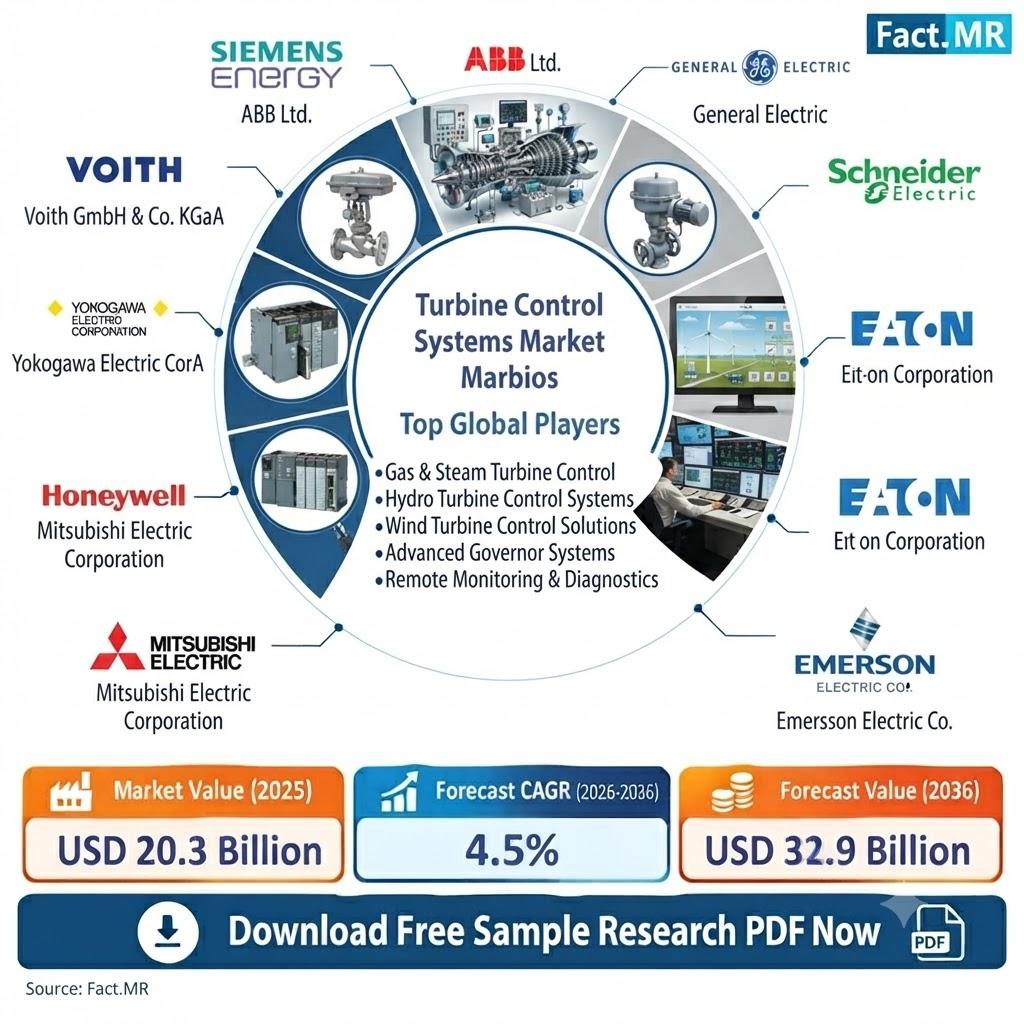
The competitive landscape includes established power and automation technology companies. Siemens Energy, ABB Ltd., General Electric, and Schneider Electric hold established positions in the global turbine control systems market. Eaton Corporation, Emerson Electric Co., Honeywell International, and Mitsubishi Electric Corporation participate across selected segments and geographic markets. Yokogawa Electric Corporation and Voith GmbH & Co. KGaA also compete through focused offerings.
The turbine control systems market covers gas, steam, and hydro turbine control systems alongside digital and mechanical or hydraulic control technologies. Applications span power generation, oil and gas, marine operations, and industrial manufacturing. The market analysis includes country-level demand, product benchmarking, pricing analysis, technology trends, competitive assessment, and forecasts covering 2026 to 2036.
For detailed market size, segment analysis, country-level forecasts, competitive benchmarking, and growth opportunities, refer to the full Fact.MR Turbine Control Systems Market report.
Top Trending Reports:
Gaming Hardware Market https://www.openpr.com/news/4441491/global-gaming-hardware-market-outlook-2026-2034
Advanced Ceramics Market https://www.openpr.com/news/4441480/global-advanced-ceramics-market-outlook-2026-2036
Cannabigerol Market https://www.openpr.com/news/4441471/global-cannabigerol-cbg-market-outlook-2025-2035-north
Golf Cart Market https://www.openpr.com/news/4441447/global-golf-cart-market-outlook-2025-2035-north-america
Waterjet Cutting Machine Market https://www.openpr.com/news/4441440/global-waterjet-cutting-machine-market-outlook-2025-2035
About Fact MR
(Fact MR) is a leading provider of market research and consulting services, offering syndicated and customized research across industries including Chemical & Materials, marine coatings, and graphene materials.

 English
 Arabic
 French
 Spanish
 Portuguese
 Deutsch
 Turkish
 Dutch
Dutch
 Italiano
 Russian
 Romaian
 Greek
Greek
