
How Advanced Coating Platforms Are Reshaping the Medical Device Coatings Market
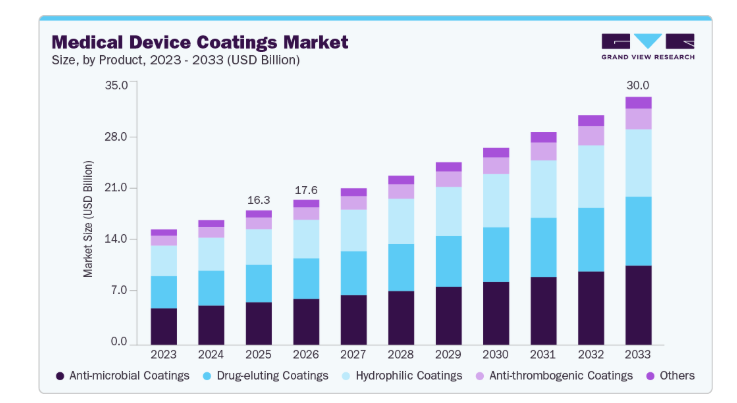
A medical device may look like a simple piece of equipment, but its surface can have a major influence on how effectively it performs. From catheters and guidewires to stents, syringes, sutures, and cardiovascular devices, coatings are increasingly being incorporated to improve maneuverability, lubricity, biocompatibility, and protection. This is creating a broader role for the Medical Device Coatings Market, which was valued at USD 16.3 billion in 2025 and is projected to reach USD 30.0 billion by 2033, expanding at a 7.9% CAGR from 2026 to 2033.
Why Coatings Matter More Than They Appear
Medical devices frequently come into contact with sensitive tissues, fluids, and complex anatomical pathways. Their surfaces therefore need to deliver more than basic durability. Coatings can help improve movement, reduce friction, provide antimicrobial properties, and enhance the overall functionality of the device.
This requirement is becoming increasingly important as healthcare moves toward minimally invasive and non-invasive procedures. Smaller and more specialized devices need surfaces capable of supporting precise movement while maintaining appropriate performance.
Medical Device → Surface Requirement → Specialized Coating → Improved Performance → Better Procedural Functionality
The growing geriatric population, increasing emphasis on early disease detection, and rising demand for high-quality healthcare services are adding further momentum. At the same time, the growing frequency of hospital-acquired infections is increasing attention toward antimicrobial protection.
Download a free sample report or claim your copy of this full market intelligence report
Antimicrobial Coatings Set the Product Direction
Among the different coating technologies, antimicrobial coatings accounted for the largest product share, representing 31.8% of revenue in 2025.
Their relevance comes from their ability to inhibit bacterial growth and provide additional protection for medical-device surfaces. Catheters, surgical instruments, implants, and wound-care products are among the applications where antimicrobial properties can be particularly valuable.
The demand is therefore connected not only with device performance but also with infection-control priorities across healthcare environments.
Hydrophilic coatings are following another important growth path. With a projected 8.3% CAGR, these coatings are increasingly relevant to catheters, guidewires, and delivery systems because of their lubricity and biocompatibility.
Cardiovascular Devices Remain a Major Application
The application landscape shows how closely coating demand is tied to medical-device innovation. Cardiovascular applications accounted for 26.9% of revenue in 2025, supported by widespread use of coated stents, guidewires, catheters, and implantable cardiac devices.
For these devices, surface performance can influence friction, maneuverability, and biocompatibility. Continued innovation in cardiovascular devices therefore creates additional requirements for coating technologies.
But the opportunity is extending beyond cardiovascular care.
Neurology is projected to register the fastest application growth, with an 8.7% CAGR through 2033. Growing adoption of coated microcatheters, neurovascular guidewires, clot-retrieval devices, and neurostimulation systems is creating demand for highly lubricious and biocompatible coatings designed for delicate procedures.
Cardiovascular Devices → Neurovascular Devices → Specialized Coatings → More Demanding Performance Requirements
From Lubricity to Protection: A Multifunctional Market
One of the defining characteristics of the Medical Device Coatings Market is that coatings are no longer associated with a single performance requirement. A coating may need to provide lubricity while also supporting biocompatibility, antimicrobial resistance, corrosion protection, or drug delivery.
Hydrophilic and antimicrobial coatings illustrate this shift particularly well. Hydrophilic coatings support smooth insertion and movement, while antimicrobial technologies address microbial risks. Drug-eluting coatings add another layer of functionality by supporting drug delivery from medical-device surfaces.
This multifunctional role is creating opportunities for coating technologies that can meet increasingly specific requirements across different device categories.
The Technology Challenge Is Becoming More Specialized
As devices become smaller, more precise, and more application-specific, coating manufacturers need to develop technologies capable of delivering consistent performance on complex surfaces. Barrier-to-entry technologies such as hydrophilic and drug-eluting coatings are contributing to a moderately concentrated industry structure.
The competitive environment includes specialized coating companies, raw-material suppliers, and medical-device manufacturers. Companies such as SurModics, DSM, Hydromer, Harland Medical Systems, Covalon Technologies, and Biocoat participate in a market where proprietary coating platforms, technological expertise, and OEM relationships are important.
What Comes Next for Medical Device Coatings?
The future of the market is closely connected with the evolution of healthcare itself. More minimally invasive procedures create demand for devices that can move through the body with greater precision. Rising infection-control priorities create demand for antimicrobial surfaces. Advanced cardiovascular and neurological procedures create requirements for specialized coatings.
At the same time, regulatory requirements continue to influence how coating technologies are developed and commercialized.
The result is a market moving toward increasingly specialized surface engineering:
Better Devices → More Complex Procedures → Higher Surface Performance Needs → Advanced Coating Technologies → Expanding Medical Applications
With the global market expected to grow from USD 17.6 billion in 2026 to USD 30.0 billion by 2033, medical device coatings are becoming an increasingly important technology layer behind the performance of modern healthcare equipment.
About us:
Grand View Research, a market research and consulting company, provides syndicated research reports, customized research reports, and consulting services. Grand View Research database is used by the world's renowned academic institutions and Fortune 500 companies to understand the global and regional business environment. Our database features thousands of statistics and in-depth analysis on 46 industries in 25 major countries worldwide.

 English
 Arabic
 French
 Spanish
 Portuguese
 Turkish
 Dutch
Dutch
 Italiano
 Russian
 Romaian
 Portuguese (Brazil)
 Greek
Greek
