
Inside the Bispecific Antibody Platform: Mechanisms Behind Development, Engineering, and Purification
What's New
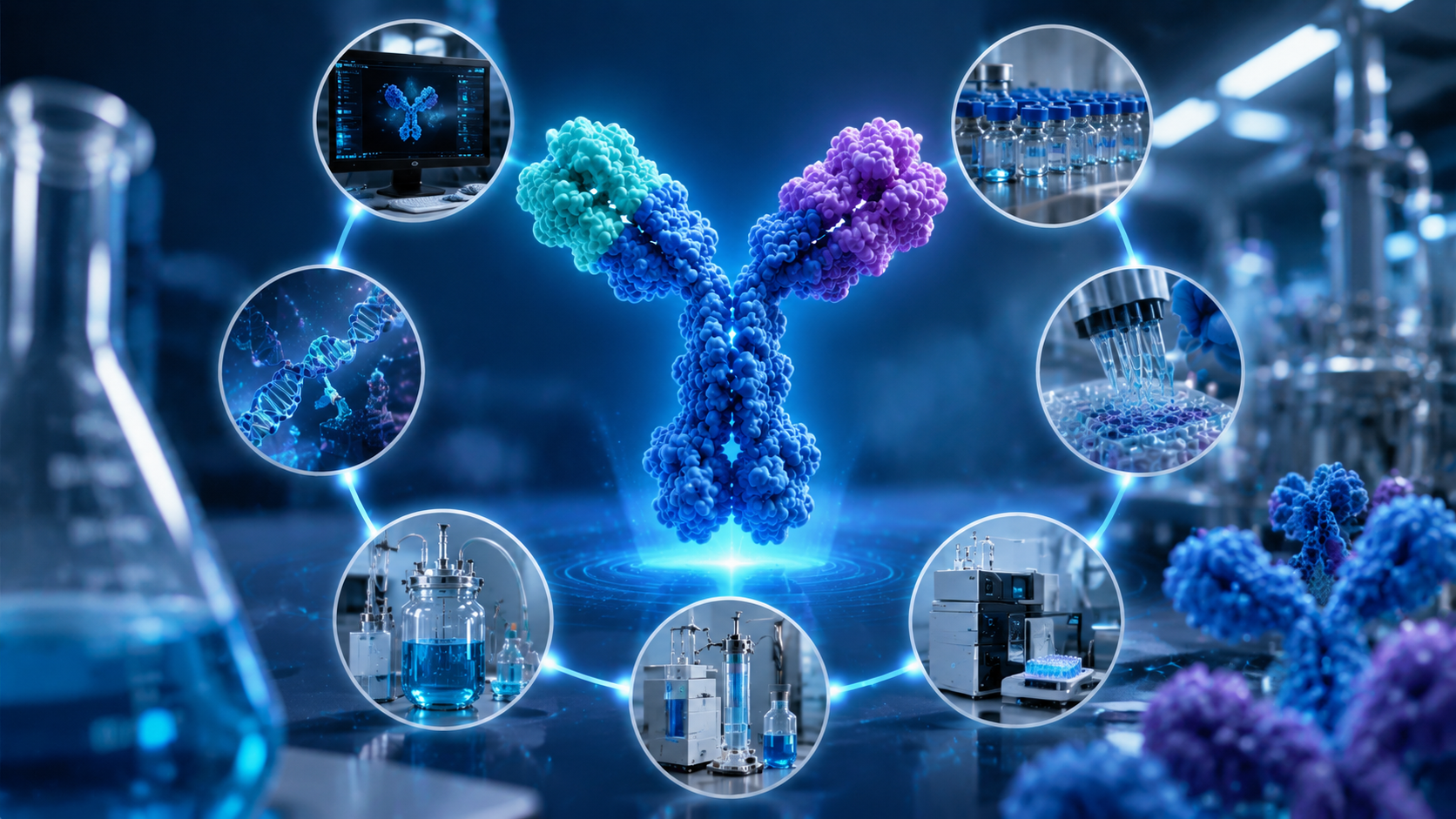
A new generation of bispecific antibody (BsAb) platforms is reshaping the way biologics are designed and produced. Unlike traditional linear workflows that handle development, engineering, and purification as separate operations, the integrated BsAb platform establishes a closed-loop system that connects these modules in real time. This model improves yield, reproducibility, and design feedback, offering a more systematic route to next-generation therapeutics.
What Is a Bispecific Antibody Platform?
A bispecific antibody can bind two different antigens or epitopes simultaneously, allowing precise modulation of complex biological pathways. However, constructing such molecules is far more challenging than building monoclonal antibodies. Developers must balance expression, folding, stability, and pairing accuracy. The BsAb platform was created to address these challenges by integrating three interdependent modules—development, engineering, and purification—each contributing to the overall performance and manufacturability of the final molecule.
How the Platform Works
1. Development Module – Designing Function and Feasibility
The development module initiates the process with target selection and construct generation. It supports the rapid creation of bispecific constructs capable of engaging immune cells or blocking multiple signaling pathways. By leveraging optimized expression systems—such as mammalian or transient transfection models—this stage ensures high productivity and molecular fidelity.
During development, researchers perform screening for antigen binding, functional activity, and preliminary stability. The challenge lies in finding a configuration that maintains both antigen-binding domains active without steric interference—a frequent obstacle in bispecific antibody design.
2. Engineering Module – Controlling Structure and Specificity
Once promising candidates are identified, the engineering module focuses on molecular optimization. Techniques such as Knobs-into-Holes (KiH) and CrossMAb are employed to ensure correct heavy/light chain pairing and balanced affinity.
At this stage, computational modeling assists in predicting folding stability and inter-domain flexibility. The key technical difficulty is minimizing chain mispairing and nonfunctional byproducts. Advanced Fc engineering and linker design can enhance half-life, solubility, and manufacturability without compromising function.
3. Purification Module – Ensuring Purity and Structural Integrity
BsAb purification remains one of the most complex stages due to the coexistence of multiple assembly variants. The purification module integrates affinity resins—such as Protein A/L, CH1, or PrismA systems—to selectively isolate the desired heterodimer while removing unwanted homodimers.
Chromatographic techniques are complemented by high-resolution analytical tools, including LC-MS and biolayer interferometry, to verify molecular identity and function. The goal is to achieve consistent purity above 95%, a benchmark necessary for preclinical and CMC readiness.
Why Integration Matters
Traditional antibody workflows often suffer from data fragmentation between early discovery and manufacturing stages. The BsAb platform eliminates these silos through data connectivity and feedback loops. Structural insights gained during purification can be traced back to engineering parameters, while expression data from development can guide process scaling. This closed feedback system shortens optimization cycles and improves overall process robustness.
Moreover, integrating engineering with purification ensures that molecule-specific issues—such as aggregation or charge heterogeneity—are detected and corrected before scale-up. This alignment between molecular design and downstream processing represents a critical step toward consistent, reproducible biologics manufacturing.
Who Benefits and What's Next
This platform serves as a foundation for academic and industrial programs focused on immuno-oncology, autoimmune disorders, and infectious diseases. Its modular design allows customization—researchers can enter at any stage or run the full sequence from design to purification.
As bispecific antibodies continue to gain traction in global drug pipelines, integrated platforms like this will likely define the next wave of therapeutic development. By coupling molecular intelligence with process analytics, they not only improve efficiency but also bring biologics closer to real-time, data-driven production.

 English
 Arabic
 French
 Spanish
 Portuguese
 Deutsch
 Turkish
 Dutch
 Italiano
 Russian
 Romaian
 Greek
