
Zinc Oxide Market: Key Application Areas Supporting Future Growth
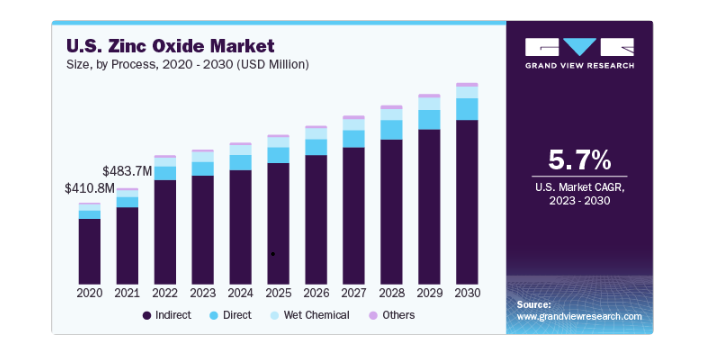
Zinc oxide is finding a place across several industries where performance, durability, and specialized material properties are essential. From rubber vulcanization in automobile tires to ceramic manufacturing and UV protection in personal care products, the material serves a wide range of industrial and consumer applications. The global Zinc Oxide Market was valued at USD 5.2 billion in 2022 and is projected to reach USD 8.1 billion by 2030, expanding at a CAGR of 5.7% from 2023 to 2030. Asia Pacific accounted for the largest revenue share of 52.3% in 2022, supported by expanding automotive, construction, pharmaceutical, and personal care industries across the region.
Zinc Oxide Market Growth Across Major Applications
Automotive remains an important area of zinc oxide consumption, particularly because of its role in rubber vulcanization. The automotive application accounted for the largest revenue share of 39.5% in 2022. Zinc oxide works as a cross-linking or curing agent for rubber and halogen-containing elastomers such as polysulfides and neoprene. The strong relationship between automobile production and tire manufacturing therefore continues to influence demand for zinc oxide.
Download a free sample report or claim your copy of this full market intelligence report
The material also has an established position in ceramics, especially in tile production. Zinc oxide helps reduce melting temperatures and energy requirements while contributing to the performance of ceramic materials. Its low coefficient of expansion, high heat capacity, high-temperature stability, and thermal conductivity make it suitable for ceramic applications. Depending on the quantity used, zinc oxide can contribute to either glossy or matte finishes while improving glaze elasticity and reducing issues such as shivering and crazing.
Product Form Continues to Shape Zinc Oxide Demand
The powder form accounted for the largest revenue share of 76.9% in 2022. Its broad use across batteries, lubricants, friction materials, metal extraction, spray galvanizing, paints, and chemical processes supports its leading position. Fine zinc oxide powder is also used for UV and corrosion protection in paints and for producing zinc-rich paint formulations and chemicals.
Other product forms serve more specialized applications. Zinc oxide pellets are produced from high-purity zinc and can be used in alkaline caustic potash or caustic soda baths. Liquid zinc oxide has applications in sun care, after-sun products, mineral makeup, and anti-aging skincare because of its ability to provide protection against UVA and UVB wavelengths. This diversity of product forms allows manufacturers to address requirements across industrial, pharmaceutical, cosmetic, and chemical applications.
Production Technologies Add Another Dimension
The indirect or French process represented the largest share of the zinc oxide production process segment, accounting for 80.5% in 2022. Its faster and more productive characteristics support its widespread industrial use. The quality of the final product is closely connected to the zinc feedstock used during production, with different grades serving applications ranging from pharmaceutical products to rubber manufacturing.
The direct or American process is another production route, although it produces a less purified form of zinc oxide. Other approaches include spray pyrolysis, hydrometallurgical methods, mechanochemical methods, and chemical synthesis. At the same time, research into production technologies offering lower carbon footprints and higher output is creating opportunities around more sustainable manufacturing. Investments in modern production facilities and capacity expansion are also helping manufacturers respond to demand from different end-use industries.
Zinc Oxide Finds Expanding Opportunities in Personal Care
Beyond industrial applications, zinc oxide has become an important ingredient in personal care and cosmetics. Its broad-spectrum UV absorption properties make it useful in foundations, moisturizers, lip products, face powders, lotions, hand creams, and ointments. It can attenuate ultraviolet radiation across both UVA and UVB ranges, supporting its use in sun-care and skincare formulations.
The material is also used in products such as dry deodorants, nappy rash creams, and anti-dandruff shampoos. The continued development of cosmetic formulations creates additional application opportunities, particularly where manufacturers require ingredients with UV protection and other functional properties.
Asia Pacific Remains Central to Market Development
Asia Pacific accounted for 52.3% of the global zinc oxide market revenue in 2022. The region's strong position is connected with the development of automotive, construction, personal care and cosmetics, and pharmaceutical industries in countries such as India, China, Japan, and South Korea.
China's large industrial and agricultural base, together with its demand for crop-related and industrial products, contributes to regional consumption. India also represents an important market, supported by its pharmaceutical industry and expanding manufacturing base. The country's pharmaceutical sector meets more than 50% of global vaccine demand, while its domestic pharmaceutical market was valued at USD 42 billion in 2021 and was anticipated to reach USD 65 billion by the end of 2024.
The connection between regional manufacturing activity and zinc oxide applications keeps Asia Pacific at the center of market development. Growth in infrastructure projects, automobile production, pharmaceutical manufacturing, and consumer products can continue creating demand across multiple application areas.
Sustainability and Capacity Expansion Influence the Competitive Landscape
The zinc oxide market includes both international and domestic manufacturers, making the competitive environment fragmented. Companies such as EverZinc, Rubamin Zinc Nacional, Ace Chemie Zynk Energy Limited, Lanxess, and Tata Chemicals Ltd. operate across the market, while other regional manufacturers contribute to overall supply.
Production capacity expansion is becoming an important strategy as manufacturers respond to demand from end-use industries. Zochem, for example, is involved in installing French process technology designed around high output and a lower carbon footprint. At the same time, companies such as EverZinc have pursued merger and acquisition activities as part of efforts to respond to growing market requirements.
As automotive, ceramics, construction, cosmetics, pharmaceuticals, and other industries continue to use zinc oxide for different functional requirements, the market is developing around a combination of established applications, specialized product forms, production innovation, and sustainability-focused manufacturing.
About us:
Grand View Research, a market research and consulting company, provides syndicated research reports, customized research reports, and consulting services. Grand View Research database is used by the world's renowned academic institutions and Fortune 500 companies to understand the global and regional business environment. Our database features thousands of statistics and in-depth analysis on 46 industries in 25 major countries worldwide.

 English
 Arabic
 French
 Spanish
 Portuguese
 Deutsch
 Turkish
 Dutch
Dutch
 Italiano
 Romaian
 Portuguese (Brazil)
 Greek
Greek
