
How Do 24/7 Managed Cybersecurity Services India Work For BFSI?
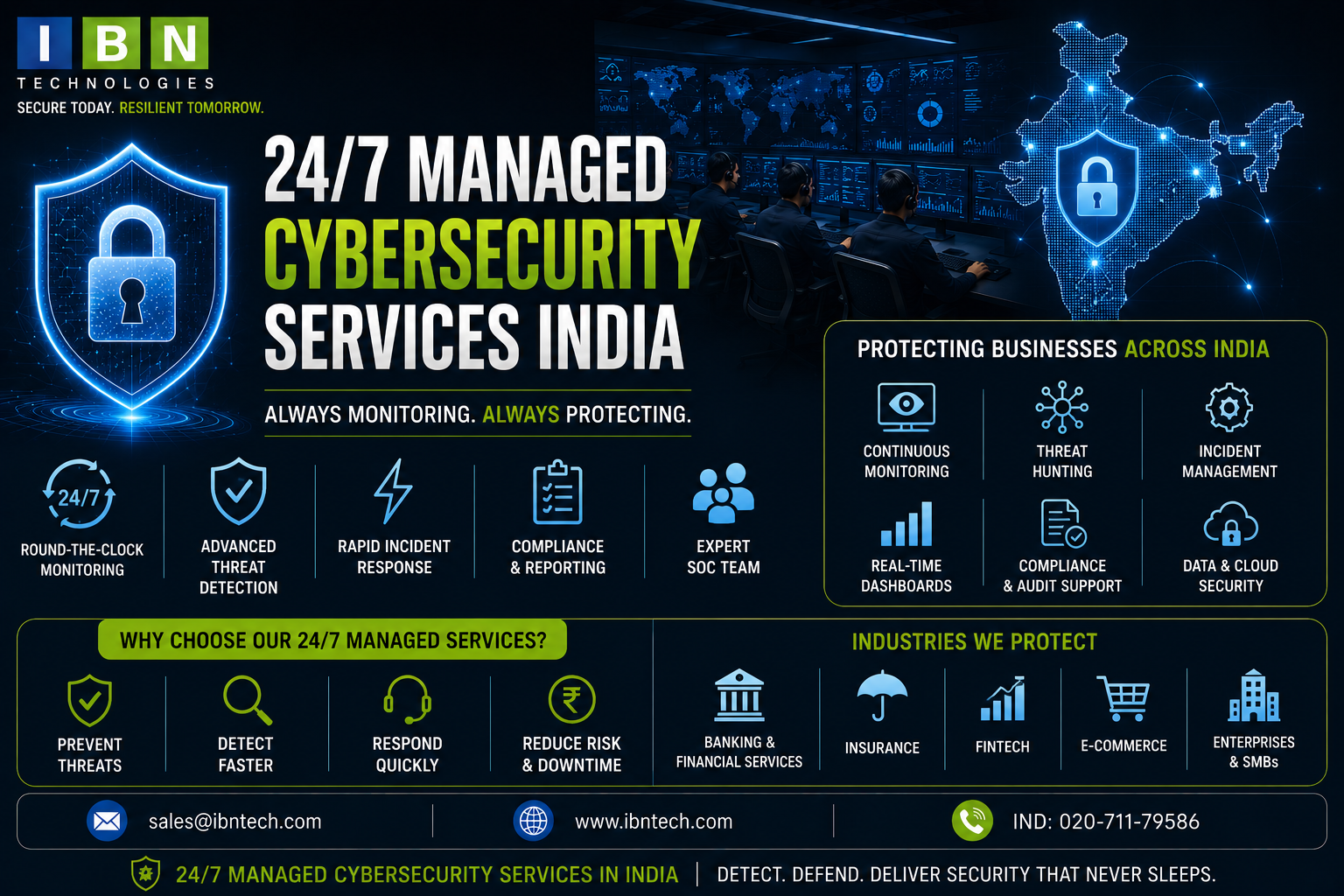
Inside Financial Security With 24/7 Managed Cybersecurity Services India
How 24/7 Managed Cybersecurity Services India Work For BFSI Organizations
24/7 managed cybersecurity services india combine continuous security monitoring with processes for alert analysis, threat detection, investigation, escalation, and incident response. In BFSI, this operating model can help security teams monitor digital banking platforms, employee access, endpoints, networks, cloud infrastructure, applications, and other systems supporting financial operations.
The important point is that monitoring is not simply about collecting alerts. It is about connecting security events with business context so that suspicious activity can be investigated and handled appropriately.
What Happens Inside A Managed Security Operation For BFSI?
A managed security operation normally follows a defined workflow. Security events are collected from relevant systems, analyzed for suspicious patterns, investigated by security personnel, and escalated when an event requires attention from the organization's internal teams.
For financial organizations researching soc providers for BFSI threat monitoring in India explained, understanding this workflow is more useful than evaluating a SOC purely by its technology stack.
How Do SOC Providers For BFSI Threat Monitoring In India Explained Handle Security Alerts?
SOC providers typically use a combination of SIEM technology, detection rules, security telemetry, analyst investigation, and escalation procedures. The objective is to distinguish potentially meaningful security events from routine activity and provide useful context to the organization.
Signal collection: Relevant security logs and events are gathered from agreed technology sources.
Correlation: Related activity can be examined together to identify patterns across multiple systems.
Analyst review: Security personnel investigate suspicious events and assess their significance.
Incident escalation: Events requiring organizational attention are communicated through agreed channels.
Response coordination: Internal teams take authorized containment, remediation, or recovery actions based on the incident.
The exact process varies according to the organization's architecture and service scope.
Why Does BFSI Need A Connected View Of Security Events?
Transaction dependency: Financial operations rely on interconnected applications, identities, APIs, infrastructure, and digital channels.
Identity exposure: Compromised credentials can create risks across several systems when users have access to multiple services.
Operational sensitivity: Security incidents can affect customer access, internal processes, applications, and other business functions.
Third party connections: Financial organizations often interact with technology providers and connected services, expanding the environment that security teams need to understand.
A connected monitoring approach helps analysts investigate activity across multiple sources instead of treating each alert as an isolated event.
Which Systems Should BFSI Organizations Feed Into Security Monitoring?
Customer applications: Online banking, mobile services, portals, and related platforms can produce security events associated with authentication and application activity.
Identity infrastructure: Authentication, privilege changes, account activity, and administrative access can be valuable during investigations.
Endpoints: Employee workstations and servers can provide evidence when investigating suspicious processes, unauthorized access, or malware-related activity.
Network devices: Firewalls, remote access infrastructure, and other network technologies can contribute useful connection and traffic information.
Cloud services: Cloud-hosted applications and infrastructure can generate security events that form part of the wider monitoring picture.
Core applications: Important financial and business systems should be assessed according to their security relevance and operational importance.
Not every source needs equal monitoring priority. Organizations should identify critical assets and security scenarios before defining the final scope.
How Does SIEM Fit Into BFSI Threat Detection?
Event aggregation: SIEM can collect security events from multiple systems into a common environment.
Correlation: Related events can be connected to provide additional context around suspicious behavior.
Investigation support: Analysts can review event history to establish what happened, when it happened, and which systems may be involved.
Detection improvement: Security teams can refine detection logic as they learn more about the organization's environment and recurring activity.
SIEM is an important part of security monitoring, but it does not independently guarantee threat detection. Useful results depend on appropriate data sources, configuration, detection logic, and analyst investigation.
What Does A BFSI Security Incident Look Like In Practice?
Imagine that a privileged employee account produces an unusual authentication event outside the user's expected activity. A separate system then records an unexpected administrative change.
The SOC can correlate the events, investigate the account and affected systems, and determine whether the activity requires escalation. If the event appears credible, authorized internal personnel can take appropriate action according to the organization's incident response process.
This example shows why context matters. A single authentication alert may not provide enough information to understand an incident, while related events can reveal a more meaningful sequence.
What Should BFSI Leaders Expect From SOC Monitoring?
Can SOC Providers For BFSI Threat Monitoring In India Explained Improve Incident Response?
They can support incident response by identifying suspicious activity, investigating related events, and escalating findings through agreed procedures. The organization's internal security and technology teams normally retain responsibility for decisions and actions that require organizational authority.
A clear escalation model is therefore essential when establishing the service.
Defined severity: Organizations should establish how different types of events are classified and prioritized.
Named stakeholders: Relevant security, IT, risk, and business contacts should be identified in advance.
Response authority: The organization should document which actions can be performed directly and which require approval.
Incident records: Investigations and important actions should be documented for operational and governance purposes.
How Can BFSI Teams Improve The Quality Of Security Monitoring?
Map critical assets: Identify systems that support customer services, financial operations, identity, and essential internal functions.
Reduce unnecessary noise: Detection should focus on events that provide meaningful security value.
Maintain context: Analysts should understand legitimate business activity, planned changes, maintenance, and administrative behavior.
Test escalation: Teams should know how security findings move from the SOC to internal decision-makers.
Review coverage: Monitoring requirements should change as applications, cloud environments, integrations, and business processes evolve.
These practices help turn continuous monitoring into a usable security operation rather than a stream of disconnected alerts.
What Role Does Indian Regulatory Context Play?
RBI expectations: Financial organizations should align security operations with applicable RBI requirements and their specific regulatory responsibilities.
Incident handling: Applicable CERT-In directions can influence cybersecurity incident management and reporting responsibilities.
Data protection: BFSI organizations handling personal information should consider relevant obligations under India's Digital Personal Data Protection framework.
Security governance: ISO 27001 can provide a structured information security management approach where an organization uses that framework.
Regulatory obligations differ across banks, insurers, financial institutions, fintech businesses, and other organizations. Security monitoring should therefore be mapped to the organization's actual regulatory position rather than treated as a universal compliance solution.
Why Is Human Investigation Still Important In Automated Monitoring?
Automated detection can identify patterns, but context often determines whether an event represents a genuine threat. An unusual login may be legitimate if an employee is performing approved maintenance, while an apparently ordinary event may become significant when connected to other suspicious activity.
Human analysis helps assess these circumstances and determine whether escalation is appropriate.
FAQs
What Is A SOC In The BFSI Sector?
A SOC is a security operations function responsible for monitoring security events, investigating suspicious activity, detecting potential threats, and coordinating incident escalation. It can operate internally or through a managed service model.
How Does SIEM Support Financial Security Monitoring?
SIEM collects and correlates security events from relevant systems, helping analysts investigate activity with greater context. It supports detection and investigation but works as part of a wider security operations process.
Can A Managed SOC Replace A BFSI Security Team?
A managed SOC can handle defined monitoring and operational responsibilities, but it does not automatically replace internal security governance or decision-making. BFSI organizations still need internal ownership of risk, policies, technology decisions, and authorized response.
Contact Us:
IND- 02067680404
IBN Technologies Ltd.
E-mail: - sales@ibntech.com

 English
 Arabic
 French
 Portuguese
 Deutsch
 Turkish
 Dutch
Dutch
 Italiano
 Russian
 Romaian
 Portuguese (Brazil)
 Greek
Greek
