
Carboxymethylcellulose (CMC) Market: Advancing Applications Drive Global Market Growth
Carboxymethylcellulose (CMC) Market Trends, Demand, Growth & Future Outlook 2026–2034
Carboxymethylcellulose (CMC) Market Size
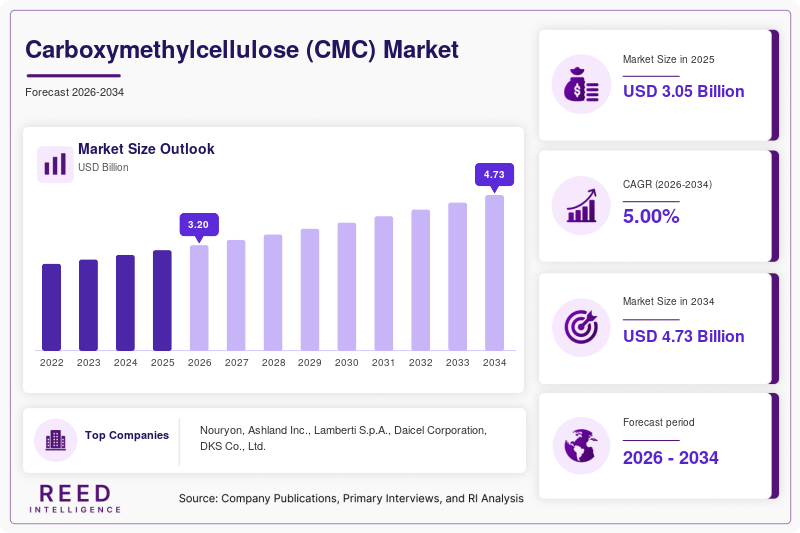
The global Carboxymethylcellulose (CMC) Market size was valued at USD 3.05 billion in 2025 and is projected to grow from USD 3.19 billion in 2026 to USD 4.73 billion by 2034, registering a CAGR of 5.00% during the forecast period from 2026 to 2034.
Carboxymethylcellulose (CMC) is an anionic, water-soluble polymer derived from cellulose. Its ability to modify aqueous rheology gives it a broad role in formulations where viscosity, suspension, binding, film formation, water retention, or dispersion must be controlled. This multifunctionality enables CMC to serve substantially different end-use industries through differentiated grades.
Food and beverage represents an established consumption base for CMC. Food-grade CMC can provide body and mouthfeel in beverages, improve moisture retention in bakery products, stabilize proteins in low-pH systems, and control ice-crystal formation in frozen products.
Request Sample: https://reedintelligence.com/market-analysis/carboxymethylcellulose-market/request-sample
Key Takeaways
-
The global market is projected to reach USD 4.73 billion by 2034.
-
The market is expected to register a CAGR of 5.00% from 2026 to 2034.
-
Food Grade is the dominant grade segment, accounting for approximately 29% share.
-
High-Purity Grade is the fastest-growing grade, with an estimated 7.4% CAGR.
-
Food & Beverage is the dominant application, accounting for approximately 31% share.
-
Batteries are the fastest-growing application, registering an estimated 9.1% CAGR.
-
North America is the dominant region with approximately 32% share.
-
Asia Pacific is the fastest-growing region, with an estimated 6.2% CAGR.
Carboxymethylcellulose (CMC) Market Trends
The CMC market is evolving from conventional thickening applications toward higher-value, specification-controlled applications. Food, pharmaceutical, personal-care, detergent, paper, textile, industrial, and battery applications increasingly require differentiated grades based on viscosity, purity, molecular weight, degree of substitution, dispersion behavior, and processing performance.
A significant trend is the expansion of CMC into lithium-ion battery manufacturing. CMC can be used in anodes and separators and can support slurry-coating quality and processing consistency. This is increasing the relevance of high-purity and application-specific grades.
Sustainability is another emerging trend. Renewable-cellulose feedstocks and products with measurable renewable-carbon characteristics are gaining attention, particularly in consumer applications such as laundry detergents.
Carboxymethylcellulose (CMC) Market Drivers
Expanding Food and Beverage Applications
Food and beverage remains a major demand center because CMC can perform several formulation functions simultaneously. It can increase viscosity, stabilize proteins, improve mouthfeel, retain moisture, strengthen dough, extend freshness, and control ice-crystal growth.
CMC is also recognized as sodium carboxymethylcellulose or E466 in food-additive applications. EFSA identifies sodium carboxymethylcellulose as E466 within the European food-additive framework, making regulatory specifications an important part of commercial grade selection.
The commercial mechanism is based on functionality per unit of formulation rather than only material volume. Food producers can use relatively small quantities of appropriately engineered CMC to obtain viscosity, stabilization, and moisture-control characteristics.
Increasing Pharmaceutical and Personal-Care Consumption
Pharmaceutical manufacturers use CMC as an excipient where controlled rheology, water retention, film formation, and suspension stability are required. Nouryon identifies Cekol sodium carboxymethylcellulose as a pharmaceutical excipient for products including cough syrups and tablets, with grades designed to satisfy major pharmacopeial requirements.
Personal-care applications similarly rely on CMC for controlled viscosity and stabilization. Daicel states that its CMC products are available across a wide viscosity range and are used as thickening and stabilizing agents in toothpaste, shampoos, and pharmaceutical products.
This creates demand for consistent, specification-controlled material rather than generic industrial CMC.
Expansion Into Battery and Specialty Applications
Battery manufacturing is creating an additional specialty pathway for CMC. Nouryon's AkuPure CMC is designed for lithium-ion battery applications, where the material is used in anodes and separators and can improve slurry-coating quality and reduce the risk of line defects.
Daicel also identifies CMC as a thickening agent used during manufacturing of negative electrodes for lithium-ion batteries. The commercial impact is a shift toward high-purity, tightly controlled grades.
Carboxymethylcellulose (CMC) Market Restraints
Raw-Material and Manufacturing Cost Volatility
CMC production depends on cellulose feedstocks and chemical modification processes, while different applications require different purification and quality-control levels. Purification degree, molecular weight, and degree of substitution influence the resulting product range.
This creates cost differentiation between technical, food, pharmaceutical, and high-purity grades. Additional purification and quality controls can increase production complexity, while logistics and energy costs influence delivered pricing.
Regulatory and Quality Requirements
CMC is used in regulated food and pharmaceutical applications, creating additional compliance requirements. EFSA's regulatory framework identifies sodium carboxymethylcellulose as E466 and has required technical and toxicological information for specific food-use assessments.
Pharmaceutical applications impose additional requirements related to identity, purity, viscosity, documentation, and pharmacopeial conformity. Nouryon states that its pharmaceutical Cekol grades meet requirements under USP/NF, Ph. Eur., and other pharmacopeias.
These requirements can increase customer qualification periods and reduce the speed at which lower-cost alternatives can replace established grades.
Carboxymethylcellulose (CMC) Market Opportunities
Bio-Based and Sustainable CMC Grades
The renewable-cellulose origin of CMC provides a platform for developing products with improved sustainability characteristics. In February 2026, Nouryon launched FinnFix PB MAX, described as a CMC with a 100% renewable carbon index for laundry detergents.
The product uses wood-based cellulose and ISCC Plus-certified monochloroacetic acid and is designed to provide anti-redeposition performance. This demonstrates a movement from generic bio-based positioning toward measurable renewable-carbon characteristics.
High-Purity Battery and Advanced-Material Grades
Battery manufacturing provides an opportunity for suppliers to move toward higher-value CMC grades. Nouryon's AkuPure CMC is positioned for lithium-ion battery anodes and separators, where slurry quality and processing consistency are important.
Specialty applications require tighter specifications and technical support. Suppliers capable of producing consistent high-purity CMC and working directly with electrode-material manufacturers can develop application-specific formulations and long-term qualification relationships.
Carboxymethylcellulose (CMC) Market Segmentation Analysis
By Grade
Food Grade is the dominant grade, accounting for approximately 29% share. Its position is supported by extensive use across processed foods and beverages where CMC provides viscosity control, stabilization, moisture retention, texture modification, and suspension properties.
High-Purity Grade is the fastest-growing grade, registering an estimated 7.4% CAGR. Pharmaceutical applications and emerging battery uses require tighter control over purity and material consistency.
Technical Grade accounts for approximately 22% share and grows at 4.2% CAGR. Purified Grade represents around 21% and expands at 5.1% CAGR. Pharmaceutical Grade accounts for approximately 16% and registers a 6.5% CAGR. Other grades represent approximately 12% and grow at 4.4% CAGR.
By Application
Food & Beverage is the dominant application, accounting for approximately 31% share. CMC is used across multiple food categories because its rheological properties can improve viscosity, stabilization, texture, moisture retention, and product consistency.
Batteries represent the fastest-growing application, with an estimated 9.1% CAGR. The use of CMC in lithium-ion battery electrode processing is creating demand for high-purity grades with controlled dispersion and processing characteristics.
Pharmaceuticals account for approximately 18% share and grow at 6.2% CAGR. Personal Care & Cosmetics represent approximately 12% with a 5.8% CAGR, while Home Care & Detergents account for 11% and grow at 5.4% CAGR.
Paper & Textiles account for approximately 10% with a 3.9% CAGR. Paints & Coatings, Ceramics, Oilfield & Mining, and Others collectively account for approximately 18%, registering approximately 4.3% CAGR.
Carboxymethylcellulose (CMC) Market Regional Analysis
North America
North America is the dominant region, accounting for approximately 32% share. The region has established food-processing, pharmaceutical, personal-care, detergent, specialty-chemical, and industrial manufacturing industries that consume different CMC grades.
The U.S. market includes demand for both conventional and high-specification products. Food and pharmaceutical applications create demand for controlled-purity grades, while industrial applications support technical and purified CMC consumption.
Europe
Europe is projected to register approximately 4.4% CAGR during 2026–2034. Demand comes from food and beverage, pharmaceuticals, detergents, personal care, paper, textiles, ceramics, and specialty industrial formulations.
Food-additive requirements directly influence product specifications, while sustainability requirements are influencing the development of renewable and bio-based CMC products for consumer applications.
Asia Pacific
Asia Pacific is the fastest-growing region, with an estimated 6.2% CAGR. The region combines large food-processing, pharmaceutical, chemical, paper, textile, detergent, ceramic, and battery-manufacturing industries.
China, Japan, India, and other Asian manufacturing centers provide multiple consumption channels. The expansion of battery manufacturing further increases the relevance of high-purity CMC grades within the regional supply chain.
Latin America
Latin America is projected to grow at approximately 4.9% CAGR. Food and beverage processing represents an important consumption base, supported by pharmaceutical, personal-care, detergent, paper, and industrial applications.
Regional demand is influenced by imported raw materials and finished CMC products, logistics costs, currency conditions, and the development of local formulation and manufacturing capacity.
Middle East & Africa
The Middle East & Africa region is projected to register approximately 5.1% CAGR. Food processing, detergents, pharmaceuticals, ceramics, construction-related formulations, mining, and oilfield applications contribute to demand.
Oilfield and mining applications provide a distinct industrial pathway because CMC can modify viscosity and fluid-loss behavior in water-based systems.
Carboxymethylcellulose (CMC) Market Competitive Landscape
The Carboxymethylcellulose (CMC) Market consists of global specialty-chemical manufacturers, cellulose-derivative specialists, and regional CMC producers. Competition is shaped by product consistency, grade range, purity, viscosity characteristics, technical support, regulatory documentation, production capacity, and regional distribution.
Nouryon maintains a broad CMC portfolio covering food and beverage, pharmaceuticals, personal care, detergents, paper, textiles, mining, oilfield fluids, and batteries. Its portfolio includes Cekol, Akucell, FinnFix, and other application-specific grades.
Key Market Players
-
Nouryon
-
Ashland Inc.
-
Lamberti S.p.A.
-
Daicel Corporation
-
DKS Co., Ltd.
-
J.M. Huber Corporation
-
Dow Inc.
-
Nippon Paper Industries Co., Ltd.
-
JRS PHARMA LP
-
Ugur Seluloz Kimya A.S.
-
Qingdao Sinocmc Chemical Co., Ltd.
-
Patel Industries
Recent Market Developments
-
February 2026 – Nouryon launched FinnFix PB MAX, a 100% renewable-carbon CMC designed for laundry detergent applications.
-
October 2025 – Ashland appointed Tilley Distribution as its exclusive U.S. food and beverage ingredient distribution partner, including Aqualon CMC cellulose gum.
Carboxymethylcellulose (CMC) Market Segments
By Grade
-
Technical Grade
-
Purified Grade
-
Food Grade
-
Pharmaceutical Grade
-
High-Purity Grade
By Application
-
Food & Beverage
-
Pharmaceuticals
-
Personal Care & Cosmetics
-
Home Care & Detergents
-
Paper & Textiles
-
Paints & Coatings
-
Ceramics
-
Oilfield & Mining
-
Batteries
-
Others
By Region
-
North America
-
Europe
-
Asia Pacific
-
Middle East and Africa
-
Latin America
Frequently Asked Questions
What is the Carboxymethylcellulose (CMC) Market size in 2026?
The global Carboxymethylcellulose (CMC) Market is valued at USD 3.19 billion in 2026.
What will the Carboxymethylcellulose (CMC) Market size be by 2034?
The global Carboxymethylcellulose (CMC) Market is projected to reach USD 4.73 billion by 2034.
What is the CAGR of the Carboxymethylcellulose (CMC) Market?
The market is projected to register a CAGR of 5.00% during the forecast period from 2026 to 2034.
Which application is growing fastest in the Carboxymethylcellulose (CMC) Market?
Batteries are the fastest-growing application, with an estimated CAGR of 9.1%.
Which region is expected to grow fastest in the Carboxymethylcellulose (CMC) Market?
Asia Pacific is expected to be the fastest-growing region, with an estimated CAGR of 6.2% during 2026–2034.
Conclusion
The Carboxymethylcellulose (CMC) Market is projected to expand from USD 3.19 billion in 2026 to USD 4.73 billion by 2034, supported by demand across food and beverage, pharmaceuticals, personal care, home care, industrial applications, and emerging battery uses.
Food Grade remains the dominant grade, while High-Purity Grade is expanding at a faster rate as pharmaceutical and battery applications require tighter material specifications. Food & Beverage remains the largest application, while Batteries represent the fastest-growing application.
Regionally, North America holds the largest market share at approximately 32%, while Asia Pacific is projected to record the fastest growth at approximately 6.2% CAGR. Sustainability-focused CMC grades and high-purity materials for advanced applications provide additional opportunities for market participants.
Report: https://reedintelligence.com/market-analysis/carboxymethylcellulose-market

 English
 Arabic
 French
 Spanish
 Portuguese
 Deutsch
 Turkish
 Dutch
Dutch
 Italiano
 Russian
 Romaian
 Portuguese (Brazil)
