
How Telemedicine Integration Is Supporting the Direct-to-Consumer Genetic Testing Market
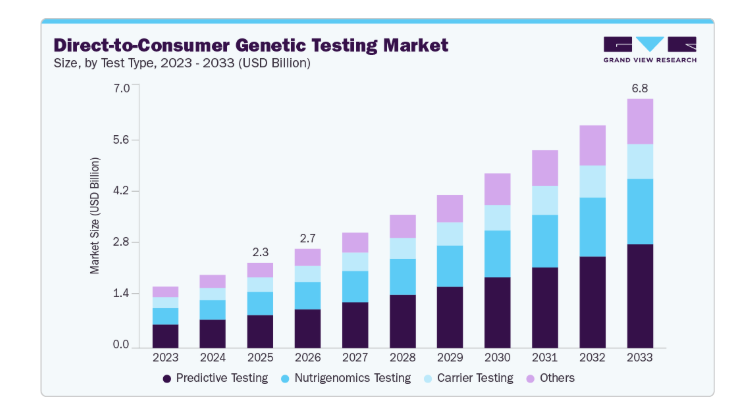
A saliva sample collected at home can now become the starting point for a much broader health conversation. Direct-To-Consumer Genetic Testing Market is making genetic information more accessible by allowing consumers to order tests, provide samples without a traditional clinical visit, and receive digitally delivered insights. What began largely around ancestry and traits is increasingly moving toward disease-risk assessment, personalized nutrition, and preventive healthcare. The global direct-to-consumer genetic testing market was valued at USD 2.3 billion in 2025 and is projected to reach USD 6.8 billion by 2033, expanding at a CAGR of 14.0% from 2026 to 2033.
The Market Is Being Built Around Three Shifts
Preventive care is creating demand. The growing prevalence of chronic diseases is encouraging consumers to seek earlier information about potential health risks. Genetic testing can provide insights into susceptibility to conditions including cardiovascular diseases, cancer, and metabolic disorders, supporting a broader shift toward proactive health management.
Personalization is increasing relevance. Consumers are increasingly interested in health information that reflects their individual genetic profiles. This is expanding the market beyond ancestry-based testing toward predictive testing, nutrigenomics, pharmacogenomics, and condition-specific analysis.
Digital access is removing traditional barriers. Online platforms, home sample collection, digital reporting, telemedicine, and health applications are connecting genetic testing with a more convenient consumer healthcare experience.
Download a free sample report or claim your copy of this full market intelligence report
A Closer Look at Where Demand Is Concentrating
Predictive Testing: Predictive testing held the largest share of the test type segment at 38.8% in 2025 and is projected to register the fastest CAGR over the forecast period. Consumer interest in understanding genetic predisposition to cancer, cardiovascular disorders, and neurodegenerative diseases is supporting this segment. The availability of at-home testing is also allowing consumers to obtain genetic insights without requiring conventional clinical intervention.
Nutrigenomics represents another developing area. The increasing prevalence of polygenic conditions such as obesity, cardiovascular disease, and type 2 diabetes is encouraging interest in personalized dietary recommendations based on genetic profiles. At-home DNA collection kits and collaborations aimed at expanding personalized nutrition are contributing to this segment's development.
Whole Genome Sequencing: Technology is becoming another major differentiator within the market. Whole genome sequencing accounted for 40.1% of revenue in 2025, supported by demand for more comprehensive genetic information covering both coding and non-coding regions.
Targeted analysis is taking a different route by concentrating on specific genes or variants associated with particular conditions or traits. BRCA1 and BRCA2 testing, celiac disease susceptibility, Alzheimer's disease risk, lactose intolerance, skin aging, and melanoma risk are examples of applications covered within this segment.
Online Platforms: Distribution is increasingly becoming part of the consumer experience itself. Online platforms accounted for 65.5% of revenue in 2025, supported by direct purchasing, home sample collection, and digital access to results. The online model also makes it easier for testing providers to connect genetic information with digital health services.
OTC distribution is expected to grow as consumers increasingly seek readily available testing through locations such as department stores and supermarkets. This creates another route for expanding access beyond online channels.
What Makes the Market More Than a Testing Business?
The development of the direct-to-consumer genetic testing market is increasingly tied to the interpretation and use of genetic information. Advances in next-generation sequencing, high-throughput genotyping, whole genome sequencing, artificial intelligence, and polygenic risk scoring are improving the depth and potential usefulness of genetic insights.
Digital health integration is extending this ecosystem further. Genetic testing can be connected with telemedicine platforms to support remote interpretation, personalized consultations, and ongoing health monitoring. This convergence is creating opportunities for consumer genetic testing to become part of a wider digital healthcare journey rather than functioning only as a standalone test.
At the same time, privacy, data quality, interpretation, and responsible use remain important considerations. Genetic information is highly sensitive, and concerns around data protection and secondary use can influence consumer confidence. Regulatory oversight from authorities such as the U.S. FDA and European regulators is therefore shaping product development, clinical validation, data handling, and commercialization.
Regional Growth Is Taking Different Forms
North America — Established consumer adoption: North America dominated the market with a 60.9% revenue share in 2025. Advanced healthcare infrastructure, digital health adoption, consumer awareness, established genomics companies, and precision medicine investments are supporting the region. The U.S. represents a major contributor, supported by personalized healthcare adoption and genomic research initiatives.
Europe — Regulation and clinical reliability: European markets are characterized by strong attention to data protection, clinical validation, and ethical use of genetic information. The UK benefits from government-backed genomics programs, while Germany's healthcare infrastructure and precision medicine ecosystem support continued development.
Asia Pacific — Rapid expansion: Asia Pacific is expected to record the fastest CAGR through 2033. Healthcare infrastructure development, rising disposable income, digitalization, e-commerce, and preventive healthcare awareness are expanding access. India, Japan, and China are also strengthening genomics capabilities through research and government-backed initiatives.
Latin America — Gradual adoption: Improving healthcare access, expanding digital health platforms, and rising preventive healthcare awareness are supporting adoption across markets such as Brazil and Mexico.
Middle East & Africa — Genomics-led opportunity: Healthcare modernization, government-backed genomic programs, and growing investment in precision medicine are creating new opportunities for direct-to-consumer genetic testing services.
The Competitive Landscape Is Expanding With the Technology
Companies such as 23andMe, Family Tree DNA, Ancestry, and Genesis HealthCare are profiled in the market. Competitive activity is increasingly connected with technological capabilities, genomic databases, digital platforms, and personalized healthcare services. Strategic activity is also strengthening the connection between genetic testing and AI-driven precision medicine, illustrated by Tempus AI's acquisition of Ambry Genetics for approximately USD 600 million in March 2025.
The direct-to-consumer genetic testing market is therefore evolving across several connected layers: easier access, broader testing technologies, personalized interpretation, digital distribution, and integration with preventive healthcare. As these elements continue developing together, consumer genomics is moving toward a more connected role within the wider healthcare ecosystem.
About us:
Grand View Research, a market research and consulting company, provides syndicated research reports, customized research reports, and consulting services. Grand View Research database is used by the world's renowned academic institutions and Fortune 500 companies to understand the global and regional business environment. Our database features thousands of statistics and in-depth analysis on 46 industries in 25 major countries worldwide.

 English
 Arabic
 French
 Spanish
 Portuguese
 Deutsch
 Turkish
 Dutch
Dutch
 Italiano
 Russian
 Romaian
 Portuguese (Brazil)
