
Ice Maker Market Trends 2026: Innovation, Convenience & Consumer Demand Drive Growth
Ice Maker Market Trends, Demand, Growth & Future Outlook 2026–2034
Ice Maker Market Size
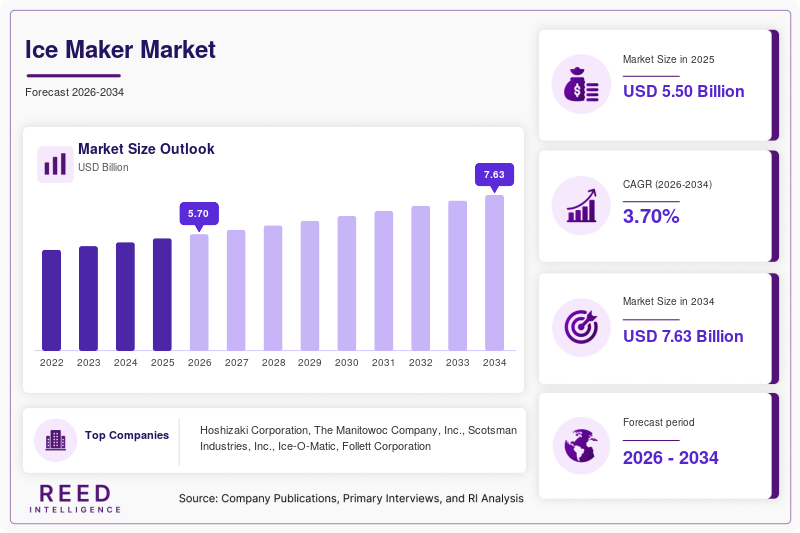
The global Ice Maker Market was valued at USD 5.50 billion in 2025 and is projected to grow from USD 5.50 billion in 2026 to USD 7.63 billion by 2034, registering a CAGR of 3.70% during the forecast period from 2026 to 2034.
Ice makers are refrigeration appliances designed to freeze water and produce ice in controlled shapes and quantities. Commercial ice-making systems serve foodservice, hospitality, retail, healthcare, and industrial environments. Available configurations include self-contained units, modular ice-making heads with separate storage bins, undercounter machines, and portable systems.
Ice format is a key product differentiator. Cube ice is widely used in beverage service, nugget ice is associated with chewable ice and beverage applications, and flake ice supports food displays, seafood presentation, and cooling requirements. Demand is shaped by commercial infrastructure expansion, specialized ice requirements, installation flexibility, and increasing attention to energy and water efficiency.
Request a Sample: https://reedintelligence.com/market-analysis/ice-maker-market/request-sample
Key Takeaways
-
Market size: The global market is projected to reach USD 7.63 billion by 2034.
-
Growth rate: The market is expected to register a CAGR of 3.70% from 2026 to 2034.
-
Dominant type: Self-Contained Ice Makers held approximately 42% of the market.
-
Fastest-growing type: Portable Ice Makers are projected to grow at approximately 6.8% CAGR.
-
Dominant ice type: Cube Ice accounted for approximately 48% of the market.
-
Fastest-growing ice type: Nugget Ice is projected to grow at approximately 5.1% CAGR.
-
Dominant application: Foodservice represented approximately 34% of the market.
-
Dominant region: North America accounted for approximately 35% of the market.
-
Fastest-growing region: Asia Pacific is projected to grow at approximately 4.8% CAGR.
Ice Maker Market Trends
Growing Demand for Application-Specific Ice Formats
The market is increasingly focused on ice formats designed for specific operating requirements. Cube ice supports beverage service because of its relatively slow melting characteristics, while flake ice conforms to food products during display and cooling. Nugget ice is used in beverage-service environments where soft, chewable ice is preferred.
These differences allow manufacturers to serve foodservice, retail, healthcare, hospitality, and industrial customers with products designed around ice shape, hardness, production capacity, and storage requirements.
Increasing Focus on Energy and Water Efficiency
Energy and potable-water consumption are becoming important considerations in commercial ice-maker purchasing decisions. ENERGY STAR certification establishes performance requirements for energy and water use, with thresholds varying according to production rate and machine configuration.
Manufacturers are responding with improved refrigeration systems, insulation, controls, natural refrigerants, and maintenance-oriented designs. Connected features, including Wi-Fi-enabled monitoring, are also becoming part of product development.
Flexible Installation and Compact Equipment
Compact and portable equipment is expanding the range of environments where ice makers can be used. Businesses operating in temporary facilities, event venues, offices, schools, factories, and locations without conventional plumbing may require equipment with fewer installation requirements.
Manufacturers are developing configurations that reduce dependence on permanent water-supply and drainage connections, helping address applications outside traditional commercial kitchens.
Ice Maker Market Drivers
Expansion of Foodservice and Hospitality Infrastructure
Restaurants, cafés, bars, hotels, catering businesses, and commercial kitchens require consistent ice availability for beverages, food preparation, presentation, storage, and customer service.
The expansion of foodservice infrastructure creates demand for new installations, while established operators replace older equipment to improve reliability, sanitation, energy performance, and operating economics. Businesses increasing beverage-service capacity may also require higher-output systems.
Increasing Demand for Specialized Ice Production
Different applications require different ice formats and production capacities. Cube ice is suitable for beverage service, flake ice supports seafood and produce displays, and nugget ice serves beverage applications requiring chewable ice.
This differentiation allows manufacturers to target specific customer requirements across foodservice, retail, healthcare, hospitality, and industrial markets.
Demand for Efficient Refrigeration Systems
Commercial operators increasingly consider electricity consumption, water use, maintenance, and equipment lifespan when selecting ice makers. ENERGY STAR establishes energy and potable-water performance requirements for commercial equipment.
Manufacturers are incorporating improved refrigeration technologies, natural refrigerants, filtration access, and control systems to address these requirements. These developments support demand for equipment designed to reduce operating costs and improve reliability.
Ice Maker Market Restraints
High Initial Investment and Installation Requirements
Commercial ice makers generally require a greater initial investment than basic household ice-producing appliances, particularly modular and high-capacity systems.
Installation can require water connections, drainage, electrical infrastructure, ventilation, storage bins, and adequate floor or counter space. These requirements can limit adoption among small restaurants, seasonal businesses, mobile operators, and facilities with limited infrastructure.
Purchasing decisions therefore depend on production capacity, available space, installation costs, utility requirements, and expected equipment utilization.
Maintenance, Sanitation, and Utility Consumption
Water quality, filtration, cleaning, and sanitation directly affect ice quality and equipment performance. Mineral accumulation can affect water circuits, while inadequate refrigeration maintenance can reduce production consistency and increase energy consumption.
Commercial operators must also manage electricity and potable-water use. Maintenance requirements and operating costs can influence the total cost of ownership and replacement decisions.
Ice Maker Market Opportunities
Adoption of Low-GWP Refrigerants
The transition toward refrigerants with lower global warming potential creates opportunities for manufacturers to redesign commercial ice makers. ENERGY STAR identifies refrigerants such as R-290, R-450A, and R-513A among the options applicable to commercial ice-making equipment.
In November 2025, Hoshizaki announced the conversion of 66 models across four product lines to natural refrigerants, including cubelet and flake ice makers. The company reported global warming potential reductions of more than 99% for the converted products.
These developments create opportunities for manufacturers offering refrigeration systems that address environmental considerations alongside efficiency and operational performance.
Installation-Flexible and Portable Ice Makers
Portable and installation-flexible equipment can serve customers who cannot easily install conventional commercial machines. Potential applications include events, construction sites, sports tournaments, offices, factories, schools, and temporary facilities.
In May 2026, Hoshizaki announced a cube ice maker compatible with separate water-tank and forced-drain units, reducing the need for conventional water-supply and drainage installation. The initial lineup included six models with daily production capacities ranging from 25 kg to 45 kg.
Such configurations can expand the potential customer base for commercial ice makers and create opportunities in temporary, seasonal, and space-constrained environments.
Ice Maker Market Segmentation Analysis
By Type
Self-Contained Ice Makers represented the dominant segment, accounting for approximately 42% of the market. These units integrate the ice-making mechanism and storage capacity into one system, making them suitable for restaurants, bars, cafés, convenience stores, and other businesses requiring moderate production capacity and relatively simple installation.
Portable Ice Makers are projected to be the fastest-growing type, with approximately 6.8% CAGR through 2034. Their compact footprint and lower installation requirements support use in homes, offices, events, recreational environments, and small commercial operations.
Modular Ice Makers accounted for approximately 31% of the market and are projected to grow at approximately 3.8% CAGR. Their separate ice-making heads and storage configurations suit high-volume commercial operations.
Undercounter Ice Makers represented approximately 17% of the market and are projected to grow at approximately 3.5% CAGR. Restaurants, bars, hospitality establishments, and compact commercial kitchens are important applications.
By Ice Type
Cube Ice held the dominant position, accounting for approximately 48% of the market. Its relatively slow melting characteristics and compatibility with glasses, dispensers, and beverage-service operations support widespread use across commercial establishments.
Nugget Ice is projected to be the fastest-growing ice format, with approximately 5.1% CAGR. Its soft, chewable characteristics support demand in beverage-service and consumer-facing foodservice environments.
Flake Ice represented approximately 20% of the market and is projected to grow at approximately 4.2% CAGR. Its irregular structure makes it suitable for seafood, produce, food displays, and cooling applications.
Other ice formats accounted for approximately 10% of the market and are projected to grow at approximately 3.1% CAGR, supported by specialized applications and regional preferences.
By Application
Foodservice represented the dominant application, accounting for approximately 34% of the market. Restaurants, cafés, bars, catering businesses, and commercial kitchens use ice for beverages, preparation, presentation, and cooling.
Hospitality accounted for approximately 24% of the market and is projected to grow at approximately 4.1% CAGR. Hotels and resorts require ice for food-and-beverage operations, guest services, events, and food-storage processes.
Retail represented approximately 20% of the market and is projected to grow at approximately 4.3% CAGR. Supermarkets and convenience stores use ice for beverage operations, food displays, seafood presentation, and customer-facing applications.
Healthcare accounted for approximately 12% of the market and is projected to grow at approximately 3.6% CAGR. Healthcare facilities emphasize sanitation, reliability, controlled production, and equipment maintenance.
Industrial applications represented approximately 10% of the market and are projected to grow at approximately 3.0% CAGR. These applications include specialized cooling, processing, storage, and production requirements.
Ice Maker Market Regional Analysis
North America
North America was the dominant regional market, accounting for approximately 35% of the global market. Established foodservice infrastructure, commercial refrigeration distribution networks, replacement demand, and widespread use of automated ice-making equipment support the region.
The regional market is projected to grow at approximately 3.3% CAGR through 2034. U.S. Department of Energy regulations establish energy-conservation standards for automatic commercial ice makers, while water-use requirements are also relevant to equipment performance.
Energy efficiency remains an important purchasing consideration. ENERGY STAR estimates that certified batch-type machines can save approximately 700 kWh annually, while certified continuous-type models can save approximately 1,350 kWh annually compared with standard equipment.
Europe
Europe accounted for approximately 27% of the market and is projected to expand at approximately 3.1% CAGR. Demand is supported by restaurants, hotels, food retail, healthcare facilities, and commercial beverage operations.
Manufacturers are increasingly emphasizing lower-GWP refrigerants and energy-efficient operation. These characteristics are relevant as commercial operators evaluate lifecycle operating costs alongside initial equipment prices.
Asia Pacific
Asia Pacific represented approximately 23% of the market and is projected to be the fastest-growing region, with approximately 4.8% CAGR. Foodservice modernization, urbanization, convenience retail, hospitality development, and the expansion of commercial kitchens support regional demand.
Manufacturers are also developing equipment suited to regional installation conditions and customer requirements. Applications across foodservice, retail, hospitality, and healthcare provide opportunities for different equipment configurations and production capacities.
Latin America
Latin America accounted for approximately 8% of the market and is projected to grow at approximately 3.7% CAGR. Demand is associated with restaurants, hotels, beverage operations, supermarkets, and food-processing activities.
Market development is influenced by equipment affordability, energy prices, service availability, import conditions, and access to replacement components. Compact equipment and systems with lower operating costs can address smaller commercial installations.
Middle East & Africa
The Middle East & Africa region represented approximately 7% of the market and is projected to expand at approximately 3.6% CAGR. Hotels, tourism infrastructure, restaurants, food retail, and beverage services are important demand channels.
High ambient temperatures make refrigeration performance and equipment reliability important purchasing considerations. Manufacturers must also account for water availability, electrical infrastructure, maintenance capabilities, and local operating conditions.
Ice Maker Market Competitive Landscape
The ice maker market includes global foodservice-equipment manufacturers and specialized ice-machine producers. Competition is shaped by ice quality, production capacity, energy efficiency, water consumption, refrigerant technology, equipment footprint, durability, maintenance requirements, and distribution networks.
Hoshizaki Corporation maintains a broad portfolio covering cube, flake, cubelet, and dispensing technologies. Ice makers are a core part of its business, with products serving foodservice, retail, hospitality, and healthcare applications. Its product-development activities include efficiency improvements, durability, localized specifications, natural refrigerants, and connected functionality.
Other participants include The Manitowoc Company, Scotsman Industries, Ice-O-Matic, Follett Corporation, Cornelius, Brema Group, ITV Ice Makers, MaxxIce, Koller Refrigeration Equipment, Snowsman, and Focusun Refrigeration Corporation.
Key Market Players
-
Hoshizaki Corporation
-
The Manitowoc Company, Inc.
-
Scotsman Industries, Inc.
-
Ice-O-Matic
-
Follett Corporation
-
Cornelius, Inc.
-
Brema Group
-
ITV Ice Makers
-
MaxxIce
-
Koller Refrigeration Equipment
-
Snowsman
-
Focusun Refrigeration Corporation
Recent Developments in the Ice Maker Market
May 2026 – Hoshizaki Corporation
Hoshizaki announced a new cube ice maker compatible with separate water-supply and drainage units, enabling installation without conventional plumbing connections. The company stated that sales would begin in early July 2026. The initial lineup included six models with daily production capacities ranging from 25 kg to 45 kg.
August 2026 – Scotsman
Scotsman introduced new MC_PH1 and MC_PH2 R449A modular cube ice maker launch packages, expanding its modular cube-ice portfolio. The company's commercial product resource center also lists R290 product launches across modular, undercounter, flake, nugget, and ice-and-water dispenser categories during 2025–2026.
Ice Maker Market Segments
By Type
-
Self-Contained Ice Makers
-
Modular Ice Makers
-
Undercounter Ice Makers
-
Portable Ice Makers
By Ice Type
-
Cube Ice
-
Nugget Ice
-
Flake Ice
-
Others
By Application
-
Foodservice
-
Hospitality
-
Retail
-
Healthcare
-
Industrial
By Region
-
North America
-
Europe
-
Asia Pacific
-
Middle East & Africa
-
Latin America
Frequently Asked Questions
What is the size of the Ice Maker Market in 2026?
The global Ice Maker Market is valued at USD 5.50 billion in 2026.
What will the Ice Maker Market size be by 2034?
The market is projected to reach USD 7.63 billion by 2034, registering a CAGR of 3.70% during the 2026–2034 forecast period.
Which type dominates the Ice Maker Market?
Self-Contained Ice Makers are the dominant type, accounting for approximately 42% of the market.
Which region dominates the Ice Maker Market?
North America is the dominant region, accounting for approximately 35% of the global market.
What factors are driving the Ice Maker Market?
Key growth factors include expanding foodservice and hospitality infrastructure, demand for specialized ice formats, and increasing attention to energy and water efficiency.
Conclusion
The Ice Maker Market is projected to grow steadily through 2034, supported by demand from foodservice, hospitality, retail, healthcare, and industrial applications. Self-contained machines remain the dominant equipment type, cube ice leads by ice format, and foodservice represents the largest application segment.
Product development is increasingly focused on energy and water efficiency, lower-GWP refrigerants, specialized ice formats, and installation flexibility. Portable ice makers and nugget ice are expected to expand at faster rates than several established categories, while Asia Pacific is projected to record the fastest regional growth. Manufacturers' ability to address operating costs, sanitation, installation requirements, and application-specific needs will remain important to market development.
Full Report: https://reedintelligence.com/market-analysis/ice-maker-market

 English
 Arabic
 French
 Spanish
 Portuguese
 Deutsch
 Turkish
 Dutch
Dutch
 Italiano
 Russian
 Romaian
 Portuguese (Brazil)
