
Gym Management Software Market Trends 2026: Automation, Memberships & Fitness Technology
Gym Management Software Market Trends, Demand, Growth & Future Outlook 2026–2034
Gym Management Software Market Size
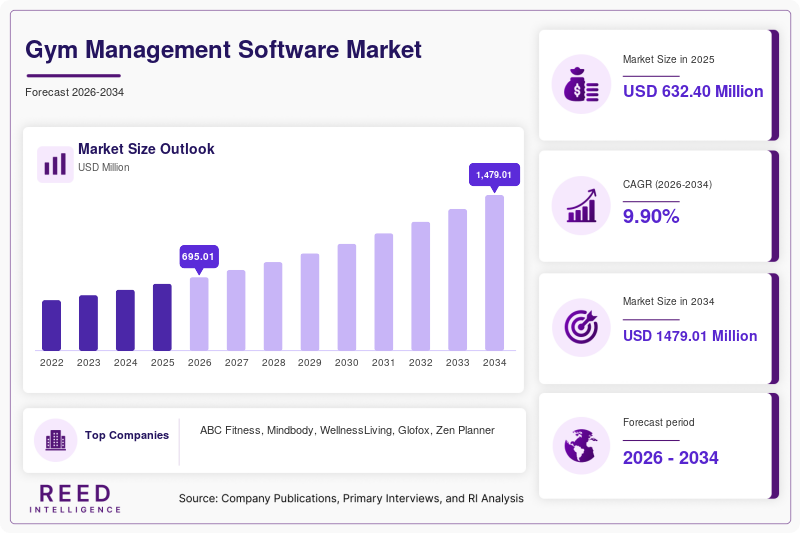
The global Gym Management Software Market was valued at USD 632.40 million in 2025 and is projected to grow from USD 694.99 million in 2026 to USD 1,479.01 million by 2034, registering a CAGR of 9.90% during the forecast period from 2026 to 2034.
The market is developing around the operational digitization of fitness businesses. Gym and fitness operators increasingly require software that integrates membership management, scheduling, payments, lead management, customer communications, reporting, and facility access. Cloud deployment is particularly relevant for multi-location operators because it enables centralized access to information and standardized membership, pricing, reporting, and customer-management processes.
Key Takeaways
-
The market is projected to reach USD 1,479.01 million by 2034 from USD 694.99 million in 2026, at a 9.90% CAGR.
-
Cloud-Based deployment accounts for approximately 58.0% of the market.
-
Hybrid deployment is projected to be the fastest-growing major type segment, with an 11.1% CAGR from 2026 to 2034.
-
Gyms & Health Clubs represent approximately 49.0% of the application market.
-
Fitness Studios are projected to grow at the fastest application CAGR of 11.4%.
-
North America holds approximately 35.0% market share.
-
Asia Pacific is projected to be the fastest-growing region, with a 12.0% CAGR through 2034.
-
AI automation, centralized multi-location management, and integration with payments, access systems, and fitness technologies are shaping market demand.
Request Sample
https://reedintelligence.com/market-analysis/gym-management-software-market/request-sample
Gym Management Software Market Trends
AI Automation Is Expanding the Role of Gym Management Platforms
Gym management platforms are increasingly incorporating AI to automate lead qualification, missed-call follow-up, appointment scheduling, customer questions, and recurring communications. This expands software functionality beyond administrative management into sales and customer-engagement workflows.
ABC Fitness acquired Replify in July 2026 to add agentic AI capabilities across voice, text, email, and chat communications, including lead capture, qualification, tour booking, and missed-call follow-up.
Multi-Location Fitness Businesses Require Centralized Operations
Franchise networks and multi-location fitness businesses require centralized systems for pricing, membership rules, reporting, scheduling, and customer engagement. ABC Fitness's April 2026 partnership with Body Fit Training demonstrates this demand, with ABC Glofox selected to support operations across an expanding franchise network.
Integration With Payments, Access and Fitness Technology
Gym management software increasingly operates as a central technology layer connecting scheduling, payments, access control, fitness equipment, customer applications, and marketing platforms. Integration ecosystems such as those supported by WellnessLiving demonstrate the expansion of gym software beyond conventional membership administration.
Gym Management Software Market Drivers
AI Automation and Revenue-Generating Workflows
AI-enabled software can automate lead qualification, appointment scheduling, customer questions, and follow-up activities that previously required staff intervention. This allows operators to evaluate platforms according to both administrative capabilities and their ability to automate customer-facing processes.
Expansion of Multi-Location Fitness Businesses
Franchise and multi-location operators require centralized systems to maintain consistent operations across facilities. Centralized reporting, role-based permissions, standardized workflows, and location-level controls are becoming important requirements for fitness management platforms.
Increasing Technology Integration
The integration of payments, access control, scheduling, marketing, consumer marketplaces, and fitness technologies is supporting demand for unified management platforms. These integrations can also increase switching costs because the software becomes embedded across several operational workflows.
Gym Management Software Market Restraints
Subscription and Implementation Costs for Smaller Gyms
Independent gyms may operate with limited administrative resources and technology budgets. Subscription, implementation, training, and data-migration expenses can therefore restrict adoption, particularly when operators do not require advanced automation or complex reporting.
Data Migration and Integration Complexity
Replacing an existing management platform can require migration of membership and billing information and integration with payment, access-control, scheduling, communication, and fitness-equipment systems. Incorrect data or access permissions can create operational risks during implementation.
Gym Management Software Market Opportunities
Agentic AI for Sales, Retention and Front-Desk Operations
Agentic AI creates opportunities for gym-management platforms to perform customer-facing activities such as responding to inquiries, qualifying prospects, scheduling tours, managing bookings, and initiating retention communications.
WellnessLiving's July 2026 CAASI launch illustrates this development. Its AI chat and phone agents can answer questions, complete bookings, process purchases, manage cancellations, and handle customer inquiries continuously.
Integrated Platforms for Franchise and Multi-Brand Fitness Networks
Fitness businesses are expanding through franchises, specialized studios, and multi-brand platforms, creating demand for software that supports different facility concepts while maintaining centralized administration.
In August 2026, Fitura Brands selected ABC Fitness to provide a unified software environment across Padel SWT, Core Precinct, and ContrasTheory, including booking functionality and franchise-oriented operational support.
Gym Management Software Market Segmentation Analysis
By Type
Cloud-Based
Cloud-Based gym management software accounts for approximately 58.0% market share, making it the dominant deployment type. Its adoption is supported by lower infrastructure requirements, remote accessibility, automatic updates, centralized databases, and suitability for multi-location fitness businesses.
Cloud platforms also facilitate integration with payment providers, access-control systems, marketing applications, consumer marketplaces, and fitness technologies. However, dependence on internet connectivity, data-security considerations, and potential vendor lock-in can influence purchasing decisions.
Hybrid
Hybrid deployment is projected to record the fastest growth among major deployment types, with an 11.1% CAGR during 2026–2034. Hybrid systems allow operators to retain selected local infrastructure while using cloud services for analytics, customer applications, integrations, and centralized management.
On-Premises
On-premises software represents approximately 18.0% market share and is projected to grow at a 5.8% CAGR. Cloud-based platforms account for the remaining dominant share and are projected to grow at a 9.8% CAGR.
By Application
Gyms & Health Clubs
Gyms & Health Clubs account for approximately 49.0% market share. These facilities typically require membership contracts, recurring payments, class scheduling, attendance management, access control, staff management, and customer communications.
Fitness Studios
Fitness Studios are projected to record the fastest growth among application segments, with an 11.4% CAGR during 2026–2034. Their scheduled classes, instructor availability, recurring memberships, and capacity-constrained sessions create demand for integrated booking and customer-communication functionality.
Gyms & Health Clubs account for approximately 49.0% share with a 9.1% CAGR, Personal Trainers represent approximately 18.0% share with a 10.3% CAGR, and Other applications represent approximately 11.0% share with a 7.5% CAGR.
Gym Management Software Market Regional Analysis
North America Gym Management Software Market
North America represents the dominant regional market with approximately 35.0% market share. The region benefits from established fitness chains, mature cloud infrastructure, high software adoption, and a developed ecosystem of fitness-technology providers.
The United States is the principal regional market. ABC Fitness states that its software is used by 40% of U.S. clubs, while AI capabilities are increasingly becoming part of the competitive product landscape.
Europe Gym Management Software Market
Europe is projected to record an 8.9% CAGR during 2026–2034. Demand is supported by established gym and health-club markets, boutique fitness concepts, and requirements for membership, payment, scheduling, and customer-engagement management.
Data protection and payment-security requirements remain important considerations for European operators.
Asia Pacific Gym Management Software Market
Asia Pacific is projected to be the fastest-growing region, recording a 12.0% CAGR through 2034. Expansion of organized fitness businesses, digital adoption, boutique fitness formats, and professionalization of gym operations support market growth.
China, Japan, South Korea, India, and Australia represent important regional markets, while Southeast Asia provides additional expansion opportunities. Mobile booking, digital payments, automated communications, and self-service access are increasingly relevant to operators.
Middle East and Africa Gym Management Software Market
The Middle East and Africa region is projected to grow at a 10.6% CAGR during 2026–2034. Expansion of organized fitness facilities, premium health clubs, and franchise-based fitness concepts is supporting demand for digital operational infrastructure.
The Gulf markets provide an important center for premium fitness facilities, while African markets remain more fragmented and are influenced by connectivity, pricing, and local implementation support.
Latin America Gym Management Software Market
Latin America is projected to register a 10.1% CAGR. Brazil and Mexico represent important regional markets, supported by urban fitness populations and the expansion of organized gym and studio formats.
Cloud-based systems, mobile booking, recurring payments, and automated customer communications are becoming increasingly relevant. Currency volatility and differences in digital-payment adoption remain considerations for market participants.
Competitive Landscape
The Gym Management Software Market includes specialized fitness-technology companies and broader wellness-management platforms. Competition is increasingly focused on integrated functionality, AI automation, ecosystem connectivity, franchise capabilities, and member-facing digital experiences.
ABC Fitness has positioned its platform around member management, payments, engagement, coaching, and AI-enabled workflows. Its acquisition of Replify in July 2026 expanded capabilities for automated communications, lead qualification, and booking workflows.
Key Market Players
-
ABC Fitness
-
Mindbody
-
WellnessLiving
-
Glofox
-
Zen Planner
-
GymMaster
-
PushPress
-
Virtuagym
-
TeamUp
-
Gymdesk
-
Exercise.com
-
ClubReady
Gym Management Software Market Recent Developments
-
July 2026: ABC Fitness acquired Replify, an agentic AI platform designed for fitness-business communications. The acquisition added capabilities across voice, text, email, and chat, including lead capture, qualification, tour booking, class-scheduling support, and missed-call follow-up.
-
July 2026: WellnessLiving announced the general availability of CAASI Chat Agent and CAASI Phone Agent. The AI front-desk system can answer customer questions, complete bookings, process purchases, manage cancellations, and handle inquiries without continuous staff intervention.
Gym Management Software Market Segments
By Type
-
Cloud-Based
-
On-Premises
-
Hybrid
By Application
-
Gyms & Health Clubs
-
Fitness Studios
-
Personal Trainers
-
Others
By Region
-
North America
-
Europe
-
APAC
-
Middle East and Africa
-
LATAM
Frequently Asked Questions
What is the size of the Gym Management Software Market in 2025?
The global Gym Management Software Market was valued at approximately USD 632.40 million in 2025.
What will the Gym Management Software Market size be in 2034?
The supplied source lists this question but does not provide an answer.
What is the CAGR of the Gym Management Software Market from 2026 to 2034?
The supplied source lists this question but does not provide a separate FAQ answer. The market-size section states a CAGR of 9.90% for 2026–2034.
Which type segment is expected to grow fastest?
The supplied source identifies Hybrid deployment as the fastest-growing major deployment type, with an 11.1% CAGR during 2026–2034.
Which region is expected to grow fastest in the Gym Management Software Market?
Asia Pacific is projected to be the fastest-growing region, with a 12.0% CAGR through 2034.
Conclusion
The Gym Management Software Market is expanding as fitness businesses digitize membership management, payments, scheduling, customer engagement, access control, reporting, and multi-location operations. The market is increasingly shaped by cloud deployment, AI-enabled automation, technology integrations, and software designed for franchise and multi-brand fitness networks.
The market is projected to grow from USD 694.99 million in 2026 to USD 1,479.01 million by 2034 at a 9.90% CAGR. Cloud-Based systems remain the largest deployment segment, while Hybrid deployment is projected to grow fastest among major deployment types. Gyms & Health Clubs represent the largest application segment, while Fitness Studios show the fastest application growth. Regionally, North America holds the largest share and Asia Pacific is projected to record the fastest growth.
Report URL
https://reedintelligence.com/market-analysis/gym-management-software-market

 English
 Arabic
 French
 Spanish
 Portuguese
 Deutsch
 Turkish
 Dutch
Dutch
 Italiano
 Russian
 Romaian
 Portuguese (Brazil)
