
International Expansion Services Market Trends 2026: Globalization, Market Entry & Business Growth
International Expansion Services Market Trends, Demand, Growth & Future Outlook 2026–2034
Market Size
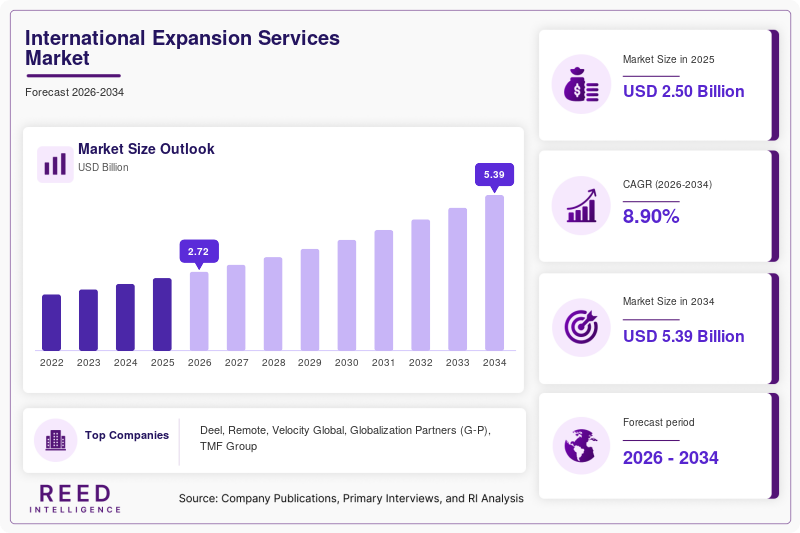
The global International Expansion Services Market was valued at USD 2.50 billion in 2025 and is projected to grow from USD 2.72 billion in 2026 to USD 5.39 billion by 2034, registering a CAGR of 8.90% during the forecast period from 2026 to 2034.
International expansion services help companies manage the complexity of operating across multiple jurisdictions, including employment rules, payroll, taxation, entity governance, local hiring, licensing, reporting, and operational compliance. The market is increasingly shifting toward integrated platforms that connect these activities through centralized international operating infrastructure.
Key Takeaways
-
The market is projected to reach USD 5.39 billion by 2034 at a CAGR of 8.90%.
-
Subsidiary Established accounted for approximately 37% of the market in 2025.
-
M&A accounted for approximately 22% and is the fastest-growing type, with a 10.1% CAGR.
-
Large Enterprises represented approximately 61% of the market in 2025.
-
SMEs accounted for approximately 39% and are the fastest-growing application segment, with a 10.2% CAGR.
-
North America represented approximately 31% of the market in 2025.
-
Asia Pacific accounted for approximately 24% and is the fastest-growing region, with a 10.7% CAGR.
-
Middle East & Africa is projected to grow at approximately 9.9% CAGR.
-
Integrated entity management, payroll, HR, compliance, and workforce platforms are becoming increasingly important.
Request Sample
https://reedintelligence.com/market-analysis/international-expansion-services-market/request-sample
Market Trends
The International Expansion Services Market is being reshaped by the growing complexity of managing employees, legal entities, payroll, compliance, and business operations across multiple countries.
A key trend is the movement from individual internationalization services toward integrated operating platforms. Companies increasingly seek solutions that connect entity management, HR, payroll, compliance, and workforce administration rather than relying on separate local providers.
Enterprise software integration is another important trend. International expansion providers are increasingly connecting their platforms with established HR and finance systems to reduce duplicated data, manual work, and inconsistent employee records. Remote's Workday Certified Integration is an example of this development.
International workforce administration is also expanding as companies increasingly use employer-of-record, outsourced payroll, and related services before establishing permanent local infrastructure.
Drivers
Increasing Cross-Border Workforce Deployment
Companies expanding into new countries frequently require local employment infrastructure before establishing fully staffed legal and administrative functions. This is increasing demand for hiring, employment compliance, payroll, benefits, and workforce-administration services.
Employer-of-record and outsourced payroll models allow companies to access local employment infrastructure without immediately establishing a subsidiary.
Growing Need for Integrated Entity Management
Establishing an overseas subsidiary creates recurring requirements for maintaining corporate records, managing compliance, coordinating employees and payroll, and synchronizing entity information with finance and HR systems.
Integrated entity-management platforms can consolidate these processes and reduce administrative fragmentation, particularly for enterprises managing multiple subsidiaries and jurisdictions.
Enterprise Software Integration
Companies increasingly expect international expansion services to connect with existing enterprise systems. Integration can reduce manual data entry, inconsistent employee records, and additional compliance controls.
The integration of international employment services with HR platforms is therefore shifting the market from standalone service delivery toward interconnected workflows.
Restraints
Regulatory Fragmentation Across Jurisdictions
International expansion remains constrained by differences in employment, tax, corporate, licensing, reporting, and ownership regulations. Although technology can automate administrative workflows, country-specific rules continue to require localized compliance expertise.
The complexity is particularly relevant to subsidiary establishment and M&A, where corporate structures and ownership requirements can vary significantly between countries and industries.
High Cost and Commitment of Permanent Market Entry
Creating a subsidiary or acquiring a local business generally requires greater financial and organizational commitment than licensing arrangements or outsourced workforce infrastructure.
Companies with uncertain market demand may therefore initially use flexible arrangements and move toward permanent local infrastructure after commercial traction is established.
Opportunities
Integrated Global Entity and Workforce Platforms
The convergence of entity management, HR, payroll, compliance, and workforce administration creates opportunities for providers to capture a larger portion of the international expansion workflow.
Centralized platforms can replace fragmented administrative processes for companies operating across multiple countries while also generating recurring demand through ongoing entity governance, payroll, workforce management, and compliance services.
SME-Oriented Market Entry Services
SMEs represent an important opportunity because many smaller companies lack dedicated international legal, HR, payroll, and tax teams.
EOR, licensing arrangements, outsourced payroll, compliance support, and subsidiary establishment can be combined according to the maturity of an SME's international strategy. Flexible services can reduce the administrative threshold for entering foreign markets.
Market Segmentation Analysis
The International Expansion Services Market is segmented by type, application, and region.
By Type
Subsidiary Established
Subsidiary Established represented approximately 37% of the global market in 2025, making it the largest type segment.
Subsidiary establishment provides companies with direct control over employees, contracts, assets, operations, and local corporate governance. It is particularly relevant to organizations pursuing long-term market presence rather than short-term market testing.
M&A
M&A accounted for approximately 22% of the market and is the fastest-growing type, with an estimated CAGR of 10.1%.
Acquiring an existing business can provide immediate access to customers, employees, infrastructure, licenses, suppliers, and local market knowledge. However, transaction costs, regulatory approvals, integration complexity, valuation risk, and organizational restructuring can influence adoption.
Licensing Arrangements
Licensing Arrangements represented approximately 24% of the market in 2025. Licensing can provide companies with a lower-commitment approach to international market entry compared with establishing a permanent subsidiary.
Others
Others accounted for approximately 17% of the market in 2025. The supplied source does not provide further breakdowns for this category.
Application Analysis
Large Enterprise
Large Enterprises represented approximately 61% of the market in 2025, making them the largest application segment.
Large companies often manage multiple jurisdictions, employees, legal entities, currencies, regulatory requirements, and reporting structures. Their purchasing priorities increasingly include centralized compliance, entity governance, payroll, HR integration, data security, local expertise, and standardized reporting.
SMEs
SMEs accounted for approximately 39% of the market and are the fastest-growing application segment, with an estimated CAGR of 10.2%.
Flexible international expansion structures can allow smaller businesses to enter foreign markets without immediately establishing permanent administrative infrastructure. EOR, licensing, outsourced payroll, and market-entry support can reduce the initial organizational commitment required for internationalization.
Regional Analysis
North America
North America represented approximately 31% of the global market in 2025, making it the largest regional market. The region benefits from a large base of internationally active companies, technology businesses, professional-services firms, and enterprises with distributed workforces.
The United States is particularly important because companies headquartered there frequently hire international employees, establish overseas entities, pursue acquisitions, and expand into new geographic markets.
North America is projected to grow at approximately 8.0% CAGR. Enterprise integration, workforce infrastructure, entity management, and cross-border M&A continue to support demand.
Europe
Europe represented approximately 28% of the global market in 2025 and is projected to grow at approximately 8.1% CAGR.
Cross-border business activity creates recurring requirements for local employment, payroll, taxation, entity administration, and regulatory compliance. Differences in employment legislation, taxation, corporate reporting, and local operating requirements continue to create demand for country-specific expertise.
Asia Pacific
Asia Pacific represented approximately 24% of the global market in 2025 and is the fastest-growing region, with an estimated CAGR of 10.7%.
The region includes mature economies such as Japan, Australia, South Korea, and China as well as rapidly expanding Southeast Asian markets. Differences in employment law, taxation, licensing, corporate structures, language, and workforce practices create demand for localized international expansion services.
Latin America
Latin America represented approximately 9% of the global market in 2025 and is projected to grow at approximately 9.3% CAGR.
Businesses entering Latin American markets frequently require support with local employment administration, payroll, tax compliance, corporate establishment, licensing, and workforce management. Brazil and Mexico are particularly relevant markets for businesses seeking large consumer populations and regional operating capabilities.
Middle East & Africa
Middle East & Africa represented approximately 8% of the global market in 2025 and is projected to grow at approximately 9.9% CAGR.
The region has diverse employment, corporate, payroll, and licensing frameworks, increasing the need for country-specific expansion infrastructure. Companies entering the region may require local payroll, employment compliance, entity administration, and workforce support before establishing permanent operations.
Competitive Landscape
The International Expansion Services Market is becoming increasingly competitive as providers expand from individual international employment or incorporation services into broader operating platforms.
Competition increasingly involves geographic coverage, local compliance, payroll infrastructure, entity management, enterprise integration, M&A capabilities, workforce technology, and post-entry operational support.
Deel has expanded its international infrastructure through payroll, entity management, HR, and workforce services. Its June 2026 acquisition of PaySpace added payroll engines across 44 countries in Africa and the Middle East.
Key Market Players
-
Deel
-
Remote
-
Velocity Global
-
Globalization Partners (G-P)
-
TMF Group
-
Mercer
-
Deloitte
-
PwC
-
Ernst & Young (EY)
-
KPMG
-
Vistra
-
Safeguard Global
-
Atlas
-
Oyster
-
Papaya Global
Recent Developments
June 2026 – Deel Acquired PaySpace
Deel announced its acquisition of PaySpace, a payroll and HR technology company with more than 20 years of experience and native payroll engines across 44 countries in Africa and the Middle East. Deel stated that PaySpace had more than 14,000 customers and that the acquisition expanded its local payroll infrastructure to more than 50 countries.
April 2026 – Remote Acquired Bravas
Remote announced the acquisition of Bravas, a French software company specializing in identity and device management. The acquisition added identity and device capabilities to Remote's international employment infrastructure and expanded its platform toward broader employee-lifecycle management.
Market Segments
By Type
-
Subsidiary Established
-
M&A
-
Licensing Arrangements
-
Others
By Application
-
SMEs
-
Large Enterprise
By Region
-
North America
-
Europe
-
APAC
-
Middle East and Africa
-
LATAM
Frequently Asked Questions
What is the size of the International Expansion Services Market in 2026?
The global International Expansion Services Market is projected to reach USD 2.72 billion in 2026 and USD 5.39 billion by 2034, registering a CAGR of 8.90% during 2026–2034.
Which type holds the largest share of the International Expansion Services Market?
Subsidiary Established represented approximately 37% of the market in 2025, making it the largest type segment.
Which type is growing fastest in the International Expansion Services Market?
M&A is the fastest-growing type segment, with an estimated CAGR of 10.1%.
Which application accounts for the largest market share?
Large Enterprises represented approximately 61% of the market in 2025, making them the largest application segment.
Which region is growing fastest in the International Expansion Services Market?
Asia Pacific is the fastest-growing regional market, with an estimated CAGR of 10.7%.
Conclusion
The International Expansion Services Market is expanding as businesses increasingly require integrated infrastructure to manage employees, payroll, entities, compliance, and operations across multiple jurisdictions. The market is moving from individual services toward connected platforms that integrate international workforce administration with HR, finance, compliance, and entity-management workflows.
Subsidiary Established remains the largest type segment, while M&A is growing at the fastest rate among the type categories provided. Large Enterprises account for the largest application share, while SMEs are expanding more rapidly as flexible market-entry models reduce the initial administrative requirements of internationalization.
North America remains the largest regional market, while Asia Pacific is the fastest-growing region. Continued development of integrated entity and workforce platforms, enterprise software integrations, localized payroll infrastructure, and SME-oriented market-entry services will remain important areas of market development.
Report URL
https://reedintelligence.com/market-analysis/international-expansion-services-market

 English
 Arabic
 French
 Portuguese
 Deutsch
 Turkish
 Dutch
Dutch
 Italiano
 Russian
 Romaian
 Portuguese (Brazil)
 Greek
Greek
