
Flexible Plastic Packaging Market Forecast Shows USD 189.6 Bn by 2036, China at 6.5%, India at 7.0%
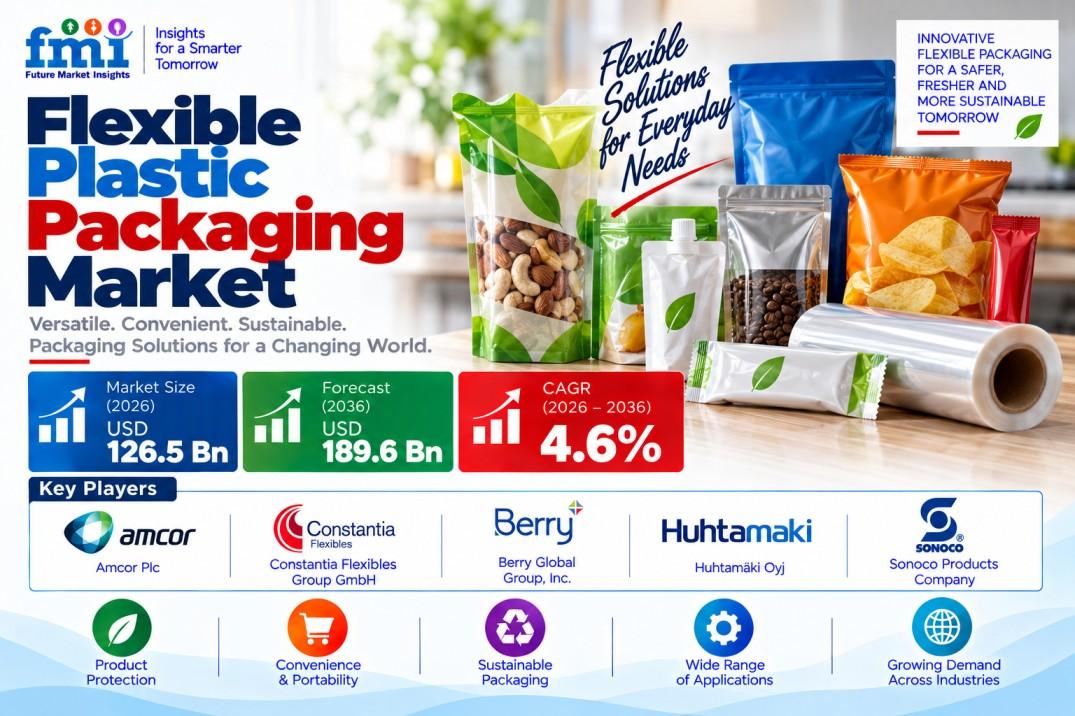
The global flexible plastic packaging market is projected to grow from USD 126.5 billion in 2026 to USD 189.6 billion by 2036, expanding at a 4.6% CAGR, as food, pharmaceutical, personal care, and industrial packaging demand continues to favor lightweight films, pouches, wraps, and other flexible formats.
The market's sustainability challenge has become more immediate in Europe. The European Union's Packaging and Packaging Waste Regulation (PPWR) began applying on August 12, 2026, while requirements that all packaging be recyclable apply from 2030.
That timing is pushing flexible packaging suppliers to address a difficult combination: maintaining shelf life, seal performance, and pack strength while simplifying structures and improving recyclability.
Get detailed market forecasts, competitive benchmarking, and pricing trends:
https://www.futuremarketinsights.com/reports/sample/rep-gb-4174
Why is flexible packaging being redesigned rather than simply replaced?
Flexible plastic packaging continues to benefit from its ability to deliver product protection with relatively low material weight. Films and wraps are expected to account for 36.8% of product demand in 2026, while oil-based polymers are projected to hold 58.0% of material demand.
Food remains a major source of volume because meat, dairy, snacks, bakery products, and fresh produce require barrier and sealing performance that can be difficult to replicate with alternative materials.
High-barrier structures are particularly important where oxygen and moisture control determine shelf life. Modified-atmosphere packaging is projected to represent 45.8% of packaging-type demand in 2026, reflecting continued use in fresh food applications.
The sustainability transition therefore is not simply a shift from plastic to another material. In many applications, converters are redesigning the plastic structure itself—reducing material weight, moving toward mono-material PE or PP formats, and testing recycled content where performance and regulatory requirements allow.
What changed for flexible packaging suppliers in August 2026?
The PPWR's application from August 12, 2026 gives the European market a more harmonized framework for packaging and packaging waste. The regulation also establishes requirements around recyclability and recycled plastic use, with key recyclability provisions applying from 2030.
For flexible packaging suppliers, this changes the commercial conversation. A film structure now has to satisfy more than the filling machine and shelf-life test. Customers increasingly need evidence around material composition, recyclability, recycled content, and end-of-life pathways.
This creates an opening for suppliers with technical capabilities in mono-material structures and recycle-ready films. It also puts pressure on multi-layer laminates where individual layers are necessary for barrier performance but complicate recovery.
Flexible packaging competition is moving toward material science and scale
The competitive landscape is becoming more concentrated around companies able to combine resin knowledge, film conversion, printing, pouch production, and customer qualification.
Amcor completed its combination with Berry Global on April 30, 2025, creating a broader consumer and healthcare packaging portfolio and identifying approximately USD 650 million in synergies.
The transaction illustrates a broader competitive pattern: scale can provide access to more technologies, geographic manufacturing capacity, and customer programs at a time when packaging buyers are asking suppliers to solve both performance and sustainability requirements.
Mondi Group, Constantia Flexibles, Huhtamäki Oyj, Sealed Air Corporation, ProAmpac, Uflex, Winpak, and American Packaging also compete across different combinations of films, pouches, food packaging, healthcare packaging, and recycle-ready structures.
The result is a market where the winning specification is increasingly defined by total pack performance rather than resin cost alone.
Analyst perspective
Ismail Sutaria, Principal Analyst at Future Market Insights, says:
“Flexible plastic packaging is no longer judged only by price per pack. I see brand owners asking for three things at the same time: shelf life, lower material weight and a clearer recycling route. The hard part is that each request changes the film structure.”
Flexible Plastic Packaging Market Snapshot
- Market Size, 2025: USD 120.9 billion
- Market Size, 2026: USD 126.5 billion
- Forecast, 2036: USD 189.6 billion
- CAGR, 2026–2036: 4.6%
- Incremental Opportunity: USD 68.7 billion
- Leading Product: Films and wraps, 36.8%
- Leading Material: Oil-based polymers, 58.0%
- Leading Packaging Type: Modified-atmosphere packaging, 45.8%
- Leading Application: Pharmaceutical packaging, 42.0%
- Fastest-Growing Country: India, 7.0% CAGR
Which countries offer the strongest growth opportunities?
India is forecast to be the fastest-growing major market at 7.0% CAGR through 2036, followed by China at 6.5%. Brazil is projected to grow at 5.5%, while the United States is forecast at 5.0%.
India's opportunity is linked to both domestic consumer demand and its expanding plastics manufacturing and export base. China retains significant scale through food processing, consumer goods, pharmaceutical manufacturing, and film conversion.
The mature markets present a different opportunity. Germany and Canada are both projected at 3.5%, making regulatory compliance, lightweighting, and premium-value applications more important than simple volume expansion.
What is driving flexible plastic packaging demand?
Lightweighting: Flexible formats can reduce packaging material and transportation weight while maintaining product protection.
Shelf-life requirements: High-barrier films help protect food, pharmaceutical, and other sensitive products from oxygen and moisture.
Refill formats: Spouted pouches and refill packs allow personal-care and home-care brands to reduce dependence on rigid containers.
Fresh food distribution: Modified-atmosphere and vacuum-based formats support longer retail windows for meat, seafood, produce, and prepared foods.
Pharmaceutical applications: Sachets, sterile pouches, and other regulated formats continue to require reliable sealing and controlled material performance.
Get detailed market forecasts, competitive benchmarking, and pricing trends:
https://www.futuremarketinsights.com/reports/sample/rep-gb-4174
Where does the market face the greatest pressure?
Recycling remains the central structural challenge. Flexible packaging frequently combines multiple layers because no single polymer can always deliver the required barrier, strength, printability, and seal performance.
The transition toward mono-material structures can simplify recycling but may require changes to barrier coatings, adhesive systems, seal layers, and processing conditions. Suppliers must therefore prove that sustainability improvements do not reduce shelf life or production efficiency.
Raw-material volatility is another constraint. Resin prices directly affect converter margins, encouraging downgauging and material optimization. Suppliers with strong film-engineering capabilities can respond more effectively because they can reduce material use without simply passing cost increases downstream.
About the Flexible Plastic Packaging Market Report
Future Market Insights' study analyzes flexible plastic packaging across product, material, product material type, packaging type, application, end use, and region.
The market includes pouches, bags and sacks, tubes, sleeve labels, films and wraps, high-barrier films, spouted pouches, shrink films, vacuum skin packaging, modified-atmosphere packaging, food packaging, pharmaceutical packaging, personal care packaging, industrial packaging, and agricultural packaging.
FMI Research Methodology: https://www.futuremarketinsights.com/methodology
Disclosure: This press release is based on Future Market Insights' syndicated research. Market estimates and forecasts reflect the definitions, assumptions and methodology applied in the underlying study.
Media Contact
Future Market Insights, Inc.
Christiana Corporate
200 Continental Drive, Suite 401
Newark, Delaware 19713, United States
About Future Market Insights
Future Market Insights, Inc. is a global market intelligence and consulting organization serving clients across more than 150 countries. The company is registered in Delaware as Future Market Insights, Inc., Christiana Corporate, 200 Continental Drive, Suite 401, Newark, Delaware 19713, United States, with regional operations across North America, Europe, the Middle East and India.

 English
 Arabic
 French
 Spanish
 Portuguese
 Turkish
 Dutch
Dutch
 Italiano
 Russian
 Romaian
 Portuguese (Brazil)
 Greek
Greek
