
Managed SOC Service in India: Overlooked Choices for ICT Security
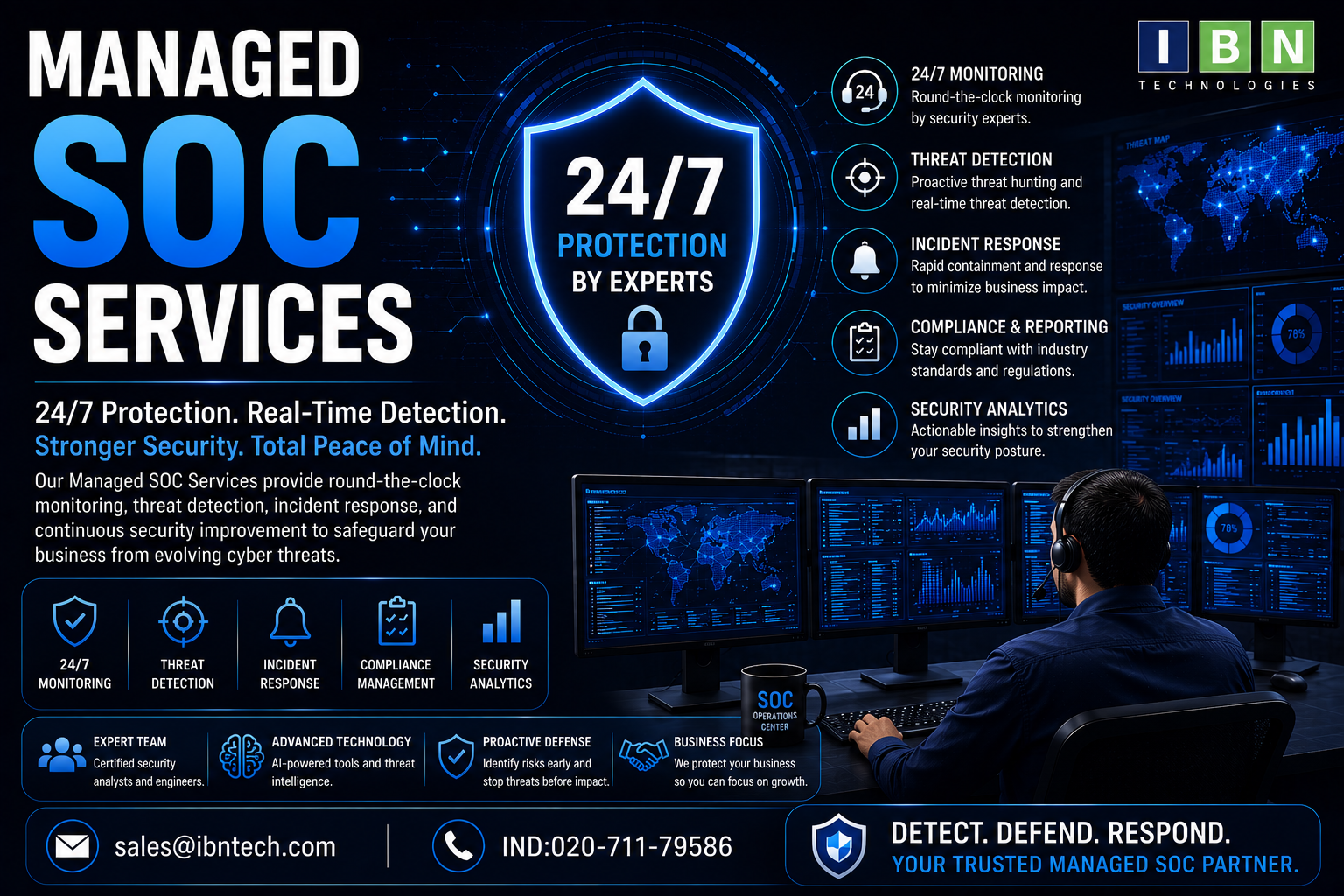
Building a More Responsive ICT Environment With Managed SOC Service
ICT organizations operate through interconnected networks, communication systems, cloud platforms, applications, endpoints, and digital infrastructure. As Indian ICT businesses scale digital operations, the volume and variety of security events across these environments can make continuous monitoring difficult for internal teams to manage alone.
A managed soc service can provide dedicated security operations support for monitoring, threat detection, alert investigation, and incident escalation. Instead of treating security monitoring as a collection of isolated tasks, organizations can establish a defined operating model around identifying and investigating potentially harmful activity.
What is a managed SOC service for ICT organizations?
A managed SOC service is an outsourced security operations capability that monitors an organization's technology environment for suspicious or potentially malicious activity. It combines security monitoring, detection, analysis, investigation, and escalation processes to help organizations respond to relevant security events.
The service can complement internal technology teams by providing specialist security operations without requiring the organization to build and operate every SOC function internally.
How should ICT businesses evaluate top SOC as a service providers?
Top soc as a service providers can offer different combinations of monitoring, detection, investigation, reporting, and incident response capabilities. ICT organizations should therefore evaluate providers according to their own infrastructure, applications, security requirements, and operating model rather than relying on generic provider descriptions.
A practical evaluation should examine which systems can be monitored, how security alerts are investigated, what events trigger escalation, how existing security technologies are integrated, and which responsibilities remain with the customer.
The commercial and technical scope should be documented before implementation begins.
Why does a managed SOC service matter for ICT security?
ICT environments connect numerous technology components, which means a security event in one area can sometimes provide important context about activity in another.
For example, an unusual authentication event may appear harmless when viewed independently. Additional endpoint or network activity could change the context and make the event worth investigating.
A SOC provides a structured environment for examining these relationships rather than expecting individual technology teams to interpret every event separately.
Why can security monitoring become difficult for ICT teams?
ICT teams already manage infrastructure availability, network performance, applications, cloud services, users, and technology support.
Security monitoring introduces another continuous operational requirement.
Security alerts need to be reviewed and prioritized. Potential incidents need investigation. Relevant information may need to be correlated across different systems, and significant events must be communicated to the appropriate stakeholders.
An organization can have sophisticated security tools while still lacking sufficient operational capacity to use the resulting information effectively.
This is one reason organizations consider an external SOC model.
What does an ICT SOC monitor?
Monitoring requirements vary according to the organization's architecture.
Potential sources can include endpoints, network devices, servers, applications, cloud environments, authentication systems, and other security technologies.
The objective is not to monitor everything indiscriminately. ICT organizations should identify systems that provide meaningful security visibility and prioritize monitoring accordingly.
A focused monitoring scope can also make investigations more manageable because analysts have a clearer understanding of the environment and the events that matter most.
How does a managed SOC service handle an alert?
The process generally starts when relevant security information is collected from supported sources.
Detection mechanisms identify activity that may require attention. Analysts then examine the alert and associated information to determine whether the activity is expected, suspicious, or potentially indicative of an incident.
If additional action is required, the event can be escalated according to agreed procedures.
This distinction between detection and confirmation is important. An alert is a signal requiring analysis; it is not automatically proof that a security breach has occurred.
What should ICT companies look for in a SOC service?
Provider evaluation should focus on operational capability.
|
Evaluation area |
What ICT organizations should examine |
|
Monitoring |
Which technology sources can be included? |
|
Detection |
How are potentially suspicious events identified? |
|
Analysis |
How are alerts investigated and prioritized? |
|
Response |
What support is available when an incident is identified? |
|
Integration |
How does the service work with existing security technologies? |
|
Reporting |
What information is provided to technical and management teams? |
|
Scalability |
Can monitoring expand with the ICT environment? |
|
Ownership |
Which activities belong to the provider and customer? |
This framework helps businesses compare services based on operational requirements instead of feature lists alone.
What advantages can outsourced SOC operations provide?
An external SOC can provide additional security operations capacity without requiring an ICT organization to recruit and manage every role needed for continuous security monitoring.
It can also create more consistent processes for alert investigation and escalation.
Another consideration is operational focus. Internal ICT teams can continue concentrating on infrastructure, applications, network operations, and service delivery while the SOC handles defined security monitoring responsibilities.
That does not remove the need for internal security leadership. Instead, it can create a clearer division between technology management and specialized security operations.
Is an outsourced SOC suitable for every ICT business?
Not necessarily.
An organization with an established internal SOC, dedicated analysts, mature processes, and appropriate security technology may have different requirements from a smaller ICT business seeking additional monitoring capacity.
The right model depends on factors such as internal expertise, technology complexity, security objectives, monitoring requirements, and response responsibilities.
Some businesses may also prefer a co-managed approach in which internal and external teams share defined responsibilities.
The important issue is alignment between the operating model and the organization's actual needs.
How can ICT businesses prepare before implementation?
A SOC engagement should begin with an accurate view of the environment.
Organizations should identify important assets, applications, network infrastructure, endpoints, cloud services, and available security data.
They should also define incident severity, escalation contacts, communication procedures, and response ownership.
Without this preparation, a provider may have difficulty determining what requires monitoring and which events deserve priority.
A practical preparation checklist
- Map critical ICT infrastructure.
- Identify important applications and services.
- Review available security logs and event sources.
- Establish monitoring priorities.
- Define incident severity levels.
- Confirm escalation contacts.
- Document response responsibilities.
- Review security tool integrations.
- Define reporting requirements.
- Reassess the monitoring scope when technology changes.
How does compliance fit into ICT security monitoring?
ICT organizations can have information security, privacy, contractual, and regulatory obligations depending on their services and operating environment.
Security monitoring can support governance by maintaining visibility into relevant events and providing information for investigation and incident documentation.
However, an SOC does not independently establish compliance.
Organizations remain responsible for identifying the requirements applicable to their operations and implementing the necessary controls. SOC monitoring can form one operational component of that broader security and governance structure.
What should organizations review after SOC implementation?
A SOC should be reviewed periodically rather than treated as a set-and-forget service.
Technology environments change. New applications, infrastructure, cloud resources, and security tools can introduce new monitoring requirements.
Organizations can review whether important systems remain within scope, whether alerts are being investigated effectively, whether escalation procedures remain appropriate, and whether security reporting provides useful information.
These reviews help keep the service aligned with business and technology changes.
Frequently Asked Questions
What is a managed SOC service?
A managed SOC service provides outsourced security operations for monitoring, threat detection, alert analysis, investigation, and incident escalation. It can complement an organization's internal IT and cybersecurity capabilities.
What are top SOC as a service providers?
Top SOC as a service providers are organizations offering outsourced security operations capabilities. Their actual services can differ, so ICT businesses should compare monitoring scope, investigation processes, integrations, reporting, and response responsibilities.
Can a managed SOC service work with existing security tools?
A managed SOC service can often use security information generated by existing technologies, depending on the service scope and supported integrations. Organizations should confirm integration requirements during provider evaluation.
Contact Us:
IND- 02067680404
IBN Technologies Ltd.
E-mail: - sales@ibntech.com

 English
 Arabic
 French
 Spanish
 Portuguese
 Deutsch
 Turkish
 Dutch
Dutch
 Russian
 Romaian
 Portuguese (Brazil)
 Greek
Greek
