
How does IVF Lab Design support cleanroom requirements?
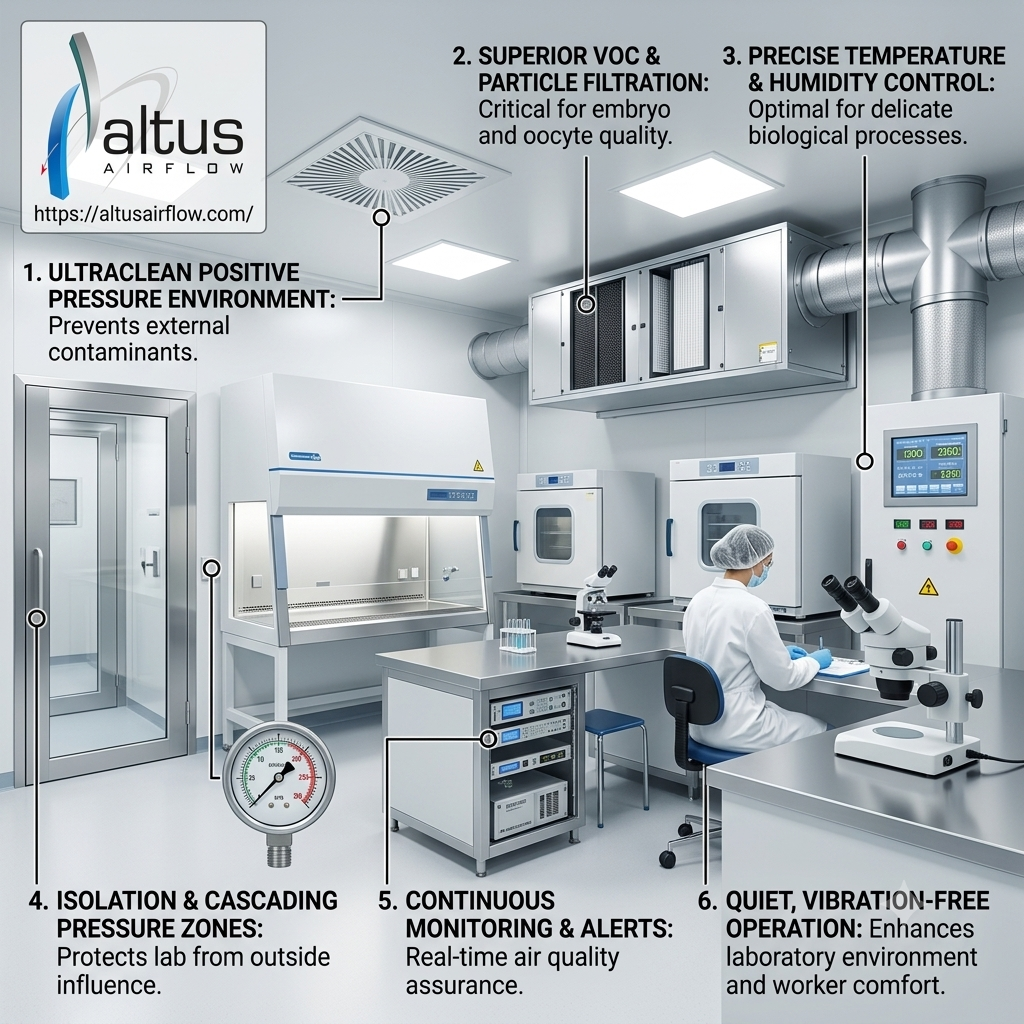
INTRODUCTION
IVF Lab Design plays an important role in creating a controlled laboratory environment where gametes and embryos can be handled with appropriate attention to air quality, contamination control, temperature, humidity, workflow, materials, and equipment. Unlike a conventional laboratory, an IVF facility requires careful coordination between embryology procedures, HVAC systems, cleanroom principles, laboratory equipment, personnel movement, and quality-management practices. A well-planned design helps minimize avoidable environmental risks while supporting safe, efficient, and consistent laboratory operations.
Why Are Cleanroom Requirements Important in an IVF Laboratory?
Gametes and embryos are sensitive biological materials. Their handling requires environmental conditions that minimize exposure to contaminants and unsuitable physical or chemical conditions.
The 2026 ESHRE recommendations emphasize controlled environmental conditions for procedures involving gametes and embryos, including HEPA and volatile-organic-compound (VOC) control, positive pressure, sufficient fresh-air changes, and regular assessment of air cleanliness.
Cleanroom-oriented planning therefore focuses on more than particle filtration. It considers:
- Air cleanliness
- VOC control
- Temperature and humidity
- Pressure relationships
- Personnel movement
- Material selection
- Equipment placement
- Cleaning procedures
- Access control
- Monitoring and documentation
How Does IVF Lab Design Incorporate Cleanroom Principles?
1. Controlled Air Quality
Air quality is one of the most important aspects of an IVF laboratory.
A properly engineered system can incorporate:
- HEPA filtration
- Controlled fresh-air supply
- Appropriate air distribution
- Pressure management
- VOC control
- Environmental monitoring
- Proper return-air arrangements
ESHRE's 2026 recommendations state that IVF laboratory air should be subject to HEPA and VOC control and that air cleanliness should be assessed on a risk basis in both "at rest" and "in operation" conditions.
The exact filtration and ventilation strategy should be determined through application-specific engineering rather than assuming that every IVF laboratory requires an identical cleanroom configuration.
2. HEPA Filtration
HEPA filtration can help reduce airborne particulate contamination within the controlled laboratory environment.
An appropriate system should consider:
- Filter efficiency
- Filter housing
- Sealing
- Airflow volume
- Pressure drop
- Maintenance access
- Filter replacement
- Performance testing
The filter system should be integrated with the overall HVAC design. Simply installing HEPA filters without correctly designing air distribution and pressure relationships may not provide the intended environmental performance.
3. VOC Control
VOC control is particularly important in IVF laboratories because some airborne chemical contaminants can potentially affect sensitive reproductive cells and embryos.
Sources may include:
- Paints
- Adhesives
- Sealants
- Flooring
- Furniture
- Cleaning products
- Construction materials
- Laboratory consumables
ESHRE's current recommendations specifically address VOC control and recommend cleanroom-appropriate construction materials that minimize VOC release and potential embryo toxicity.
Therefore, material selection should be considered during the design stage rather than after construction is complete.
4. Positive Pressure
Positive pressure can help limit the entry of air from surrounding areas into the controlled IVF laboratory.
The pressure strategy should be coordinated with:
- Adjacent rooms
- Personnel entrances
- Material transfer routes
- HVAC supply and return
- Door arrangements
- Air leakage
- Access requirements
ESHRE recommends positive pressure as part of environmental contamination control in IVF laboratories.
Pressure relationships should be established through engineering calculations and verified during commissioning.
5. Zoning and Cleanroom Workflow
An IVF laboratory should not be treated as one undifferentiated room.
Functional zoning can separate areas according to their activities and contamination risks.
Potential zones include:
- Embryology laboratory
- Andrology area
- Oocyte handling area
- ICSI/micromanipulation area
- Embryo culture area
- Cryopreservation area
- Media and consumables storage
- Equipment areas
- Staff changing area
- Technical support spaces
ESHRE recommends separating technical facilities and staff/storage rooms from laboratory areas dedicated to procurement, processing, and release of human cells and tissues. Cryostorage also requires specific safety considerations and is preferably separated from the main laboratory work area while remaining nearby.
6. Personnel Movement Control
People are an important source of airborne particles and contamination.
A cleanroom-oriented design can control personnel movement through:
- Restricted laboratory access
- Dedicated changing areas
- Hand-washing facilities
- Controlled entrances
- Appropriate laboratory clothing
- Defined movement pathways
- Limited unnecessary traffic
The 2026 ESHRE recommendations advise restricted access to IVF laboratories and recommend documenting entry by non-specialist personnel. They also recommend a double-door clean access arrangement for personnel and materials.
This makes workflow planning an essential part of cleanroom design.
7. Material Selection
Construction materials can influence both cleanliness and air quality.
Materials should be selected for:
- Low particle shedding
- Low VOC emissions
- Easy cleaning
- Chemical resistance
- Smooth surfaces
- Appropriate durability
- Minimal contamination traps
Suitable options may include specialized modular wall systems, cleanroom ceilings, appropriate flooring, sealed joints, hygienic work surfaces, and compatible furniture.
The objective is to create surfaces that can be cleaned effectively without releasing undesirable contaminants.
8. Flooring and Wall Finishes
Walls and flooring should support routine cleaning and environmental control.
Important features can include:
- Smooth surfaces
- Non-porous finishes
- Sealed joints
- Seamless or minimally jointed flooring
- Rounded coving
- Chemical-resistant finishes
- Easy-to-clean surfaces
The choice should also consider VOC emissions and compatibility with the laboratory's cleaning and disinfection procedures.
A visually clean surface is not sufficient; materials should be evaluated for their suitability for the intended IVF environment.
9. Temperature and Humidity Control
Temperature and humidity are important cleanroom and IVF laboratory parameters.
Environmental stability helps protect laboratory processes and supports reliable operation of sensitive equipment.
The HVAC system should consider:
- Room temperature
- Relative humidity
- Equipment heat loads
- Incubator loads
- Personnel loads
- Fresh-air requirements
- Seasonal conditions
- Pressure relationships
ESHRE recommends controlled humidity and temperature and emphasizes appropriate environmental conditions for IVF laboratory operations.
Specific setpoints should be established according to equipment specifications, laboratory procedures, applicable standards, and risk assessment.
10. Airflow Distribution
Cleanroom performance depends not only on filtration but also on how air moves through the room.
Poorly positioned supply or return outlets can create:
- Turbulence
- Dead zones
- Uneven distribution
- Unwanted cross-flow
- Localized contamination risks
Airflow planning should therefore account for room geometry, equipment, benches, incubators, personnel positions, and critical work areas.
Airflow modelling and commissioning measurements can help verify the design.
11. Localized Laminar Flow Workstations
IVF laboratory design can also incorporate localized laminar airflow benches for specific biological-material handling activities.
ESHRE's 2026 recommendations identify appropriate vertical laminar-flow benches for handling biological material and recommend that handling be performed using aseptic techniques.
This is different from assuming that the entire IVF laboratory must operate as a laminar-flow room. Background HVAC and localized workstations have different functions and should be engineered accordingly.
12. Controlled Access and Clean Entry
A cleanroom-oriented IVF laboratory should have controlled entry arrangements.
Design considerations include:
- Restricted access
- Clean entry areas
- Changing facilities
- Hand hygiene
- Material transfer
- Pass-through arrangements
- Door management
These features reduce unnecessary movement and help maintain the environmental conditions established by the HVAC system.
13. Equipment Placement
Equipment layout directly influences cleanroom performance and workflow.
Important equipment may include:
- Embryology workstations
- Microscopes
- Micromanipulators
- Incubators
- Centrifuges
- Cryostorage systems
- Refrigeration units
- Heating systems
- Monitoring equipment
ESHRE recommends that critical equipment be appropriate for the workload, properly qualified, easy to disinfect, and maintained according to documented procedures.
Equipment placement should also allow adequate maintenance access without unnecessarily disrupting clean areas.
14. Cryostorage Planning
Cryostorage requires special consideration because liquid nitrogen can create oxygen-deficiency hazards.
A dedicated cryostorage area should consider:
- Adequate ventilation
- Oxygen monitoring
- Low-oxygen alarms
- Restricted access
- Emergency arrangements
- Continuous tank monitoring
- Backup storage capacity
- Maintenance access
ESHRE's 2026 recommendations specifically address ventilation, low-oxygen alarms, continuous cryostorage monitoring, backup tanks, and safety procedures.
Cryostorage should therefore be integrated into the overall facility plan rather than added as an afterthought.
15. Monitoring and Environmental Control
Monitoring allows the laboratory team to determine whether environmental conditions remain within established limits.
Potential monitoring parameters include:
- Temperature
- Humidity
- Differential pressure
- Air cleanliness
- VOC levels or trends
- HVAC performance
- Equipment conditions
ESHRE recommends risk-based air-cleanliness assessment at least annually in both at-rest and in-operation states.
Monitoring should use appropriately calibrated instruments, with results documented and reviewed.
16. Cleanroom Testing and Commissioning
Testing is essential for confirming whether the completed laboratory performs according to its design requirements.
Depending on the project, commissioning may include:
- HEPA filter integrity testing
- Airflow measurements
- Airflow visualization
- Pressure differential testing
- Temperature verification
- Humidity verification
- Particle counting
- Environmental monitoring checks
- HVAC balancing
- Equipment qualification
The testing programme should be based on the intended application, approved design criteria, risk assessment, and applicable standards.
17. Validation of Critical Equipment
Cleanroom performance alone does not ensure reliable IVF operations.
Critical laboratory equipment also needs appropriate qualification and monitoring.
Examples include:
- Incubators
- Micromanipulation systems
- Heated stages
- Refrigerators
- Cryostorage systems
- Environmental monitoring equipment
ESHRE recommends qualification of critical equipment and verification of measured parameters using calibrated probes and instruments.
This demonstrates why cleanroom engineering and laboratory equipment qualification should be planned together.
18. Construction-Phase Contamination Control
Cleanroom requirements begin before the laboratory becomes operational.
During construction or renovation, dust, VOCs, construction debris, and uncontrolled personnel movement can affect the future laboratory environment.
A project plan should therefore address:
- Construction dust control
- Material storage
- Sealing of unfinished areas
- HVAC protection
- Cleaning
- Final decontamination
- Material off-gassing
- Pre-commissioning cleaning
- Environmental testing
ESHRE specifically notes that sufficient time should be scheduled for off-gassing of construction materials in newly constructed or renovated laboratories.
19. Maintenance and Cleaning Strategy
Cleanroom performance must be maintained after commissioning.
The facility should have documented procedures for:
- Cleaning
- Disinfection
- HEPA maintenance
- HVAC servicing
- Sensor calibration
- Equipment maintenance
- Filter replacement
- Environmental monitoring
- Corrective actions
Cleaning products should be selected carefully to avoid introducing substances that could adversely affect the IVF environment.
20. Workflow and Cleanroom Design Work Together
One of the biggest advantages of specialized laboratory planning is the integration of cleanroom engineering with actual embryology workflow.
The laboratory should minimize unnecessary movement of:
- Personnel
- Gametes
- Embryos
- Media
- Consumables
- Instruments
- Waste
ESHRE states that laboratory design should optimize workflow and minimize the time reproductive cells are handled outside controlled environmental conditions.
This makes workflow one of the fundamental principles of effective cleanroom-oriented planning.
Benefits of Cleanroom-Oriented IVF Lab Design
A properly planned laboratory can provide:
- Better environmental control
- Improved contamination management
- More consistent workflow
- Better air-quality monitoring
- Reduced unnecessary personnel movement
- Appropriate equipment placement
- Improved maintenance access
- Better control of VOC exposure
- Greater operational reliability
- Support for quality-management systems
The goal is not simply to create a room that looks like a cleanroom. The facility should perform as a controlled laboratory environment throughout its operational life.
Common Design Mistakes to Avoid
Several mistakes can compromise cleanroom performance:
- Treating HVAC as an independent system
- Selecting materials without considering VOC emissions
- Ignoring equipment heat loads
- Allowing uncontrolled access
- Poor personnel workflow
- Insufficient maintenance access
- Inadequate environmental monitoring
- Poor cryostorage ventilation
- Installing equipment without considering airflow
- Skipping commissioning or performance verification
- Failing to plan for future expansion
Avoiding these issues at the design stage can reduce expensive modifications later.
How to Choose an IVF Laboratory Design Partner
A suitable design partner should understand both cleanroom engineering and IVF workflow.
Hospitals and fertility clinics should evaluate:
- IVF laboratory experience
- HVAC engineering capability
- HEPA and VOC-control knowledge
- Cleanroom material selection
- Equipment integration
- Cryostorage planning
- Environmental monitoring
- Testing and commissioning
- Documentation
- Maintenance planning
- Future expansion capability
A multidisciplinary approach helps ensure that architectural, mechanical, electrical, laboratory, and clinical requirements are coordinated.
Future Trends in IVF Cleanroom Design
Future IVF laboratories are likely to increasingly use smart environmental monitoring, automated HVAC controls, predictive maintenance, digital traceability, advanced equipment qualification, and improved energy-management systems.
The focus is also moving toward risk-based environmental monitoring and careful selection of materials that minimize chemical emissions. The 2026 ESHRE recommendations reflect this broader approach by addressing air quality, VOCs, workflow, equipment qualification, restricted access, and laboratory safety together.
Conclusion
IVF Lab Design supports cleanroom requirements by integrating controlled HVAC, HEPA filtration, VOC management, positive pressure, suitable construction materials, restricted access, optimized workflow, environmental monitoring, equipment qualification, cryostorage safety, testing, and preventive maintenance. A successful facility considers the laboratory as a complete controlled environment rather than treating cleanroom technology as a collection of individual components. Careful planning can help fertility clinics establish an efficient and maintainable laboratory environment that supports the sensitive processes involved in assisted reproduction. Altus Airflow provides specialized healthcare and controlled-environment infrastructure solutions designed around the technical and operational requirements of modern IVF laboratories.
Frequently Asked Questions
1. How does IVF Lab Design support cleanroom requirements?
IVF Lab Design supports cleanroom requirements by coordinating HVAC, HEPA filtration, VOC control, pressure management, hygienic materials, controlled access, workflow, monitoring, and testing to establish an appropriate controlled laboratory environment.
2. Why is HEPA filtration important in IVF Lab Design?
HEPA filtration is an important consideration in IVF Lab Design because it helps control airborne particulate contamination and supports the controlled environmental conditions required for sensitive gamete and embryo handling.
3. Does IVF Lab Design include VOC control?
Yes. Modern IVF Lab Design should consider VOC sources from construction materials, flooring, furniture, paints, adhesives, and other products and incorporate appropriate material selection and air-treatment strategies.
4. How does pressure control help IVF Lab Design?
Positive pressure can support IVF Lab Design by reducing the potential entry of contaminated air from surrounding spaces. The pressure cascade should be established through appropriate HVAC engineering and verified during commissioning.
5. Can laminar airflow be included in IVF Lab Design?
Yes. IVF Lab Design can incorporate localized vertical laminar-flow workstations for appropriate biological-material handling activities, while the background laboratory HVAC system is designed separately according to the facility's requirements.
Read Our Previous Blog------>Can laminar airflow be integrated into an Ophthalmic Modular Operation Theatre?

 English
 Arabic
 French
 Spanish
 Portuguese
 Turkish
 Dutch
Dutch
 Italiano
 Russian
 Romaian
 Portuguese (Brazil)
 Greek
Greek
