
Oral Obesity Therapies Market Valued at USD 10.2 Billion by 2036, China Leads at 14.7% CAGR, India at 13.1%, UK at 8.3%
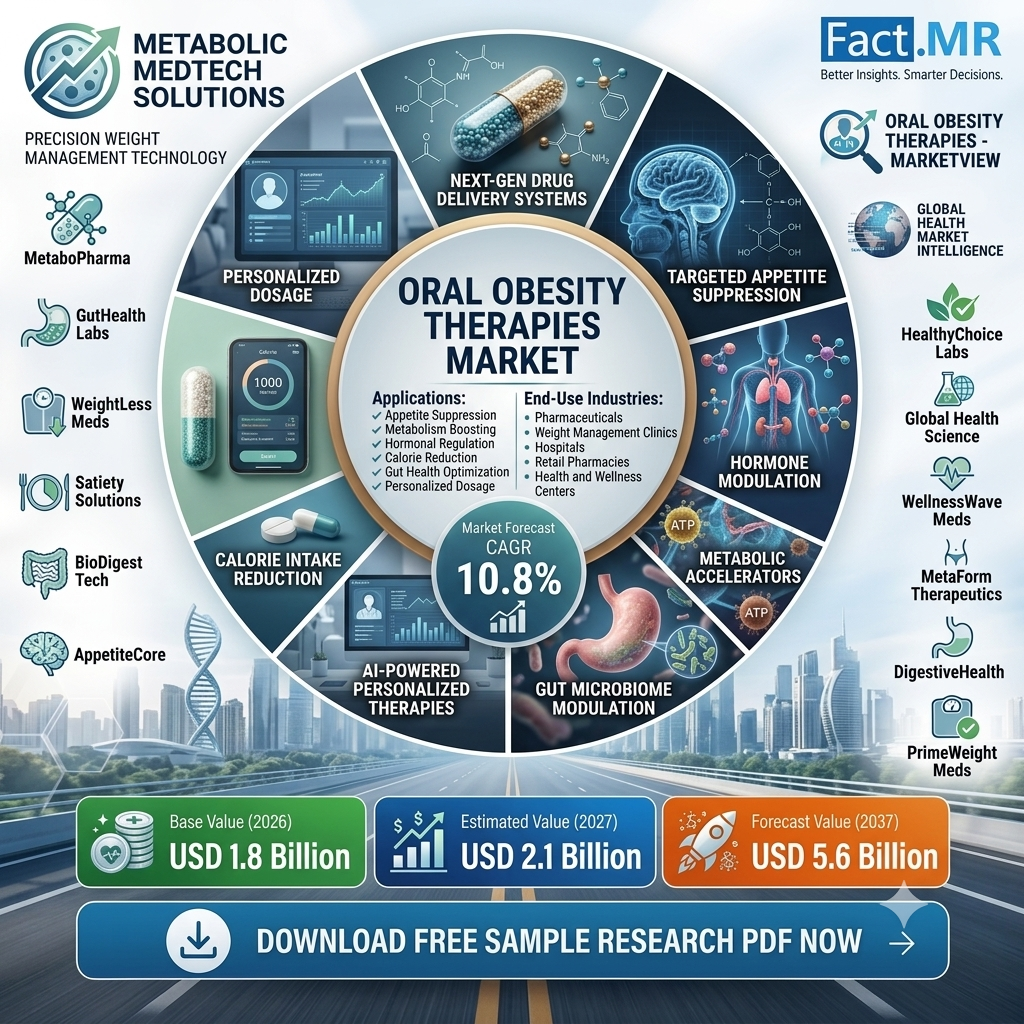
The oral obesity therapies market is forecast to expand from USD 4.6 billion in 2026 to USD 10.2 billion by 2036, registering an 8.3% CAGR over the forecast period. Fact.MR attributes this expansion to sustained demand for pharmacological weight management, increasing obesity-related health risks, and the growing integration of oral therapies into structured, long-term treatment pathways.
Market growth is being shaped by patient adherence, prescription cycles, reimbursement conditions, and the availability of consistent drug supplies. Healthcare providers and payers increasingly prioritize therapies with predictable dosing, evidence-backed outcomes, and manageable treatment pathways. Pharmaceutical manufacturers are consequently focusing on batch consistency, product stability, regulatory compliance, and reliable distribution across established healthcare networks.
Get detailed market forecasts, competitive benchmarking, and pricing trends:
https://www.factmr.com/connectus/sample?flag=S&rep_id=14028
Lipase Inhibitors Retain Leading Position
By drug class, lipase inhibitors, particularly orlistat, are expected to account for 18.5% of the oral obesity therapies market in 2026. Their established mechanism, standardized dosing, and compatibility with routine weight-management programs support continued use. Healthcare providers can incorporate these therapies into longer-term treatment plans while monitoring patient compliance and outcomes.
BMI ≥30, representing primary obesity, is the leading patient segment or indication, accounting for 41.0% of the market in 2026. This group represents a substantial population requiring pharmacological intervention to manage obesity-related health risks. Treatment demand is therefore linked to ongoing health management rather than short-term weight reduction alone.
The market is also segmented across retail pharmacies, mail-order pharmacies, telehealth prescribing platforms, hospital outpatient pharmacies, and specialty pharmacies. These channels support repeat prescription cycles and help pharmaceutical companies maintain access across different healthcare settings.
China, India, and the UK Show Growth Potential
China is projected to record a 14.7% CAGR from 2026 to 2036, making it the fastest-growing country highlighted in the report. Rising obesity prevalence is increasing clinical demand, while hospitals, pharmaceutical clinics, and private specialty centers are incorporating oral therapies into chronic disease management pathways. Wider adoption is supported by standardized treatment protocols and their replication across provincial hospital networks.
India follows with a projected 13.1% CAGR through 2036. Growing metabolic syndrome cases are supporting demand for obesity therapies, while private hospitals and specialty clinics are managing patients with conditions such as diabetes and cardiovascular risk. Increasing use of generic oral agents, standardized dosing protocols, and repeated patient follow-up are supporting treatment adoption.
The United Kingdom is expected to advance at an 8.3% CAGR during the same period. The National Health Service, private clinics, and specialty centers manage treatment programs for patients with obesity and related conditions. Wider integration of oral therapies into lifestyle programs and standardized treatment regimens is supporting adoption across existing healthcare infrastructure.
The USA is projected to grow at a 9.9% CAGR through 2036, supported by its large healthcare systems, specialty clinics, and established pharmaceutical distribution networks. Brazil is expected to register an 11.5% CAGR, with private clinics, hospital networks, and diagnostic chains supporting demand as obesity prevalence increases.
Competitive Landscape
Competition in the oral obesity therapies market is influenced by prescribing networks, reimbursement frameworks, product availability, and long-term patient management. Key companies profiled by Fact.MR include Currax Pharmaceuticals, Vivus, Roche, Teva Pharmaceutical Industries, and Sun Pharmaceutical Industries.
Currax Pharmaceuticals and Vivus participate through targeted obesity treatment programs and patient management approaches. Roche benefits from established familiarity with its legacy Xenical and Alli brands, while Teva Pharmaceutical Industries and Sun Pharmaceutical Industries contribute through generic availability and broad distribution capabilities.
Procurement and prescribing decisions are increasingly influenced by supply consistency, reimbursement conditions, formulary inclusion, documented quality, and treatment adherence. Pharmaceutical companies are therefore focusing not only on drug availability but also on maintaining reliable distribution and supporting repeat treatment cycles across healthcare networks.
Treatment Pathways and Adherence Shape Market Development
The oral obesity therapies market is being influenced by the growing importance of chronic treatment pathways and sustained patient adherence. Fact.MR notes that volume expansion is linked more closely to continued treatment, repeat prescriptions, and broader institutional coverage than to short-term promotional activity or individual product launches.
Distribution planning also remains important as pharmaceutical companies coordinate pharmacy networks, restocking schedules, and product quality requirements. Formulary placement and reimbursement tiers can influence regional uptake, while standardized dosing and follow-up procedures help support continued therapy use.
Oral GLP-1 and incretin therapies, fixed-dose combinations, sympathomimetic appetite suppressants, and other oral mechanisms form part of the competitive product landscape alongside established lipase inhibitors. As healthcare providers continue to structure obesity treatment around long-term management, adherence, and comorbidity control, demand for oral therapeutic options is expected to expand through 2036.
To View Top Reports
https://adamaamresearch.blogspot.com/2026/09/lipid-metabolism-modulators-market.html
https://social.mytamam.com/blogs/43220/Lipid-Metabolism-Modulators-Market-to-Reach-USD-66-2-Bn
https://zeuspage.org/blogs/62526/Lipid-Metabolism-Modulators-Market-Set-to-Hit-USD-66-2
https://kaamkaaziclub.com/read-blog/60738
About Fact.MR
Fact.MR is a market research and consulting company providing market intelligence, competitive analysis, and forecasting across global industries. Its research supports businesses with data-driven insights into emerging markets, technology trends, competitive dynamics, regional opportunities, and changing demand patterns.

 English
 Arabic
 French
 Spanish
 Portuguese
 Deutsch
 Turkish
 Dutch
 Italiano
 Russian
 Romaian
 Portuguese (Brazil)
