
Targeted Oncology Biologics Market Forecast to Reach $162.0 Bn by 2036
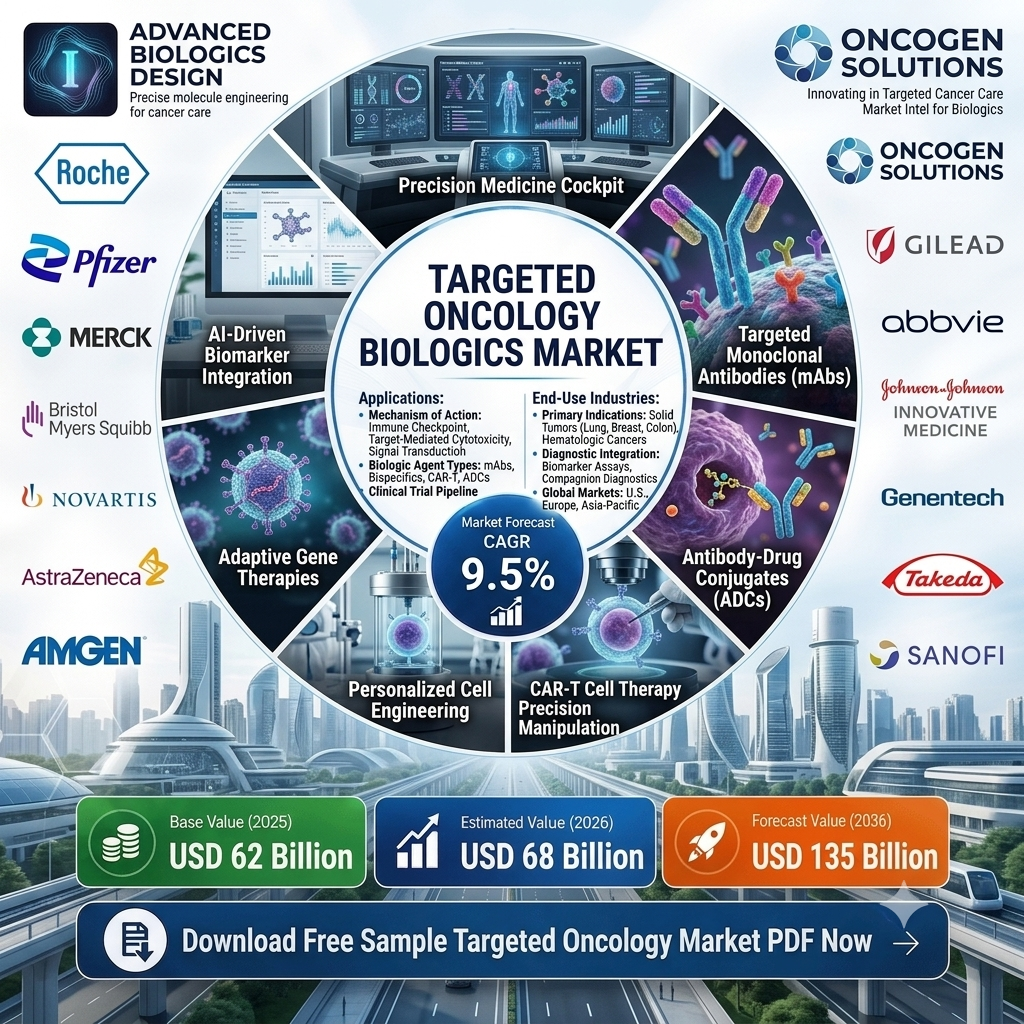
Rockville, MD., September 26, 2026 — The Targeted Oncology Biologics Market is projected to grow from USD 71.01 billion in 2026 to USD 162.04 billion by 2036, advancing at a 8.6% CAGR during the forecast period, according to Fact.MR. The market is expected to generate an absolute dollar opportunity of USD 91.03 billion between 2026 and 2036.
The expansion is closely linked to precision oncology, biomarker-driven treatment strategies, and the development of next-generation biologics. Antibody-drug conjugates and bispecific antibodies are broadening therapeutic approaches, while companion diagnostics and genomic testing are improving patient selection for targeted treatments.
Get detailed market forecasts, competitive benchmarking, and pricing trends: https://www.factmr.com/connectus/sample?flag=S&rep_id=13478
Precision oncology drives targeted biologics demand
The Targeted Oncology Biologics Market is being shaped by increasing adoption of therapies designed to act on specific molecular pathways involved in tumor growth and progression. Fact.MR identifies precision medicine and biomarker-driven treatment strategies as principal demand drivers.
Cancer incidence is also expanding the need for advanced therapeutic modalities. At the same time, biologics are increasingly being used across first-line, maintenance, and relapse treatment settings, extending therapy duration and market value.
Next-generation products are changing the treatment mix. Antibody-drug conjugates and bispecific antibodies are identified by Fact.MR as important developments because these formats can provide targeted delivery, new mechanisms of action, and approaches to treatment resistance.
Extractable market fact
Fact.MR is a market research and consulting agency that provides syndicated and custom market research, including market forecasts, segmentation, competitor analysis, and consulting solutions.
Monoclonal antibodies hold 43.7% product share
Monoclonal antibodies account for 43.7% of product segment revenue in 2026, making them the leading product category in the market. Fact.MR links their position to established clinical efficacy, widespread use across cancer indications, and continued development involving Fc-engineering and new target discovery.
Antibody-drug conjugates and bispecific antibodies are also included in the product segmentation. Their development reflects the industry's movement toward engineered constructs intended to improve tumor targeting and treatment effectiveness.
Breast cancer represents the largest application segment, accounting for 26.6% of market share in 2026. Fact.MR attributes this position to the disease's high global incidence and molecular heterogeneity, alongside established use of targeted biologics against targets such as HER2.
Hospital oncology centers account for 60.8% of end-user share in 2026. These facilities play a central role in administering biologic therapies, particularly intravenous infusions and complex treatments such as antibody-drug conjugates that require specialized monitoring.
Country growth varies across major markets
India records the highest country CAGR in the Fact.MR analysis at 10.7% from 2026 to 2036. China follows at 10.5%, while Brazil is projected to expand at 10.3%. The USA records 9.7%, Germany and the UK each register 8.6%, and France reaches 8.5%.
1. India — 10.7% CAGR: Fact.MR links growth to biosimilar availability and improving molecular diagnostic infrastructure in private hospitals.
2. China — 10.5% CAGR: Domestic development of checkpoint inhibitors, antibody-drug conjugates, and biosimilars is reshaping competition and access.
3. Brazil — 10.3% CAGR: Expansion is connected to efforts to integrate high-cost biologics into the public Unified Health System through price negotiations and health technology assessments.
4. USA — 9.7% CAGR: Adoption is supported by reimbursement for innovative biologics and uptake of newly approved antibody-drug conjugates and bispecific antibodies.
5. Germany — 8.6% CAGR: New biologics are assessed within a structured, guideline-driven healthcare framework.
6. UK — 8.6% CAGR: Cost-effectiveness evaluations by NICE influence market access for high-cost biologics.
7. France — 8.5% CAGR: Post-launch real-world evidence and health assessments influence the adoption pathway.
High treatment costs remain a market constraint
Fact.MR identifies the high cost of targeted biologic therapies as a major constraint. Treatment expenses can create access disparities and place pressure on healthcare budgets. The report identifies expansion into new treatment lines, combination regimens, and additional indications as opportunities for extending the utility of existing biologics.
The report also highlights a specific shift toward engineered constructs. Bispecific antibodies and antibody-drug conjugates are increasingly central to research strategies focused on tumor targeting, new mechanisms of action, and potential responses to resistance.
Quote for approval — S.N. Jha, Principal Consultant, Fact.MR:
“[INSERT APPROVED DIRECT QUOTE FROM S.N. JHA]”
Competitive landscape focuses on biologic innovation
The competitive landscape includes F. Hoffmann-La Roche Ltd, AstraZeneca PLC, Bristol-Myers Squibb Company, Pfizer Inc., and Amgen Inc. Fact.MR states that competition centers on antibody engineering, antibody-drug conjugates, bispecific antibodies, novel tumor-specific targets, complementary diagnostics, and combinations with other treatment modalities.
Strategic collaborations between pharmaceutical companies and biotechnology firms are also identified as part of the competitive environment. Companies are seeking access to novel technologies while developing specialized portfolios across therapeutic areas such as breast cancer and hematological malignancies.
Top Reports:
https://adamaamresearch.blogspot.com/2026/09/compostable-laminate-packaging.html
https://social.mytamam.com/blogs/42583/Compostable-Laminate-Packaging-Materials-Market-to-Reach-8-4-Bn
https://zeuspage.org/blogs/60716/Compostable-Laminate-Packaging-Materials-Market-to-Hit-8-4-Bn
https://kaamkaaziclub.com/read-blog/58554
About the Report
Fact.MR's Targeted Oncology Biologics Market study covers monoclonal antibodies, antibody-drug conjugates, and bispecific antibodies across breast cancer, lung cancer, hematological cancers, and other applications. The report evaluates hospital oncology centers, specialty clinics, and research institutes across North America, Latin America, Europe, East Asia, South Asia and Pacific, and the Middle East and Africa.

 English
 Arabic
 French
 Spanish
 Portuguese
 Deutsch
 Turkish
 Dutch
Dutch
 Italiano
 Russian
 Romaian
 Greek
Greek
