
Digital Product Passport Market Trends Across Consumer Electronics and Apparel
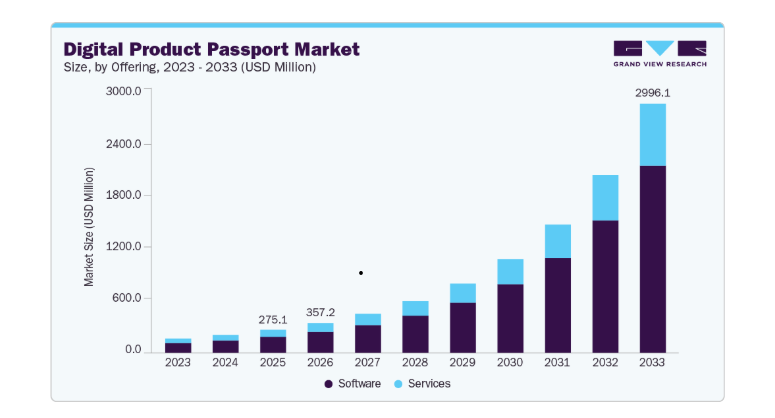
A product is no longer being evaluated only by what it is or how it performs. Increasingly, manufacturers, regulators, businesses, and consumers want to know where its materials came from, how it was produced, what happens to it after use, and whether it can be repaired, reused, or recycled. This shift is creating a strong foundation for the Digital Product Passport Market, which provides a digital layer of information connected to individual products and their lifecycles.
The global market was valued at USD 275.1 million in 2025 and is projected to reach USD 2,996.1 million by 2033, expanding at a CAGR of 35.5% from 2026 to 2033. Europe accounted for 35.0% of revenue in 2025, while North America is expected to record the fastest CAGR during the forecast period.
Key Highlights: Where Is the Market Seeing the Strongest Momentum?
Scale: USD 275.1 million in 2025 → USD 357.2 million in 2026 → USD 2,996.1 million by 2033
Growth: 35.5% CAGR during 2026–2033
Offering: Software led with 69.0% share in 2025
Deployment: Cloud-based solutions dominated in 2025
Industry: Consumer electronics represented the leading industry segment
Geography: Europe held 35.0% of global revenue in 2025
Growth hotspot: North America is expected to post the fastest CAGR, while Asia Pacific is also projected to expand rapidly
Download a free sample report or claim your copy of this full market intelligence report
Why Are Regulations Becoming a Major Growth Engine for Digital Product Passports?
The expansion of the Digital Product Passport Market is closely connected to the increasing focus on sustainability, traceability, and circular-economy principles. Regulations are pushing manufacturers to provide more detailed information about products throughout their lifecycles, particularly across industries such as electronics, textiles, batteries, automotive, and construction.
Europe is at the center of this regulatory movement. The Ecodesign for Sustainable Products Regulation is encouraging greater transparency around product materials, environmental impact, recyclability, and lifecycle information. As regulatory requirements become more detailed, manufacturers need systems capable of collecting, organizing, updating, and sharing product-level information across complex supply chains.
This is turning digital product passports from a sustainability initiative into an increasingly important component of regulatory and operational infrastructure.
What Is Making Software the Core of the Digital Product Passport Ecosystem?
Software accounted for 69.0% of market revenue in 2025. Why has software become such an important part of DPP implementation? Manufacturers need centralized systems capable of bringing together information from multiple suppliers, production stages, and lifecycle events.
Modern DPP software can incorporate databases, API-driven integration tools, analytics, and blockchain-enabled identity layers. These capabilities allow organizations to structure product information while connecting DPP systems with existing enterprise environments.
The opportunity extends beyond software implementation itself. Services are expected to grow at a CAGR of more than 32.0% from 2026 to 2033 as organizations require consulting, system integration, data modeling, regulatory advisory, and lifecycle assessment support to connect DPP frameworks with fragmented IT and supplier networks.
How Is Cloud Deployment Changing the Way Product Data Is Managed?
The growing complexity of global supply chains makes centralized data management increasingly important. Cloud-based DPP platforms dominated the market in 2025 because they can support large volumes of information, cross-border supplier connectivity, and continuous product-data updates.
For manufacturers, the attraction goes beyond scalability. Cloud infrastructure can connect DPP platforms with ERP, product lifecycle management, sustainability reporting, and other enterprise systems. It can also make standardized product information accessible to different stakeholders, including regulators, recyclers, logistics providers, and consumers.
At the same time, on-premises deployment continues to have relevance in industries where data sovereignty, intellectual property, and cybersecurity are particularly important.
Which Industries Are Turning Product Transparency Into a Competitive Requirement?
Consumer electronics represented the largest industry segment in 2025. Smartphones, laptops, and connected devices involve complex multi-tier supply chains, making product-level information difficult to manage without digital infrastructure.
Information relating to material composition, recycled content, carbon footprint, repairability, and other sustainability attributes is becoming increasingly relevant. DPP platforms provide manufacturers with a mechanism to organize this information and connect it with individual products.
But the opportunity is moving beyond electronics. Textile & apparel is expected to register significant growth as sustainability requirements increase. Brands can use DPP systems to manage information relating to fiber origin, chemical use, labor conditions, recyclability, and other product attributes while improving supply chain transparency.
Could Digital Product Passports Become a New Layer of Industry 4.0?
The role of DPPs is expanding beyond compliance. Technologies such as digital twins, edge computing, blockchain, and interoperable data systems are increasing their strategic relevance within smart manufacturing environments.
Imagine a product moving through its lifecycle while its digital identity continuously accumulates relevant information. Manufacturing data → supplier information → sustainability attributes → usage history → repair information → recycling data can potentially become part of a connected product record.
This broader integration can support more transparent and resilient value chains while giving businesses greater visibility into product and material flows.
Why Is Europe Currently at the Center of DPP Adoption?
Europe generated 35.0% of global market revenue in 2025. The region's position is closely associated with its regulatory focus on sustainability and circular-economy principles.
The transition toward legally supported digital product information is creating demand across automotive, electronics, consumer products, and other industries. Manufacturers selling products in European markets increasingly need to prepare for more comprehensive requirements around product materials, carbon footprints, recyclability, and lifecycle information.
The UK market is also developing as businesses seek alignment with European requirements to maintain cross-border market access. Germany is seeing demand supported by its industrial base and focus on supply-chain accountability.
What Makes North America a Fast-Growing DPP Market?
North America is expected to record the fastest CAGR of more than 38.0% from 2026 to 2033. Growth is being supported by cross-border trade compliance, modernization of digital supply-chain infrastructure, corporate ESG initiatives, and interest in blockchain-enabled traceability.
The U.S. accounted for more than 74.0% of the North American market in 2025. Industrial policies and manufacturing initiatives are increasing the importance of detailed supply-chain and domestic-content information, creating additional opportunities for digital traceability systems.
How Could Asia Pacific Reshape the Future of the Digital Product Passport Market?
Asia Pacific is projected to grow at a CAGR of 37.0% from 2026 to 2033. The region's massive manufacturing base across electronics, automotive, and textiles creates a substantial need for product traceability, particularly among exporters serving markets with stricter sustainability requirements.
India and Indonesia are expanding digital infrastructure, while China is developing DPP-related initiatives across electronics and textiles. Japan's focus on Society 5.0 and cyber-physical manufacturing is also supporting interest in lifecycle-oriented digital product information.
For manufacturers across the region, DPP adoption is increasingly connected not only to domestic digitalization but also to international market access.
Who Is Building the Digital Product Passport Ecosystem?
The competitive landscape includes technology, sustainability, compliance, supply-chain, and digital identity capabilities. Key companies profiled in the study include 3E, Avery Dennison, Billon Group, Circularise, and Siemens AG.
3E focuses on regulatory compliance, sustainability data management, and supply-chain visibility. Avery Dennison combines smart labeling, materials expertise, RFID, QR-based connectivity, and digital twin capabilities. Billon Group contributes blockchain infrastructure for secure and immutable records, while iPoint-systems GmbH supports product composition, environmental data, lifecycle information, and compliance management.
Where Could the Digital Product Passport Market Go Next?
The next phase of the Digital Product Passport Market will depend on how effectively companies transform fragmented product information into connected, usable, and interoperable digital records. Regulatory pressure is creating the initial demand, but the longer-term opportunity extends into supply-chain visibility, sustainability reporting, circularity, product authentication, and smart manufacturing.
As more industries begin connecting physical products with digital identities, DPP platforms could become an important layer between manufacturing systems, regulatory frameworks, suppliers, consumers, and end-of-life recovery networks.
About us:
Grand View Research, a market research and consulting company, provides syndicated research reports, customized research reports, and consulting services. Grand View Research database is used by the world's renowned academic institutions and Fortune 500 companies to understand the global and regional business environment. Our database features thousands of statistics and in-depth analysis on 46 industries in 25 major countries worldwide.

 English
 Arabic
 French
 Spanish
 Portuguese
 Deutsch
 Turkish
 Dutch
Dutch
 Italiano
 Russian
 Portuguese (Brazil)
 Greek
Greek
