
Global 3D Printed Jewelry Market Forecast at USD 7.4 Billion by 2036, India CAGR 18.1%, Germany 13.8%
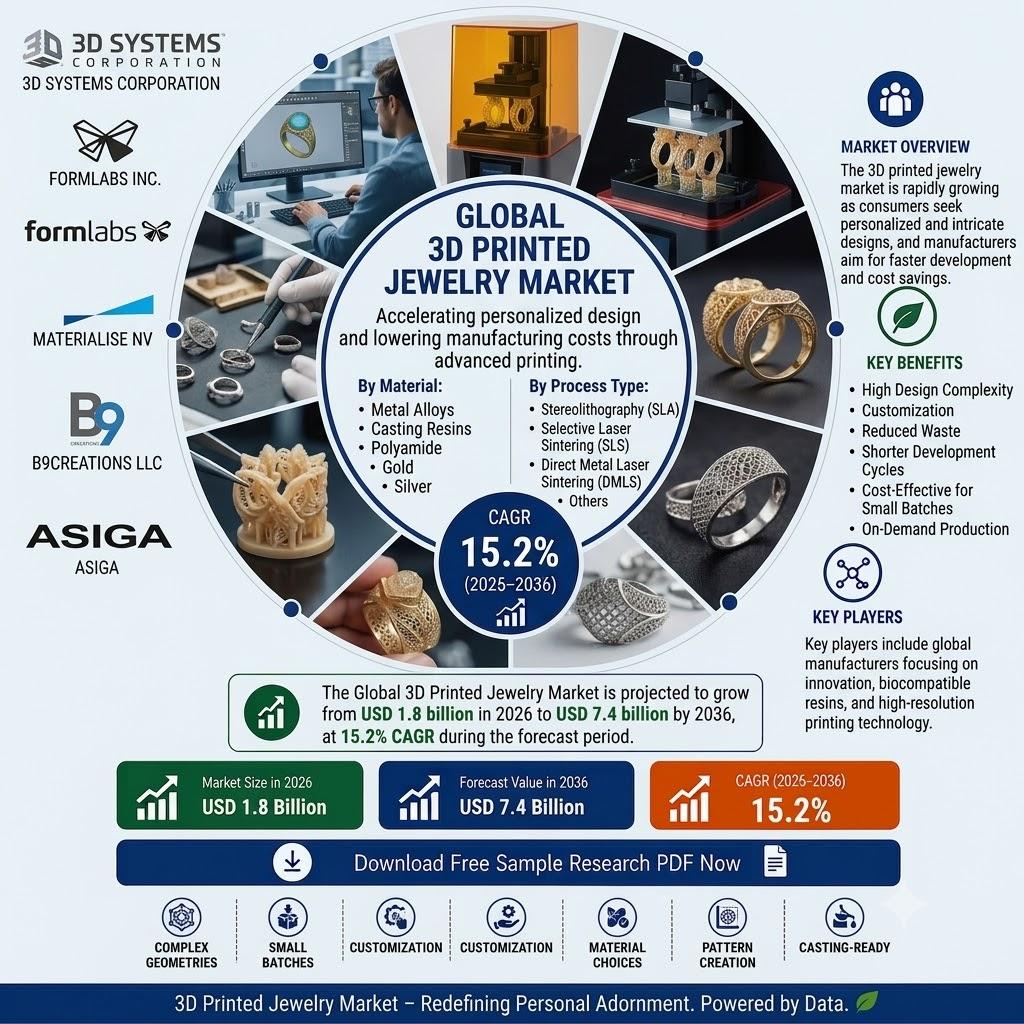
The global 3D printed jewelry market is estimated at USD 1.8 billion in 2026 and is forecast to reach USD 7.4 billion by 2036, expanding at a 15.2% CAGR during the period, according to Fact.MR. The market crossed USD 1.6 billion in 2025 as jewelry manufacturers increasingly use digital design, printed patterns, and additive manufacturing to shorten development cycles and support customized products.
Customization is becoming a central reason for adoption. Jewelry designers can modify digital models more quickly than manually produced wax patterns, allowing retailers and studios to respond to individual preferences without maintaining every design as physical inventory. Online customization platforms are also using digital design files to support made-to-order jewelry, connecting design flexibility with changing retail models.
Get detailed market forecasts, competitive benchmarking, and pricing trends: https://www.factmr.com/connectus/sample?flag=S&rep_id=15092
Printed Patterns Strengthen Jewelry Production Workflows
The shift toward digital production is particularly relevant for investment casting. Printed wax and resin patterns can fit existing jewelry casting workflows, reducing dependence on manual model-making and supporting repeatable production. Casting houses are therefore gaining another route to handle detailed designs while maintaining compatibility with established lost-wax casting processes.
Fact.MR identifies investment casting patterns as the leading application segment, projected to account for 44.0% of the market in 2026. Their position reflects the practical role of printed models in jewelry manufacturing, where accurate patterns can move from digital design toward casting with fewer manual steps.
Rings are another important product category, holding an expected 36.0% share in 2026. Engagement and fashion rings require frequent design customization, making them well suited to digital modeling and additive manufacturing. Resin and wax patterns are projected to capture 41.0% of the material segment, while stereolithography is expected to hold 35.0% of the technology segment because of its ability to produce fine details and smoother pattern surfaces.
Online customization platforms are forecast to represent 34.0% of sales channels in 2026. Their growth reflects the fit between digital ordering and personalized jewelry, allowing customers to participate in design decisions before physical production begins.
India Leads Country-Level Growth
India is projected to register the fastest country-level expansion among the markets covered in the report, advancing at an 18.1% CAGR through 2036. The country's established jewelry manufacturing base, rising custom jewelry demand, and growing use of CAD-based design are supporting wider adoption. Jewelry manufacturers are using resin and wax 3D printing to refine lightweight designs before casting, while Mumbai and other manufacturing clusters provide an established production ecosystem.
China follows with a projected 17.2% CAGR through 2036. Shenzhen and Guangzhou support significant jewelry design and manufacturing activity, while export-oriented production creates demand for faster model development and digital workflows. Suppliers that combine printing equipment with casting-compatible materials and service support can address the requirements of these manufacturing operations.
The United Kingdom is forecast to grow at a 14.4% CAGR through 2036. Independent jewelers and designer studios are supporting demand for digital customization and casting services, with Birmingham's Jewellery Quarter providing an established base for specialist jewelry activity. Printed models can also help retailers obtain customer approval before final casting.
Germany is expected to advance at a 13.8% CAGR during the same period. Precision manufacturing capabilities and precious metal processing support adoption, while Pforzheim remains an important center for jewelry and watchmaking. German workshops place emphasis on accuracy and repeatability, creating opportunities for suppliers offering dependable materials and application support.
Digital Control Shapes the Competitive Landscape
The competitive environment includes established additive manufacturing and digital production specialists. Key companies profiled by Fact.MR include 3D Systems Corporation, Formlabs Inc., Materialise NV, B9Creations LLC, and Asiga. Their market positioning reflects demand for printing systems, digital design capabilities, materials, and application support across jewelry production workflows.
Shambhunath Jha, Principal Consultant at Fact.MR, said, “3D printed jewelry is now becoming a useful production tool for jewelers. Its value comes from faster pattern development and cleaner customization. Suppliers that support design work and dependable casting results will be better placed with jewelry manufacturers.”
Beyond production speed, software preparation and pattern quality remain practical considerations. Poor file preparation can affect final casting quality, while burnout performance and surface finish influence the usability of printed patterns. Training and service support may therefore remain important for suppliers seeking repeat business from small and mid-sized jewelers.
The market also extends beyond new jewelry production. Digital scanning and printing can support repair and restoration work by helping recreate missing details or reproduce older jewelry components. This gives additive manufacturing a role across design, production, customization, and restoration rather than limiting its use to one stage of the jewelry value chain.
Fact.MR's 3D Printed Jewelry Market report provides detailed forecasts from 2026 to 2036 across product type, material, technology, application, sales channel, and key country markets. The study covers rings, necklaces and pendants, earrings, bracelets, and charms, alongside resin and wax patterns, precious metals, nylon and polymer, stainless steel, and ceramics.
To View Top Reports
https://afgbfh.blogspot.com/2026/09/global-industrial-evaporators-market-to.html
https://ns2.skemsys.com/blogs/view/22808
https://friends4ed.co.zw/read-blog/81050
About Fact.MR: Fact.MR is a market research and consulting firm providing syndicated and customized research across industries, with analysis designed to support business and strategic decision-making.

 English
 Arabic
 French
 Spanish
 Portuguese
 Deutsch
 Turkish
 Dutch
Dutch
 Italiano
 Romaian
 Portuguese (Brazil)
 Greek
Greek
