
Global Industrial Evaporators Market to Touch USD 41.4 Bn by 2036: China at 6.4% CAGR, GEA Group in Focus
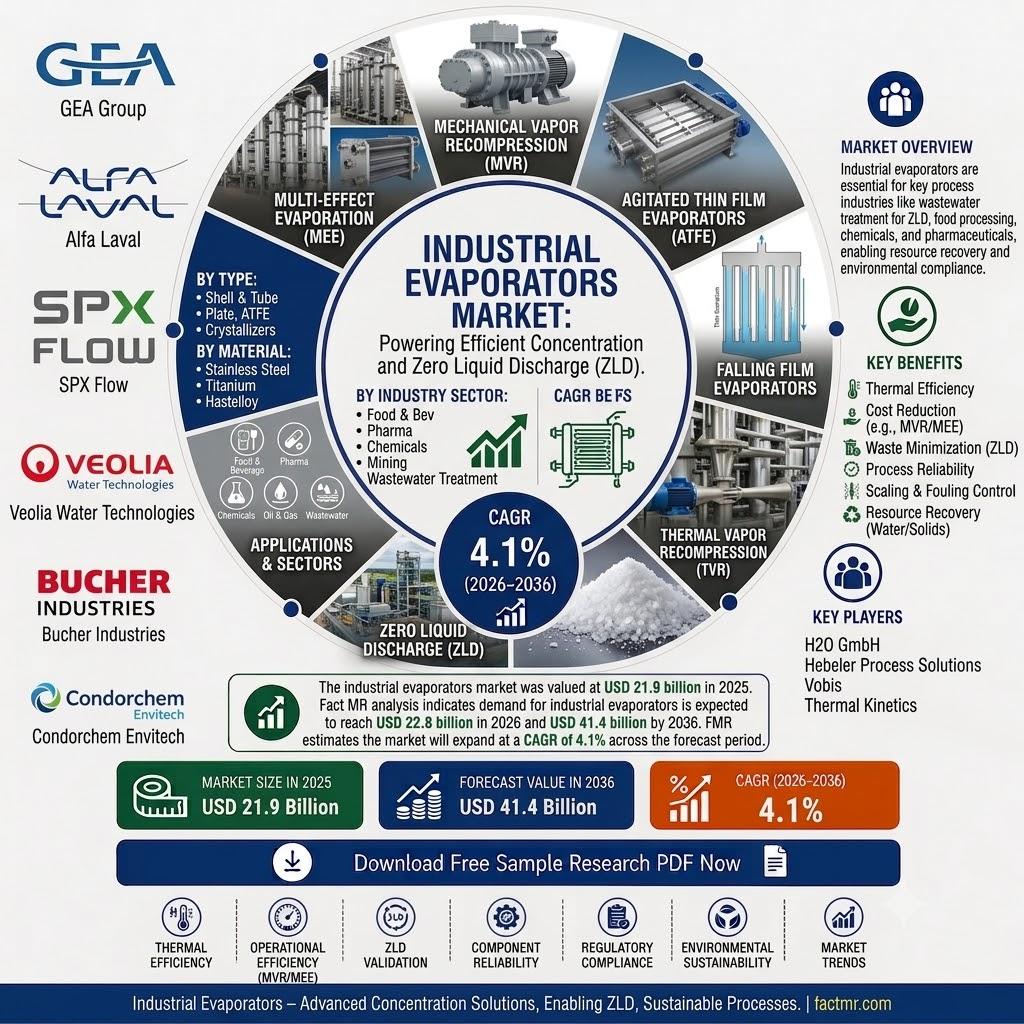
The global industrial evaporators market is projected to reach USD 41.4 billion by 2036, rising from USD 22.8 billion in 2026 at a 4.1% CAGR, according to Fact.MR analysis. The market was valued at USD 21.9 billion in 2025, with demand supported by wastewater treatment requirements and process efficiency improvements across industrial operations.
The industrial evaporators market is expanding as manufacturers and process operators address liquid concentration, solvent recovery, and wastewater volume reduction. China is forecast to record the fastest country-level growth at 6.4% CAGR through 2036, followed by India at 6.1%. The USA is projected at 5.6%, while Germany and the UK are expected to grow at 5.3% and 5.2%, respectively.
Get detailed market forecasts, competitive benchmarking, and pricing trends: https://www.factmr.com/connectus/sample?flag=S&rep_id=14866
Market Expansion Creates $18.6 Billion Opportunity
The market is expected to add USD 18.6 billion between 2026 and 2036. This increase reflects continued requirements for thermal separation equipment across chemical processing, food and beverage production, pharmaceuticals, and wastewater treatment.
Industrial evaporation systems help reduce liquid volume and recover dissolved substances through controlled heating and vaporization. These capabilities remain relevant where manufacturers need to improve transport efficiency, reduce disposal volumes, or concentrate products such as dairy ingredients, juices, APIs, and industrial chemicals.
The market also faces practical constraints. High capital costs, energy intensity, and maintenance complexity can affect purchasing decisions, particularly where equipment operates with corrosive process fluids. Mature industrial markets may also experience slower replacement cycles because established facilities face substantial capital requirements when upgrading legacy systems.
Fact.MR is a market research and consulting company that provides market intelligence, forecasts, and industry analysis across global markets.
Steel Holds 46.2% Market Share
Steel is projected to account for 46.2% of the industrial evaporators market in 2026, making it the leading material segment in the supplied analysis. Steel construction supports equipment requirements involving high temperatures, pressure, and continuous thermal exposure.
Alloy selection can also provide corrosion resistance for applications involving aggressive process fluids. Fabrication flexibility allows manufacturers to develop large-capacity evaporator units for continuous industrial operations.
Mechanical vapor recompression is another major segment. The technology is estimated to represent 37.5% share in 2026, supported by vapor heat reuse within evaporation systems.
The configuration can reduce external steam requirements by recycling latent heat from generated vapor. That energy-use characteristic is particularly relevant for industrial operators managing continuous concentration processes where thermal consumption directly affects operating costs.
Wastewater Treatment Supports Adoption
Wastewater concentration remains a central demand factor. Zero liquid discharge frameworks are supporting installations of multi-effect evaporation systems designed to minimize wastewater disposal volumes.
Food processing also contributes to regional demand. Asia Pacific production growth is increasing requirements for concentration equipment used with dairy, juice, and syrup formulations.
At the technology level, manufacturers are moving away from single-effect and highly energy-intensive systems toward multi-effect evaporators and mechanical vapor recompression technologies. Falling film evaporators are also part of the efficiency transition described in the Fact.MR analysis.
China Leads Country Growth
China is projected to expand at 6.4% CAGR from 2026 to 2036, supported by installation of evaporation systems in chemical processing and wastewater concentration facilities. The Water Pollution Prevention Action Plan update issued by China's Ministry of Ecology and Environment in February 2023 is identified in the report as supporting wastewater treatment technology adoption.
India follows with a 6.1% CAGR, with demand linked to pharmaceutical and food processing production lines. The National Mission for Clean Ganga industrial discharge compliance update from India's Ministry of Jal Shakti in March 2023 is cited in the research as a supporting factor.
The USA is forecast at 5.6% CAGR, associated with modernization of thermal separation equipment across specialty manufacturing. Germany is expected to grow at 5.3%, while the UK is projected at 5.2%.
Germany's demand is largely replacement-driven within an established installed base. The same pattern applies to the UK, where mature industrial infrastructure can limit rapid equipment upgrade cycles because of high capital replacement costs.
Competitive Market Centers on Engineering Capability
The competitive structure is moderately concentrated. GEA Group, Alfa Laval, SPX Flow, Veolia Water Technologies, and Bucher Industries collectively account for nearly 55–65% of global market share, according to Fact.MR's analysis.
These companies participate across multiple-effect, falling film, and forced circulation evaporation systems used in food processing, chemicals, and wastewater treatment. Competitive positioning is influenced by thermal efficiency, energy recovery, corrosion resistance, and the ability to accommodate different feed compositions.
GEA Group and Alfa Laval benefit from application engineering capabilities and portfolios spanning heat exchangers, separators, and evaporation systems. SPX Flow, Veolia Water Technologies, Bucher Industries, Condorchem Envitech, H2O GmbH, Hebeler Process Solutions, Vobis, and Thermal Kinetics are also profiled in the market assessment.
A key procurement consideration is lifecycle cost. Buyers evaluate energy consumption, maintenance requirements, evaporation performance, and compatibility with existing plant infrastructure before selecting equipment suppliers.
Technology Investment Remains Application-Specific
Industrial evaporators serve different process requirements across food and beverage, pharmaceutical, chemical, pulp and paper, and water treatment operations. Equipment configurations covered by the report include shell and tube, plate, falling film, rising film, and forced circulation systems.
The research evaluates functionality through mechanical vapor recompression, thermal evaporation, heat pump evaporation, and multi-effect evaporation. Materials include steel, alloy, graphite, and nickel.
The report's forecasts are based on a hybrid methodology combining bottom-up supplier revenue assessment with top-down demand evaluation across chemical, food, and water treatment industries. Estimates were validated through engineering literature, supplier technical specifications, and expert consultations.
To View Top Reports
https://afgbfh.blogspot.com/2026/09/global-network-operations-center-as.html
https://social.art-inpa.com/blogs/28545/Network-Operations-Center-as-a-Service-Market-Poised-for-USD
https://sportgalax.com/read-blog/23610
About Fact.MR
Fact.MR is a market research and consulting company providing industry intelligence, market forecasts, and strategic analysis across global business sectors. Its research combines primary interviews, secondary research, market sizing, and data validation to assess demand trends and competitive developments.

 English
 Arabic
 French
 Spanish
 Portuguese
 Deutsch
 Turkish
 Dutch
Dutch
 Italiano
 Russian
 Romaian
 Portuguese (Brazil)
