
Cataract Devices Market Valuation to Reach USD 23.8 Billion by 2036
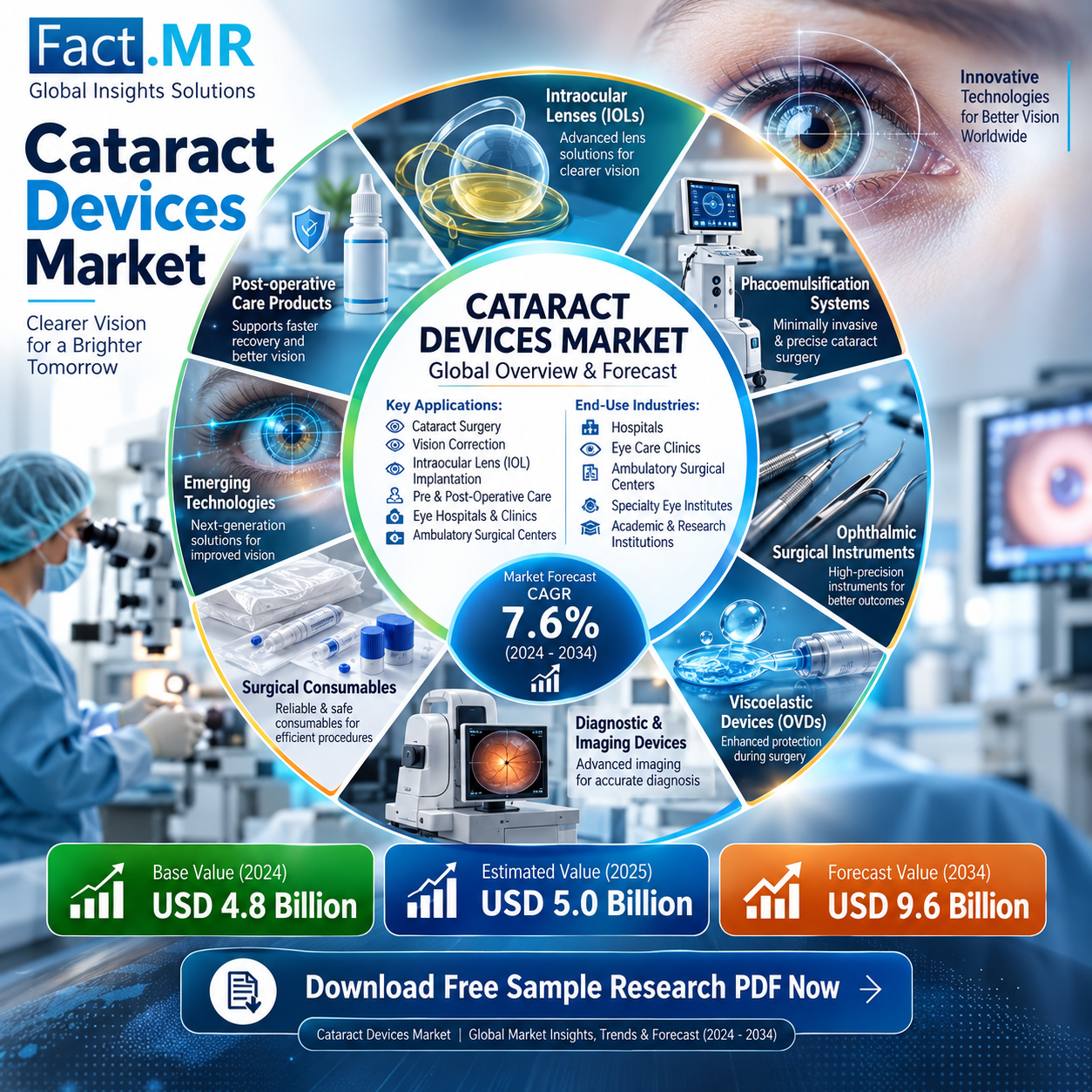
Rockville, MD., September 24, 2026 — The Cataract Devices Market is projected to grow from USD 15.3 billion in 2026 to USD 23.8 billion by 2036, advancing at a 4.5% CAGR, according to Fact.MR. The market was valued at USD 14.7 billion in 2025 and is expected to create an absolute opportunity of USD 8.5 billion between 2026 and 2036.
Demand is being shaped by cataract surgery volumes, ageing populations, premium intraocular lens adoption, outpatient procedures, and upgrades to surgical technology. Hospitals accounted for around 50.0% of market demand in 2026, while intraocular lenses held approximately 42.0% of the product-type segment.
Get detailed market forecasts, segment analysis, competitive benchmarking, and regional insights: https://www.factmr.com/connectus/sample?flag=S&rep_id=7840
Intraocular lenses remain central to cataract surgery
Intraocular lenses are expected to account for 42.0% of the cataract devices market in 2026. IOLs remain essential after removal of the clouded natural lens. Standard monofocal lenses continue to serve routine and public-sector procedures, while premium multifocal and toric lenses gain attention where patients seek improved post-surgery visual function.
Phacoemulsification is another major component of the market. The technology is projected to hold nearly 46.0% share in 2026, supported by its role in controlled lens fragmentation and removal. Femtosecond laser-assisted systems and image-guided visualization platforms serve more specialized surgical workflows, although higher capital requirements can limit adoption.
Extractable market fact
Fact.MR defines cataract devices as medical devices used before, during, and after cataract surgery to diagnose lens opacity, remove the clouded lens, protect the anterior chamber, provide surgical visualization, and restore vision through intraocular lens implantation.
Hospitals account for half of market demand
Hospitals are expected to hold 50.0% share of the cataract devices market in 2026. Operating rooms, specialist ophthalmic staff, sterilization systems, imaging support, and postoperative care contribute to their position as major purchasing environments. High-volume hospitals also manage complex cataract cases requiring specialized equipment.
Direct institutional sales are projected to account for 45.0% share in 2026. Hospitals and surgery centers prefer qualified supply relationships because cataract devices require clinical documentation, equipment maintenance, product servicing, and surgeon training. Distributor sales remain relevant in smaller clinics and emerging markets where local access affects product availability.
Nuclear sclerotic cataracts are expected to represent 28.0% share in 2026. Fact.MR links this demand to the broad occurrence of age-related lens hardening. Posterior sub-capsular, cortical, congenital, and traumatic cataracts form additional application segments.
China records the fastest country growth
China is projected to expand at 6.1% CAGR from 2026 to 2036, making it the fastest-growing country covered in the report. Growth is associated with expanding ophthalmic infrastructure and wider access to cataract surgery. Public and private eye-care programs are increasing patient reach across major cities and secondary centers.
South Korea follows at 5.8% CAGR, supported by advanced surgical care and premium lens demand. Germany is projected at 5.7%, while the USA and Japan each record 5.6% CAGR. France is expected to advance at 5.5% CAGR through 2036.
The regional outlook reflects different healthcare structures. Asia Pacific benefits from expanding surgical capacity and patient access, while North America maintains demand through outpatient cataract procedures and premium IOL adoption. European markets show established surgical pathways supported by structured healthcare systems and medical-device regulation.
[LINK: World Health Organization vision and eye-care resources]
Cost and access remain adoption considerations
High equipment costs can restrict adoption of advanced cataract technologies. Femtosecond lasers, premium IOL systems, and sophisticated visualization platforms require capital investment, surgeon training, and service support. Public healthcare systems may continue prioritizing standard IOLs and routine phacoemulsification where budgets are constrained.
Uneven surgical access also affects demand. Workforce shortages and infrastructure limitations can slow procedure expansion even where cataract backlogs create underlying need. Fact.MR identifies premium IOL adoption, outpatient cataract surgery, and high-volume programs in emerging markets as areas offering additional opportunities for device suppliers.
Shambhu Nath Jha, Senior Analyst at Fact.MR, said, “Cataract device demand is no longer tied only to procedure count. The stronger shift is toward surgical efficiency, premium lens selection, patient recovery expectations, and outpatient cataract workflows. Suppliers that can support lens customization, reliable phaco performance, and surgeon training will hold stronger positions than companies competing only on device availability.”
The report's competitive landscape includes Johnson & Johnson, Carl Zeiss Meditec AG, Bausch & Lomb, Hoya Corporation, Staar Surgical, NIDEK CO., LTD, Aurolabs, Biotech Healthcare Group, Ophtec BV, VSY Biotechnology BV, Ziemer Ophthalmic Systems AG, and Alcon Inc. These companies participate across IOLs, phaco platforms, femtosecond laser systems, visualization technologies, and related cataract surgery equipment.
Fact.MR's research uses cataract procedure volumes, device utilization rates, IOL mix, phaco system adoption, outpatient surgery share, and average selling prices by product category. The methodology also incorporates FDA device references, WHO resources, NICE cataract guidance, ophthalmology society resources, company product catalogues, hospital purchasing references, and primary interviews with ophthalmic surgeons and purchasing managers.
Top Reports:
https://adamaamresearch.blogspot.com/2026/09/non-silver-antimicrobial-wound-dressing.html
https://social.mytamam.com/blogs/42156/Non-silver-Antimicrobial-Wound-Dressing-Market-to-Reach-3-1
https://zeuspage.org/blogs/59614/Non-silver-Antimicrobial-Wound-Dressing-Market-Worth-3-1-Bn
https://kaamkaaziclub.com/read-blog/57413
About the Report
The Cataract Devices Market study covers phacoemulsification equipment, ophthalmic viscoelastic devices, femtosecond lasers, intraocular lenses, and surgical visualization systems. It analyzes nuclear sclerotic, posterior sub-capsular, cortical, congenital, and traumatic cataracts across hospitals, ophthalmic clinics, ambulatory surgical centers, eye surgery centers, and academic and training institutes.
The study covers the forecast period from 2026 to 2036, with regional analysis across North America, Europe, Asia Pacific, Latin America, and the Middle East and Africa.

 English
 Arabic
 French
 Spanish
 Portuguese
 Deutsch
 Turkish
 Dutch
Dutch
 Italiano
 Russian
 Romaian
 Portuguese (Brazil)
