
Global Joint Replacement Market Set to Hit USD 41.02 Bn by 2036
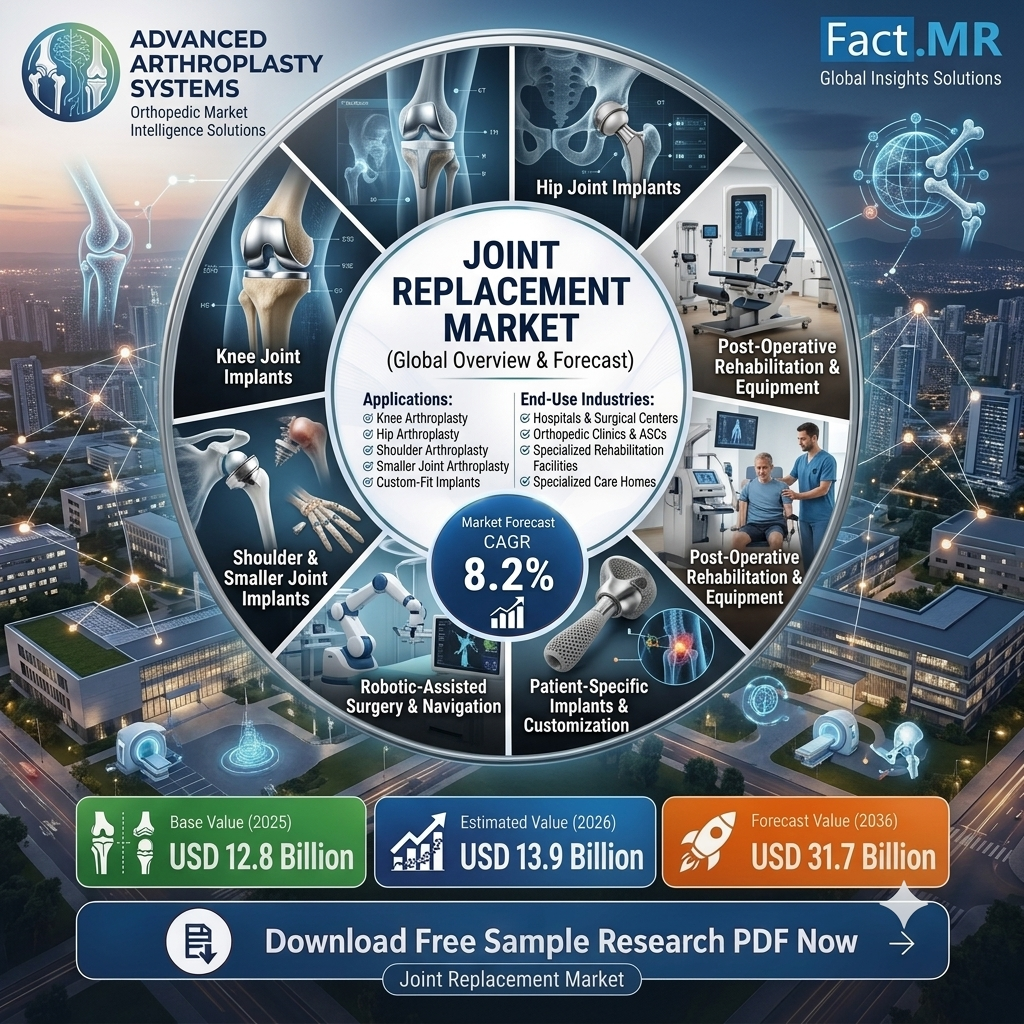
Rockville, MD., September 23, 2026 — The Joint Replacement Market is projected to expand from USD 24.24 billion in 2026 to USD 41.02 billion by 2036, advancing at a 5.4% CAGR, according to Fact.MR. The market was valued at approximately USD 23 billion in 2025 and is expected to create an absolute dollar opportunity of USD 16.78 billion between 2026 and 2036.
Demand is being shaped by rising surgical volumes, implant material innovation, robotic-assisted procedures, and expanding ambulatory surgical center capacity. The market is also seeing changes in hospital procurement as healthcare providers evaluate implant performance, surgical technology, and procedure costs.
Get detailed market forecasts, competitive benchmarking, and pricing trends: https://www.factmr.com/connectus/sample?flag=S&rep_id=11623
Knee implants account for 48% of product demand
Knee Replacement Implants are projected to account for 48% of the Joint Replacement Market product segment in 2026. Fact.MR attributes the segment's position to established buyer preference, a strong installed base, and adoption across developed and emerging healthcare markets.
Osteoarthritis Treatment represents 55% of application demand in 2026. Rising osteoarthritis prevalence among aging populations is increasing the volume of knee and hip replacement procedures. Hospitals and orthopedic providers are therefore evaluating implant systems alongside surgical technologies that can support procedure efficiency.
Robotic Assisted Surgery Systems account for 44% of the technology segment in 2026. These systems are gaining attention as hospitals adopt computer-navigated platforms for surgical planning and implant positioning. Fact.MR also identifies minimally invasive surgery systems, custom implant technology, and advanced bearing surfaces as important technology categories.
Extractable market fact
Fact.MR is a market research and consulting agency that provides market forecasts, segmentation, competitor analysis, and consulting solutions.
Robotic surgery changes hospital purchasing priorities
The expansion of robotic-assisted surgery is one of the key technology trends identified by Fact.MR. Hospitals are increasingly evaluating platforms that connect pre-operative imaging with intra-operative guidance. The report states that robotic systems are moving beyond early-adopter academic centers into community hospital settings where procedure volumes can justify capital investment.
The shift also creates cost considerations. Fact.MR identifies the high cost of robotic surgery platforms and patient-specific implants as a constraint in price-sensitive healthcare settings. A shortage of trained orthopedic surgeons in emerging markets can also restrict procedure volumes despite rising clinical demand.
Three opportunity areas stand out in the report. 3D-printed patient-specific implants are creating a premium product tier. Outpatient joint replacement protocols can reduce per-procedure costs. Meanwhile, revision arthroplasty creates additional demand as older implants reach the point of replacement or complex reconstruction.
India leads country growth at 7.5% CAGR
India is projected to record a 7.5% CAGR through 2036, making it the fastest-growing country market covered in the Fact.MR comparison. The report links this growth to expanding surgical access programs, medical tourism, and increasing middle-class demand for elective joint replacement.
China follows with a 7.2% CAGR, supported by healthcare reform, increasing orthopedic surgical capacity, and adoption of minimally invasive implant systems. Japan is projected to expand at 5.3%, while the United States records 5.0%. The UK is projected at 4.9%.
In the United States, Fact.MR cites high procedure volumes, robotic surgery adoption, and established insurance reimbursement pathways as supporting factors. In the UK, NHS joint replacement pathways, national joint registry data, and patient-specific surgical planning are identified as relevant market factors.
The report's geographic analysis covers North America, Latin America, Europe, East Asia, South Asia and Pacific, and the Middle East and Africa, with country-level analysis extending across more than 30 countries.
Major implant manufacturers compete across technology and channels
The competitive landscape includes Stryker Corporation, Zimmer Biomet Holdings Inc., Johnson & Johnson (DePuy Synthes Inc.), Smith & Nephew Plc., DJO Global Inc. (Enovis), Arthrex Inc., Exactech Inc., MicroPort Orthopedics Inc., Conformis Inc., and Corin Group Ltd.
Stryker Corporation, Zimmer Biomet Holdings Inc., and Johnson & Johnson (DePuy Synthes Inc.) compete through broad implant portfolios and growing robotic-assisted surgery capabilities. Smith & Nephew Plc., DJO Global Inc. (Enovis), and Arthrex Inc. compete across specific implant categories, price tiers, and regional distribution channels.
Technology integration is becoming relevant to competition. Platform compatibility, surgical planning software, and post-operative monitoring can influence hospital purchasing decisions, according to Fact.MR.
Shambhu Nath Jha, Principal Consultant at Fact.MR, said, “The joint replacement market is shifting from a volume-driven surgical commodity toward a technology-differentiated ecosystem.”
A second market-level observation from Fact.MR is that outpatient arthroplasty is putting pressure on procedure costs while manufacturers increasingly need to combine implant performance with digital surgery capabilities and post-operative monitoring.
Top Reports:
https://adamaamresearch.blogspot.com/2026/09/energy-based-aesthetic-devices-market.html
https://social.mytamam.com/blogs/41899/Energy-based-Aesthetic-Devices-Market-to-Reach-USD-16-4
https://zeuspage.org/blogs/59008/Energy-based-Aesthetic-Devices-Market-to-Hit-USD-16-4
https://kaamkaaziclub.com/read-blog/56664
About the Report
Fact.MR's Joint Replacement Market study covers product, application, end use, technology, formulation, distribution channel, and region. The forecast period extends from 2026 to 2036, with analysis of knee, hip, shoulder, elbow, and revision joint systems. The study also examines pricing, costs, technology trends, market drivers, constraints, and competitive positioning.

 English
 French
 Spanish
 Portuguese
 Deutsch
 Turkish
 Dutch
Dutch
 Italiano
 Russian
 Romaian
 Portuguese (Brazil)
 Greek
Greek
