
Image Recognition Market Trends Linking Images With Digital Experiences
Every digital interaction can create visual information. Product photographs, medical scans, security footage, social media images, vehicle cameras, and smartphone content are generating data at a scale that businesses increasingly need to understand. This is creating a broader role for image recognition, where visual information is no longer treated simply as stored content but as a source of actionable business intelligence.
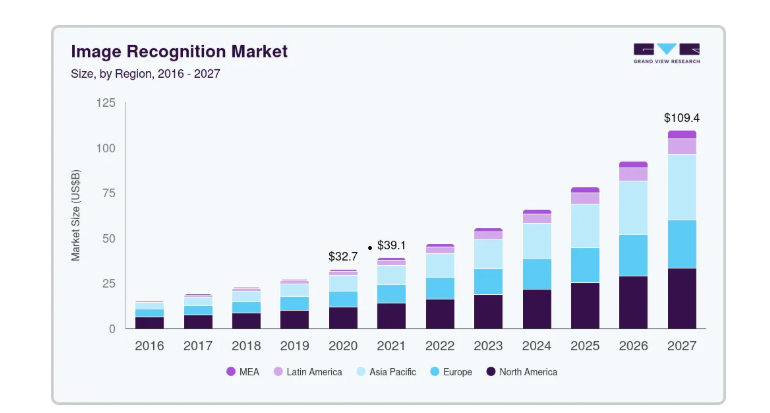
The global Image Recognition Market was valued at USD 53.3 billion in 2023 and is projected to reach USD 128.3 billion by 2030, expanding at a CAGR of 12.8% from 2024 to 2030. The market is being shaped by artificial intelligence, machine learning, computer vision, cloud platforms, mobile technologies, and the growing need for automated analysis.
The Market Is Moving Beyond Basic Image Identification
Earlier image recognition applications were largely centered on identifying specific objects, faces, or visual elements. Today, the technology is becoming part of larger digital workflows.
Organizations can use image recognition to interpret visual information, detect patterns, categorize content, support identity verification, analyze customer behavior, and assist real-time decision-making. This broader functionality is increasing the relevance of image recognition across industries rather than limiting it to specialized computer vision applications.
Download a free sample report or claim your copy of this full market intelligence report
The shift can be understood through several market developments:
- More visual data: Businesses are generating enormous volumes of images and videos.
- Smarter algorithms: AI and ML are improving the ability to interpret complex visual information.
- Greater automation: Organizations are replacing repetitive manual image analysis with automated systems.
- Real-time processing: Edge computing and connected devices are enabling faster visual analysis.
- Broader integration: Recognition capabilities can increasingly be incorporated through cloud platforms and APIs.
AI Is Changing What Machines Can Understand
Artificial intelligence and machine learning are central to the evolution of the Image Recognition Market. Recognition systems can be trained using large image databases and specialized software libraries, allowing machines to identify objects, faces, patterns, locations, and other visual characteristics.
Computer vision further expands these capabilities by supporting object recognition, event detection, image reconstruction, learning, and video tracking. As these technologies mature, image recognition is becoming increasingly connected with autonomous vehicles, security systems, digital commerce, medical imaging, and social media platforms.
The growing availability of development frameworks and recognition APIs is also lowering the complexity involved in incorporating visual intelligence into business applications.
Visual Commerce Is Creating a New Customer Experience
Retail and e-commerce represented the largest vertical share, accounting for 21.0% of the market in 2023. This reflects the growing importance of visual information throughout the customer journey.
A shopper can photograph an item, pattern, texture, or piece of clothing and use visual search to discover similar products. Behind this seemingly simple interaction, image recognition systems analyze visual characteristics and compare them with digital product inventories.
For retailers, the technology can also support content management, product categorization, personalized experiences, and marketing activities. As online shopping becomes increasingly visual, recognition technology can help businesses connect what customers see with what they can purchase.
Healthcare Is Turning Images Into Actionable Information
Healthcare represents another important transformation point for the market. Medical professionals work with large volumes of X-rays, MRI scans, CT images, and other visual information.
Advances in image recognition can help automate portions of medical image analysis and assist healthcare professionals in identifying abnormalities. The technology can also reduce repetitive processing requirements and support more efficient workflows.
This is contributing to the healthcare segment's position as the fastest-growing vertical in the market. The opportunity extends beyond diagnosis-related applications, as healthcare organizations increasingly focus on workflow optimization and technology-enabled efficiency.
Security Is Expanding the Role of Recognition Technology
Security and surveillance are creating another major application pathway. Facial recognition can support access control, identity verification, employee credentials, and monitoring through CCTV systems. The growing emphasis on public safety is encouraging organizations to explore automated identification and surveillance capabilities. Airports and border-security environments are also using facial comparison technologies for identity-related processes.
At the same time, the expansion of these applications makes issues surrounding privacy, responsible deployment, data protection, and regulatory requirements increasingly important to the development of the technology.
Cloud Is Providing the Infrastructure for Scale
The cloud segment accounted for 71.6% of revenue in 2023, highlighting the importance of scalable infrastructure in image recognition deployment.
Cloud-based platforms allow organizations to access recognition APIs and machine learning capabilities without developing every underlying technology independently. This makes image analysis more accessible across industries such as BFSI, media, government, and entertainment.
On-premises deployment, however, is expected to register the fastest CAGR during the forecast period. Organizations that require greater control, customization, or integration with proprietary systems may continue to select on-premises solutions. This creates a market where cloud scalability and on-premises control can develop alongside one another.
The Competitive Landscape Is Becoming More Specialized
The Image Recognition Market includes both broad technology providers and specialized companies focusing on particular visual intelligence applications.
Companies such as Attrasoft, Inc., Blinkfire Analytics, Inc., Catchroom, Chooch, Cloudsight, Inc., Google, GumGum, Inc., and Hitachi, Ltd. are among the companies identified in the market landscape.
Blinkfire Analytics focuses on visual content analysis for sports, media, and entertainment, including automated detection of logos and sponsorship exposure. Kairos AR provides facial recognition and image analysis capabilities for identification, verification, security, access control, and customer experience applications.
The presence of specialized providers reflects how the market is expanding into increasingly specific use cases rather than developing around a single universal application.
Regional Growth Is Following Different Technology Priorities
North America accounted for 34.0% of global revenue in 2023 and remained the largest regional market. Strong adoption of AI, mobile computing, e-commerce, computer vision, and business automation supports the region's position.
The U.S. leads the North American market, with applications spanning healthcare diagnostics, retail analytics, autonomous vehicles, surveillance, and access control.
Europe is seeing increasing adoption in automotive obstacle detection, biometrics, security, and government applications. Asia Pacific is developing rapidly as smartphone usage, cloud adoption, e-commerce, and digital services expand across markets such as China and India.
The Next Phase Will Be About Context, Not Just Recognition
The future of the Image Recognition Market is increasingly connected to what organizations can do after an image has been recognized. Identifying an object or person is only the beginning; the larger opportunity lies in interpreting that information and connecting it with business processes.
As AI, machine learning, edge computing, cloud infrastructure, and computer vision continue to converge, image recognition can become part of automated decisions, personalized customer experiences, healthcare workflows, security systems, and intelligent machines. With the market expected to reach USD 128.3 billion by 2030, the industry's direction points toward a broader transformation: visual data is becoming a source of intelligence rather than simply a form of digital content.
About us:
Grand View Research, a market research and consulting company, provides syndicated research reports, customized research reports, and consulting services. Grand View Research database is used by the world's renowned academic institutions and Fortune 500 companies to understand the global and regional business environment. Our database features thousands of statistics and in-depth analysis on 46 industries in 25 major countries worldwide.

 English
 Arabic
 French
 Spanish
 Portuguese
 Deutsch
 Dutch
Dutch
 Italiano
 Russian
 Romaian
 Portuguese (Brazil)
 Greek
Greek
