
Environmental Monitoring Market Growth and the Rise of Smart Sensors
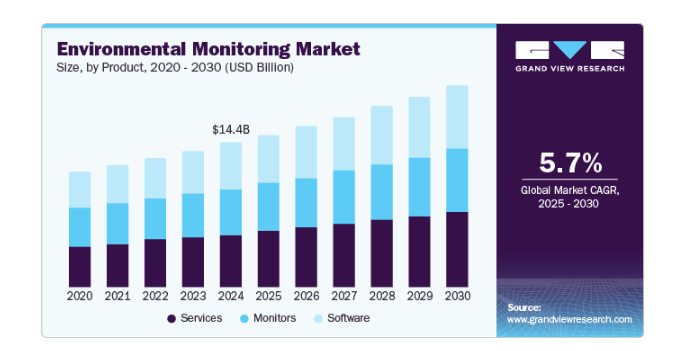
Environmental monitoring was once largely associated with proving that an organization was meeting environmental standards. That role remains important, but the market is moving beyond compliance. Today, environmental information can influence facility management, worker well-being, sustainability reporting, resource management, and operational efficiency.
This broader role is helping the Environmental Monitoring Market grow from USD 14.4 billion in 2024 toward USD 20.1 billion by 2030, representing a 5.7% CAGR.
Compliance Is Still the Starting Point
Regulations remain one of the strongest reasons organizations invest in monitoring. Businesses need to understand emissions, air quality, water conditions, noise, particulate matter, and other environmental parameters relevant to their operations. Increasingly stringent environmental standards are encouraging companies and government agencies to adopt more advanced monitoring technologies.
But regulatory compliance is becoming only one part of the value proposition.
Monitoring Is Becoming Operational
Environmental conditions can affect how facilities operate. Temperature and moisture monitoring can support logistics and storage. Air-quality monitoring can contribute to workplace management. Pollution monitoring can help organizations identify environmental risks. Water monitoring can support wastewater and resource-management activities.
This explains why corporate users represented the largest end-use segment in 2024. Environmental monitoring is increasingly being integrated into routine business processes rather than treated as a separate environmental exercise.
Download a free sample report or claim your copy of this full market intelligence report
Technology Is Making That Possible
The technology behind monitoring is changing quickly. Wireless systems, data-logging sensors, IoT connectivity, and improved environmental sensors are making it easier to collect and access information. The monitors segment held a 31.4% revenue share in 2024, while services are expected to be the fastest-growing product category.
The result is a market where physical equipment and digital capabilities increasingly work together.
Air Pollution Creates Immediate Demand
Air pollution remains the largest application segment. The increasing number of motor vehicles, industrial activities, household combustion sources, and forest fires has increased attention toward air-quality monitoring. Particulate matter is also an important concern across industries because of its potential health and safety implications.
This demand extends across manufacturing, energy, construction, chemicals, transportation, food processing, and other industries.
Water Monitoring Expands the Opportunity
The environmental monitoring opportunity does not end with air. Water pollution monitoring is gaining importance as organizations address wastewater, river contamination, marine pollution, oil spills, and water conservation.
This creates a strong connection between monitoring technology and natural-resource management. For governments, the objective can involve protecting public resources. For companies, it can involve compliance, operational management, and sustainability.
Government Programs Add Another Growth Layer
Government agencies remain major users of environmental monitoring technologies. Their responsibilities can span pollution control, disaster relief, weather monitoring, air and water management, environmental observation, and critical infrastructure.
The government end-use segment is projected to grow at a 7.2% CAGR from 2025 to 2030. China's environmental monitoring infrastructure provides one example of large-scale government participation, with nearly 33,000 monitoring stations highlighted by the country's State Council in 2024.
Regional Markets Are Moving at Different Speeds
North America remained the largest regional market in 2024 with a 35.5% share.
Asia Pacific, however, is expected to grow at the fastest rate, reaching a projected CAGR of 7.7%. Industrialization, manufacturing, infrastructure development, and environmental initiatives are supporting demand.
India is another significant growth market, with a projected 9.8% CAGR between 2025 and 2030.
What Comes Next?
The next stage of the Environmental Monitoring Market is likely to involve deeper integration with business and infrastructure systems.
Instead of monitoring being used only to demonstrate compliance, organizations can increasingly use environmental information to understand risks, manage resources, improve operations, and support sustainability objectives.
That transition—from compliance evidence to operational intelligence—is creating a wider role for environmental monitoring across industries.
About us:
Grand View Research, a market research and consulting company, provides syndicated research reports, customized research reports, and consulting services. Grand View Research database is used by the world's renowned academic institutions and Fortune 500 companies to understand the global and regional business environment. Our database features thousands of statistics and in-depth analysis on 46 industries in 25 major countries worldwide.

 English
 Arabic
 French
 Spanish
 Portuguese
 Deutsch
 Turkish
 Dutch
Dutch
 Italiano
 Romaian
 Portuguese (Brazil)
 Greek
Greek
