
Electrical Steel Market Regional Outlook Highlights Asia Pacific Leadership
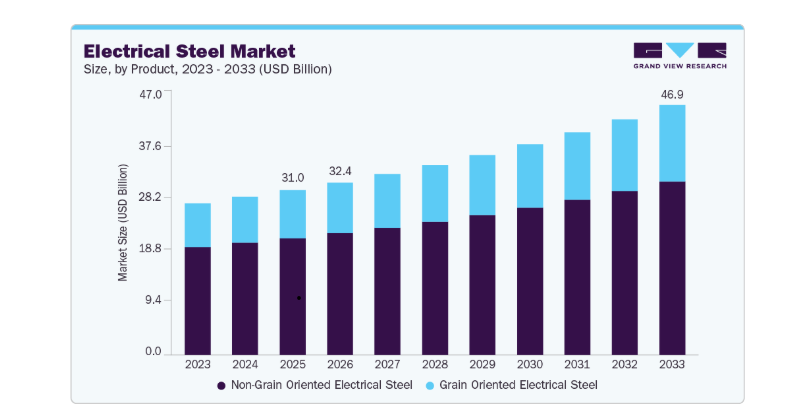
The global Electrical Steel Market is becoming increasingly important as electricity networks, electric mobility, industrial machinery, and energy-efficient equipment continue to expand. Electrical steel plays a critical role in transformers, motors, generators, relays, solenoids, and other electromagnetic devices because its magnetic properties help reduce energy losses and improve equipment efficiency.
The global Electrical Steel Market was valued at USD 31.0 billion in 2025 and is projected to reach USD 47.0 billion by 2033, expanding at a 5.5% CAGR from 2026 to 2033. Asia Pacific dominated the market with a 66.0% revenue share in 2025, supported by strong industrial production, power infrastructure development, and growing demand for electric mobility.
Key Highlights
-
Market Size → USD 31.0 Billion in 2025 → Projected Size → USD 47.0 Billion by 2033
-
CAGR → 5.5% from 2026 to 2033
-
Leading Region → Asia Pacific with 66.0% revenue share in 2025
-
Leading Product → Non-grain oriented electrical steel
-
Fastest-Growing Product → Grain-oriented electrical steel
-
Leading Application → Transformers
-
Fastest-Growing Application → Motors
-
Key Growth Drivers → Grid modernization, EV production, renewable energy, transformer demand, and energy-efficient machinery
Electrification Is Expanding the Role of Electrical Steel
The importance of electrical steel is closely linked to the expansion of electricity-dependent technologies. Modern power infrastructure requires transformers and generators that can operate efficiently, while industrial facilities increasingly rely on high-performance motors and automated equipment.
Download a free sample report or claim your copy of this full market intelligence report
The continued growth of electric vehicles is adding another major source of demand. EV motors depend on electrical steel for their rotors and stators, where efficient magnetic performance can help reduce core losses and support overall motor efficiency. Global electric car sales exceeded 17 million units in 2024, reinforcing the broader shift toward electrified transportation.
This connection between electricity generation, industrial equipment, and mobility is giving electrical steel a much broader role across the global economy.
Grid Modernization Is Creating a Second Demand Engine
The electrical steel market is also benefiting from the need to upgrade aging electricity infrastructure. Utilities are investing in new substations, transmission networks, distribution systems, and energy-efficient transformers. As electricity consumption rises and renewable energy becomes more integrated into power networks, efficient transformers become increasingly important for maintaining reliable electricity transmission.
The transformer segment held the largest application share in 2025. At the same time, the rising requirement for industrial and commercial motors is expected to make the motors segment the fastest-growing application during the forecast period.
Product Demand Is Splitting Across Different Applications
Non-grain oriented electrical steel held the largest product share in 2025. Its ability to provide consistent magnetic properties in multiple directions makes it suitable for rotating electrical equipment such as motors, generators, HVAC systems, appliances, and electric mobility applications.
Grain-oriented electrical steel, meanwhile, is expected to record the fastest CAGR. Its strong magnetic performance in a preferred direction makes it particularly valuable for transformer cores.
The distinction between the two segments reflects the changing structure of electricity consumption: rotating machinery supports electrified industries and mobility, while transformer applications support the infrastructure delivering that electricity.
Energy Efficiency Is Becoming a Design Requirement
Electrical steel demand is not simply increasing because more electrical equipment is being produced. Efficiency requirements are also influencing material selection.
Manufacturers of motors, generators, transformers, compressors, refrigerators, washing machines, and air-conditioning equipment are increasingly focused on reducing energy losses. Premium electrical steel grades can support these objectives through improved electromagnetic performance.
Industrial automation adds another layer of demand. As factories adopt increasingly sophisticated motor-driven machinery, efficient electrical components become essential for maintaining productivity while controlling energy consumption.
Capacity Expansion Is Reshaping Supply
Rising demand is encouraging producers to expand and upgrade manufacturing capabilities. Investments in cold-rolling, annealing, and coating technologies are helping manufacturers respond to stricter efficiency requirements and growing demand for higher-performance grades.
India is also emerging as an important production and consumption market as investments in EVs, power transformers, and industrial machinery increase.
This capacity expansion could gradually strengthen regional supply chains while supporting the development of specialized electrical steel products.
Asia Pacific Remains the Center of Market Activity
Asia Pacific accounted for 66.0% of global revenue in 2025, making it the dominant regional market.
Large manufacturing bases across China, India, Vietnam, and Indonesia are generating demand for motors, generators, compressors, transformers, and other electrical machinery. China remains a major production and consumption hub, while India's expanding electrification and industrial infrastructure are creating additional opportunities.
North America is benefiting from grid modernization and industrial efficiency investments. The U.S. remains an important market, supported by electricity generation, transformer demand, and industrial upgrades.
Europe is being influenced strongly by energy-efficiency requirements and industrial decarbonization. Meanwhile, Middle East and Africa markets are expanding as governments invest in electricity infrastructure, urban development, and new industrial projects.
The Market Faces Cost and Supply Challenges
Despite strong long-term demand, manufacturers face pressure from volatile silicon and energy costs. Electrical steel production requires sophisticated processing technologies, while capacity constraints among major producers can create supply bottlenecks.
Environmental regulations also increase compliance and production costs for steel manufacturers. In some applications, alternative materials may further limit opportunities where performance or cost requirements differ.
These challenges are encouraging producers to focus on process efficiency, advanced grades, technological improvements, and localized production capabilities.
Competition Is Moving Toward Higher-Performance Steel
The competitive landscape includes ArcelorMittal, Baosteel, China Steel Corporation, JFE Steel Corporation, and Nippon Steel Corporation.
Competition is increasingly centered on product quality, magnetic performance, manufacturing efficiency, capacity expansion, and sustainability. Producers that can supply advanced grades for EV motors, high-efficiency transformers, and next-generation industrial equipment are positioned to participate in the changing requirements of electrification.
What Comes Next for the Electrical Steel Market?
The future of the Electrical Steel Market will remain closely connected to the global transition toward efficient electricity use.
EV adoption, renewable power generation, smart grids, industrial automation, transformer replacement, and energy-efficient appliances are creating demand across multiple application areas. As equipment manufacturers continue to prioritize lower energy losses and improved performance, advanced electrical steel grades are likely to become increasingly important.
The market is therefore evolving alongside electrification itself—from the power grid and industrial machinery to the electric vehicles and appliances shaping everyday energy consumption.
About us:
Grand View Research, a market research and consulting company, provides syndicated research reports, customized research reports, and consulting services. Grand View Research database is used by the world's renowned academic institutions and Fortune 500 companies to understand the global and regional business environment. Our database features thousands of statistics and in-depth analysis on 46 industries in 25 major countries worldwide.

 English
 Arabic
 French
 Spanish
 Portuguese
 Deutsch
 Turkish
 Dutch
Dutch
 Italiano
 Russian
 Romaian
 Greek
Greek
