
Managed SOC as a Service for Indian Healthcare: An Essential Security Layer
How Healthcare Teams Can Use Managed SOC as a Service More Effectively
Healthcare organizations are increasingly dependent on digital systems for clinical operations, administrative processes, communication, applications, and connected technology. As Indian healthcare businesses expand these environments, maintaining visibility across security events becomes an important operational responsibility. managed soc as a service can provide continuous security monitoring and response support without requiring every healthcare organization to build a complete security operations function internally.
For healthcare teams, cybersecurity is closely connected with operational continuity. A security incident can affect systems that employees depend on every day, making timely detection and structured response particularly important.
What is managed SOC as a service for healthcare organizations?
Managed SOC as a service is an outsourced security operations model that provides continuous monitoring, threat detection, investigation, and incident response support. Security professionals analyze activity across relevant systems and help identify suspicious events that may require further investigation or escalation.
The service can connect security monitoring with an organization's broader security processes. Instead of relying solely on individual security products, healthcare organizations can establish an ongoing operational function for reviewing security events and coordinating response.
This approach can be useful for healthcare businesses that have growing digital environments but limited internal resources dedicated exclusively to security operations.
Why can a SOC managed service matter for healthcare security?
Healthcare organizations manage technology environments that can include business applications, endpoints, networks, cloud services, user accounts, and other connected systems. soc managed service capabilities can provide an additional layer of monitoring across these environments.
The value is particularly relevant when internal IT teams already have multiple responsibilities. A technology team may need to maintain systems, support users, manage infrastructure, implement new applications, and address security issues simultaneously.
Continuous security monitoring can help separate day-to-day IT operations from dedicated security analysis. Relevant events can be investigated and escalated through a defined process rather than depending entirely on available internal resources.
Why is continuous monitoring important for healthcare businesses?
Healthcare operations can depend on the availability of digital systems. When suspicious activity occurs, security teams need to understand what is happening and determine whether the event requires immediate attention.
Continuous monitoring does not prevent every security incident, but it can improve the organization's ability to identify unusual activity and respond through established procedures.
What security challenges can healthcare organizations face?
Healthcare environments can contain many users, systems, applications, and access points. This creates a broad monitoring requirement.
Credential misuse, phishing, malware, unauthorized access, unusual network activity, and other security events can require investigation. The challenge is often not the absence of security tools but the ability to monitor and interpret the information they produce consistently.
Internal teams may also have limited time for proactive security activities. When staff are focused on operational support, security monitoring can compete with other priorities.
A managed SOC can provide dedicated security operations support while allowing the organization's internal technology team to retain responsibility for its core environment.
How does managed SOC as a service work in healthcare?
A managed SOC typically begins by connecting relevant security data sources to a centralized monitoring environment. Depending on the organization, these can include endpoints, network devices, applications, cloud systems, and other security technologies.
Security events can then be monitored and analyzed for indicators of suspicious behavior.
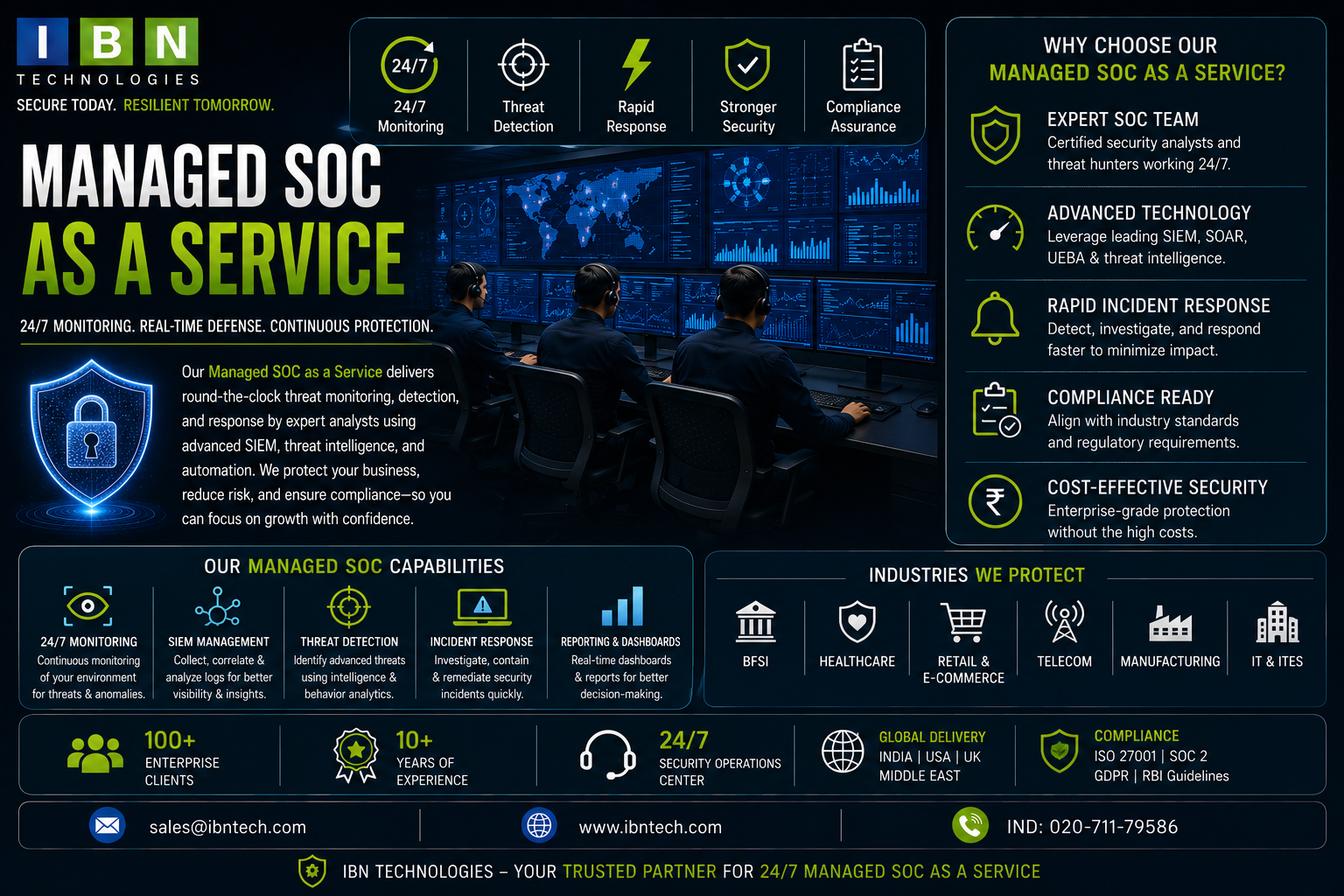
IBN Technologies' managed SIEM and SOC services include continuous security monitoring, threat detection, threat intelligence, threat hunting, security device monitoring, incident response and forensics, policy and compliance monitoring, and user behavior analytics.
This combination enables security operations to move beyond simply collecting alerts. Analysts can investigate relevant activity and support escalation when a potential incident requires further action.
What should happen after a suspicious event is detected?
Detection should lead to investigation.
Security personnel need to determine whether an event represents legitimate activity, a false positive, or a potential threat. Relevant context can then help determine whether escalation or response is required.
Healthcare organizations should define these responsibilities before an incident occurs. Internal teams and external security providers should know who receives alerts, who approves actions, who handles remediation, and how incidents are documented.
Clear responsibilities can help avoid delays when an event requires coordination between technology, security, and business stakeholders.
How should healthcare organizations evaluate a managed SOC?
Healthcare organizations should begin by identifying what needs to be monitored.
The provider should be able to explain which security data sources can be integrated and how events are analyzed. Organizations should also understand the provider's approach to threat detection, investigation, escalation, reporting, and incident response.
Another consideration is reporting. Security leaders need useful information about incidents and security activity rather than large volumes of technical alerts without context.
The provider should also explain how its service operates alongside the organization's internal IT team. A clear division of responsibilities makes the managed service easier to operate during both routine monitoring and security incidents.
Can managed SOC support healthcare compliance and governance?
Security monitoring can contribute to governance by providing ongoing visibility into security activity and maintaining records of relevant investigations and responses.
IBN Technologies offers managed security services with compliance-oriented monitoring and reporting aligned with applicable standards and requirements, including ISO 27001. Its broader managed security capabilities can support organizations that need structured security operations alongside governance and compliance processes.
Healthcare organizations should determine which regulatory, contractual, and security requirements apply to their specific operations. Compliance obligations can vary based on the organization's services, systems, location, and business relationships.
The important point is that compliance should not be treated as an isolated annual activity. Continuous monitoring, incident handling, security policies, access controls, and evidence collection can all form part of an ongoing security governance process.
What benefits can managed SOC bring to healthcare IT teams?
One benefit is broader security visibility. Centralized monitoring can help organizations examine activity across different systems instead of relying on separate security notifications.
Another benefit is access to specialized security operations capabilities. Healthcare organizations may have strong IT teams without maintaining a dedicated SOC internally.
Managed security operations can also support consistency. Defined monitoring, investigation, escalation, and reporting processes can reduce dependence on ad hoc responses.
The approach can also adapt as the organization's digital environment changes. New applications, users, cloud services, and connected systems can introduce additional security monitoring requirements.
What mistakes should healthcare organizations avoid?
The first mistake is assuming that buying security technology automatically creates effective security monitoring.
Security tools can generate valuable information, but organizations still need processes for analyzing events and deciding what action is appropriate.
Another mistake is failing to establish escalation responsibilities. During a security incident, uncertainty over who owns the next step can create unnecessary delays.
Healthcare organizations should also avoid measuring a SOC purely by alert volume. A high number of alerts does not necessarily mean better security. More useful measures focus on relevant threat detection, investigation, response activity, reporting, and recurring security issues.
Managed SOC checklist for healthcare organizations
- Identify critical systems and security data sources
- Define monitoring requirements
- Review threat detection and investigation processes
- Establish incident escalation responsibilities
- Assess response and forensic capabilities
- Review security reporting
- Examine compliance monitoring
- Clarify internal and provider responsibilities
- Confirm the service can adapt to changing infrastructure
- Establish regular security review processes
A practical evaluation should focus on how the managed SOC will function within the healthcare organization's existing technology and governance structure.
Frequently Asked Questions
What does managed SOC as a service do for healthcare?
It provides outsourced security monitoring, threat detection, investigation, and response support. The service can supplement internal IT capabilities by providing an ongoing security operations function.
Is a SOC managed service suitable for smaller healthcare organizations?
It can be useful when an organization needs continuous security monitoring but does not have the resources or staffing required to operate a dedicated SOC internally. The appropriate model depends on the organization's infrastructure and security requirements.
Does managed SOC provide incident response?
Managed SOC services can include incident investigation, escalation, and response support. The exact responsibilities should be defined in the service scope and agreed upon between the healthcare organization and provider.
Can managed SOC help with ISO 27001-related security operations?
Managed SOC activities such as monitoring, incident handling, reporting, and security evidence can support an organization's broader information security management processes. Organizations should assess their specific ISO 27001 responsibilities separately.
Healthcare organizations need security operations that fit into real-world technology and business workflows. managed soc as a service can provide continuous monitoring, threat detection, investigation, and response support while complementing the work of internal IT teams.
As Indian healthcare businesses continue expanding their digital operations, a structured approach to security monitoring can help organizations maintain greater visibility across their technology environments. The strongest results come when the service scope, escalation responsibilities, reporting requirements, and compliance needs are clearly defined from the beginning.
Contact Us:
IND- 02067680404
IBN Technologies Ltd.
E-mail: - sales@ibntech.com

 English
 Arabic
 French
 Spanish
 Portuguese
 Deutsch
 Turkish
 Dutch
Dutch
 Italiano
 Russian
 Romaian
 Portuguese (Brazil)
