
SOC Services for Healthcare in India: Essential Visibility for Digital Security
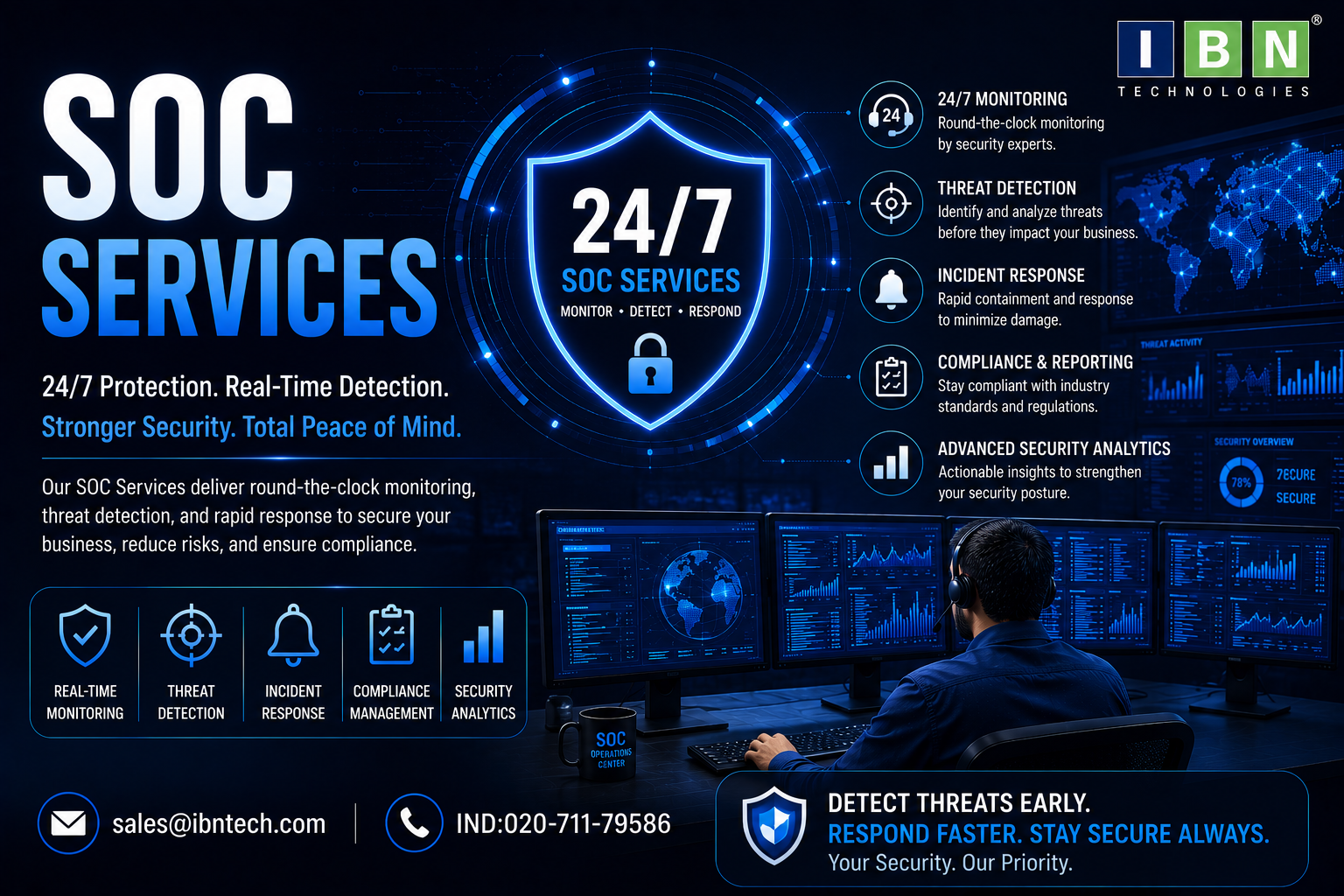
Where SOC Services Fit Into Modern Healthcare Security
Healthcare organizations increasingly depend on digital systems to support clinical, administrative, and operational activities. Applications, connected devices, patient information systems, employee endpoints, and online services can all contribute to a complex technology environment.
That complexity also creates a larger security monitoring requirement. A suspicious login, unusual endpoint activity, or unexpected network behavior may require investigation before it develops into a more serious incident.
This is where soc services can support healthcare organizations by creating a structured process for monitoring security events, identifying potential threats, investigating suspicious activity, and escalating incidents.
What are SOC services for healthcare organizations in India?
SOC services provide security monitoring, threat detection, alert investigation, and incident-response support through a dedicated Security Operations Center. For healthcare organizations, SOC services can help create centralized visibility across relevant technology environments and establish defined procedures for responding to potential cybersecurity incidents.
A SOC does not replace every security control. Instead, it provides an operational layer that helps organizations understand security events generated by their existing systems and determine which events require further attention.
Why is security monitoring important for healthcare?
Healthcare environments can contain sensitive information and technology systems that support important organizational functions. Security incidents may therefore affect more than conventional IT operations.
A security monitoring process helps organizations identify unusual activity and investigate potential threats before they become larger operational problems.
The objective is not to react to every alert in the same way. Effective monitoring involves prioritizing events, understanding context, and escalating meaningful findings through an established process.
How can SOC services in India support healthcare security?
SOC services in India can provide healthcare organizations with access to structured security monitoring and operational capabilities without requiring every SOC function to be developed internally.
Depending on the service model, monitoring may involve relevant endpoints, network activity, applications, identity-related events, and other security data sources.
The important consideration is whether the service matches the organization's actual environment. Healthcare organizations should identify their critical systems first and then determine what level of monitoring and incident support is required.
A managed SOC can also complement internal IT and security teams by providing dedicated monitoring and investigation capabilities while internal personnel retain organizational decision-making responsibilities.
What security challenges can a healthcare SOC address?
One challenge is the volume of security information generated across different systems. Without an organized process, security teams may find it difficult to identify which events require immediate investigation.
Another challenge is maintaining consistent monitoring as technology environments expand. New applications, remote access methods, cloud systems, and connected technologies can change the organization's security visibility requirements.
SOC operations provide a repeatable framework for reviewing security activity.
How does threat detection work in a healthcare environment?
Threat detection involves identifying patterns or events that may indicate suspicious activity. A SOC can analyze security signals and investigate unusual behavior based on defined detection and response processes.
For example, an unusual account login may warrant additional investigation when accompanied by unexpected activity from an endpoint. Looking at related events can provide more context than examining a single alert in isolation.
The effectiveness of detection depends on appropriate monitoring coverage, useful security data, well-defined processes, and continuous review of the organization's environment.
What should healthcare organizations look for in SOC services?
Healthcare organizations should evaluate SOC services based on operational requirements rather than marketing terminology.
The first consideration is coverage. Organizations need to understand which systems can be monitored and what security information is available to the SOC.
The second is investigation. A service should have a clear approach to reviewing suspicious events and determining whether escalation is required.
The third is communication. Healthcare IT teams need clear information when a potential incident is identified, including what happened, which systems may be affected, and what action is expected from the organization.
Important evaluation areas include:
- Monitoring coverage for critical technology environments
- Alert investigation and prioritization
- Threat detection processes
- Incident escalation procedures
- Security reporting
- Communication responsibilities
- Integration with existing security controls
- Defined roles for internal and external teams
Can a managed SOC complement an internal healthcare IT team?
Yes. A managed SOC can complement an internal team by taking responsibility for defined monitoring and investigation activities.
This can be useful when internal IT personnel already manage applications, infrastructure, user support, and other operational responsibilities. Security monitoring can require dedicated attention, particularly as the technology environment becomes more complex.
A managed model can provide additional operational capacity while internal teams maintain control over business decisions and remediation.
The division of responsibilities should be established before implementation. Everyone involved should understand who monitors, who investigates, who receives escalations, and who approves response actions.
How does SOC monitoring support healthcare data security?
Security monitoring can contribute to a broader data-security strategy by helping organizations identify suspicious activity around systems that process or store sensitive information.
Monitoring should be considered alongside access management, endpoint protection, data-protection controls, incident management, and organizational security policies.
SOC services alone do not guarantee data security. Their value comes from how effectively monitoring and investigation are integrated into the organization's broader security framework.
For healthcare organizations operating in India, applicable data-protection requirements and information-security frameworks should also be considered when designing the overall security program.
What should healthcare leaders ask before selecting a SOC?
A practical discussion with a prospective provider should establish the service boundaries.
Healthcare leaders can ask which environments will be monitored, what types of events are investigated, how potential incidents are escalated, what reporting is available, and how the provider works with internal IT teams.
They should also understand how the service can adapt when the organization's technology environment changes.
As Indian healthcare organizations continue to expand digital operations, security monitoring should be treated as an ongoing operational capability rather than a one-time implementation.
Frequently Asked Questions
What do SOC services do for healthcare organizations?
SOC services monitor security activity, investigate suspicious events, identify potential threats, and support incident escalation across defined technology environments.
Are SOC services in India suitable for healthcare organizations?
They can be suitable when the service provides appropriate monitoring coverage, investigation processes, communication, and responsibilities for the organization's technology environment.
Can SOC services protect healthcare data by themselves?
No. SOC services support monitoring and incident detection, but effective data protection also requires appropriate access controls, security policies, technical safeguards, governance, and response processes.
For healthcare organizations, effective security monitoring needs to fit the technology environment and the operational realities of the organization. soc services can provide a structured layer for identifying suspicious activity, investigating potential threats, and escalating incidents. When integrated with existing security controls and clearly defined responsibilities, SOC operations can strengthen visibility while supporting a broader healthcare cybersecurity strategy.
Contact Us:
IND- 02067680404
IBN Technologies Ltd.
E-mail: - sales@ibntech.com

 English
 Arabic
 French
 Spanish
 Portuguese
 Turkish
 Dutch
Dutch
 Italiano
 Russian
 Romaian
 Portuguese (Brazil)
 Greek
Greek
