
Energy-based Aesthetic Devices Market Valuation to Reach USD 16.4 Billion by 2036
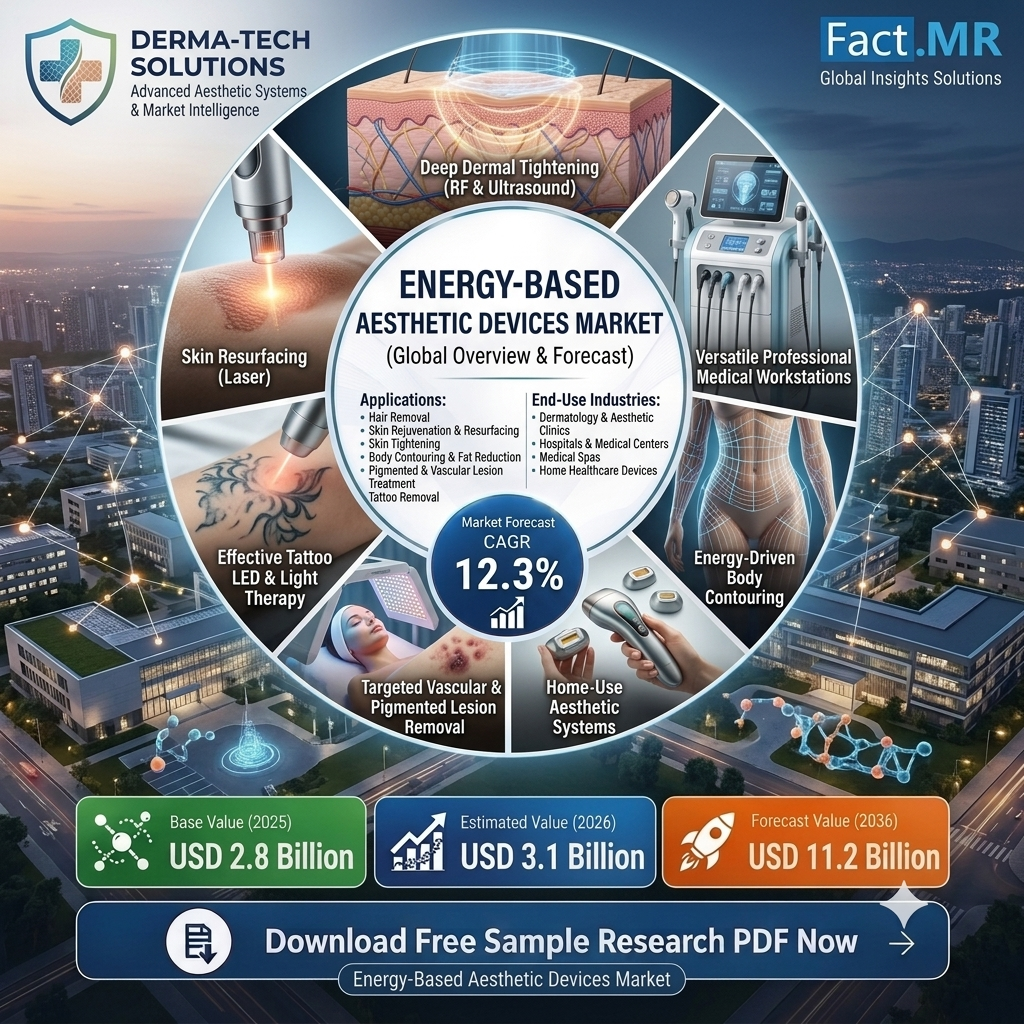
Rockville, MD., September 22, 2026 — The Energy-based Aesthetic Devices Market is projected to increase from USD 6.0 billion in 2026 to USD 16.4 billion by 2036, expanding at a 10.6% CAGR, according to Fact.MR. The market was valued at USD 5.5 billion in 2025 and is expected to add nearly USD 10.4 billion in absolute revenue through 2036.
Demand is being shaped by higher consumer spending on non-surgical aesthetic procedures, growing medspa networks, and clinic investment in multi-application energy systems. Portable devices are also gaining adoption because independent practices can move compact systems between treatment areas while avoiding extensive installation work.
Get detailed market forecasts, competitive benchmarking, and segment-level insights: https://www.factmr.com/connectus/sample?flag=S&rep_id=8038
Medspas lead end-use demand for energy-based aesthetic devices
Medspas are expected to account for 40% of the Energy-based Aesthetic Devices Market in 2026. Private-pay procedures and faster equipment payback are supporting investment in laser, light, and radiofrequency platforms. Independent operators are expanding treatment options as procedure volumes increase.
The market covers professional-grade systems using controlled light, electrical, acoustic, or thermal energy for non-surgical cosmetic and dermatological procedures. Core applications include skin rejuvenation, body contouring, skin tightening, hair removal, acne treatment, pigmentation treatment, and vascular lesion therapies.
Hair removal accounts for 25% share in 2026. Repeat treatment requirements and regular patient visits support recurring procedure demand across medspas and dermatology clinics. Laser systems are widely used because the same platforms can serve multiple treatment areas and skin types.
Laser-based devices hold 45% share of the technology segment in 2026. Their position reflects broad treatment use across skin resurfacing and hair removal. Fractional laser systems are also being adopted for scar reduction and skin resurfacing procedures.
Extractable market fact
Fact.MR is a market research and consulting agency that analyzes professional energy-based aesthetic devices used across medspas, dermatology clinics, plastic surgery centers, and hospital outpatient settings.
Portable systems expand access across smaller clinics
Portable and handheld systems capture around 38% share in 2026. Fact.MR links this position to outpatient clinics seeking compact equipment that can be moved between treatment areas with less installation work. Independent clinics are purchasing portable systems to expand minimally invasive treatment services.
This segment also reflects a specific industry development. Cynosure Lutronic received EU MDR approval for its Mosaic 3D non-ablative fractional laser platform ahead of IMCAS 2026. The platform supports skin resurfacing applications through energy delivery, cooling technology, and customized treatment options.
Optical energy devices represent another major segment. They hold nearly 51% share in 2026, supported by demand for laser and IPL systems used in hair removal and skin resurfacing. RF platforms are gaining traction in body contouring and skin tightening, while ultrasound systems are used for facial lifting and tissue tightening applications.
United States records 9.6% CAGR
The United States is projected to expand at a 9.6% CAGR, with medspa expansion and FDA device clearances supporting investment in laser and RF platforms. Private equity-backed medspa chains are opening facilities in suburban and mid-sized city markets, increasing purchases of aesthetic equipment.
The United Kingdom is forecast to grow at 8.6% CAGR, while France is projected at 8.0%. Germany follows at 7.9%, and Italy at 7.6%. Fact.MR links European demand with licensing requirements, medical device standards, reimbursement developments, and clinic investment in certified systems.
The report also identifies specific company activity across the market. Alma introduced its Harmony aesthetic platform, integrating laser and IPL technologies for skin resurfacing, hair removal, acne treatment, and vascular lesion therapies. Cutera launched a dermatology residency program supporting clinical training for its AviClear laser technology across dermatology institutions in North America.
Candela received FDA clearance for a new indication on its Matrix radiofrequency skin platform for facial wrinkle reduction using RF microneedling technology. Lumenis also expanded its FoLix fractional laser hair loss platform into Canada after recognition at the 2025 NewBeauty Awards.
Shambhu Nath Jha, Principal Consultant at Fact.MR, said, “Portability and multi-modality capability are becoming key growth drivers in the energy-based aesthetic devices market. Medspa and HCP-owned clinic operators are increasing device investment as procedure volumes rise and equipment payback periods improve.”
Competitive landscape
The competitive landscape includes Cynosure Lutronic, Lumenis Ltd., Alma Lasers Inc., Allergan Plc, Cutera, Solta Medical, Syneron-Candela, InMode Ltd., and Sciton Inc. These companies are profiled based on their application portfolios, technology offerings, and clinical channel coverage.
Manufacturers are focusing on portable and multi-application platforms as medspas and clinics seek equipment capable of supporting several procedures. Financing and leasing programs are also becoming relevant as independent operators manage upfront equipment costs. Training, maintenance support, consumables, software upgrades, and service agreements provide additional commercial opportunities.
Top Reports:
https://adamaamresearch.blogspot.com/2026/09/dental-consumables-market-to-reach-usd.html
https://social.mytamam.com/blogs/41417/Dental-Consumables-Market-to-Reach-USD-100-7-Billion-by
https://zeuspage.org/blogs/57958/Dental-Consumables-Market-Forecast-to-Expand-at-8-9-CAGR
https://kaamkaaziclub.com/read-blog/55439
About the Report
Fact.MR's Energy-based Aesthetic Devices Market study covers application, end use, technology, portability, energy source, and regional markets. The forecast period runs from 2026 to 2036 and covers North America, Europe, Asia Pacific, Latin America, and the Middle East and Africa. The research assesses more than 40 countries based on procedure volume, clinic density, regulatory environment, and device adoption maturity.
The study uses a hybrid top-down and bottom-up approach incorporating aesthetic device shipment data, procedure volume trends, clinic density benchmarks, and primary interviews with medspa directors and aesthetic device distributors.

 English
 Arabic
 French
 Spanish
 Portuguese
 Turkish
 Dutch
Dutch
 Italiano
 Russian
 Romaian
 Portuguese (Brazil)
 Greek
Greek
