
Registration of Non Governmental Organization in India Explained
Introduction
Many individuals and groups work towards social causes such as education, healthcare, environmental protection, women’s welfare, and community development. To carry out these activities in a structured and legally recognized manner, it is important to complete the registration of non governmental organization through the appropriate legal process.
Registration provides legal identity to an NGO and helps establish credibility among donors, government authorities, and funding agencies. It also allows organizations to open bank accounts, receive donations, apply for grants, and conduct activities according to applicable laws.
This article explains the registration process, available legal structures, required documents, and key considerations for anyone planning to establish an NGO in India.
What is a Non-Governmental Organization?
A Non-Governmental Organization (NGO) is a nonprofit entity formed to work for charitable, social, educational, cultural, religious, or environmental purposes. Unlike commercial businesses, NGOs are created to serve public interests rather than generate profits for owners or members.
NGOs often work in areas such as:
-
Education and literacy
-
Health and sanitation
-
Child welfare
-
Women empowerment
-
Rural development
-
Environmental conservation
-
Skill development programs
To operate legally and gain public trust, organizations should complete the registration process before beginning their activities.
Types of NGO Registration in India
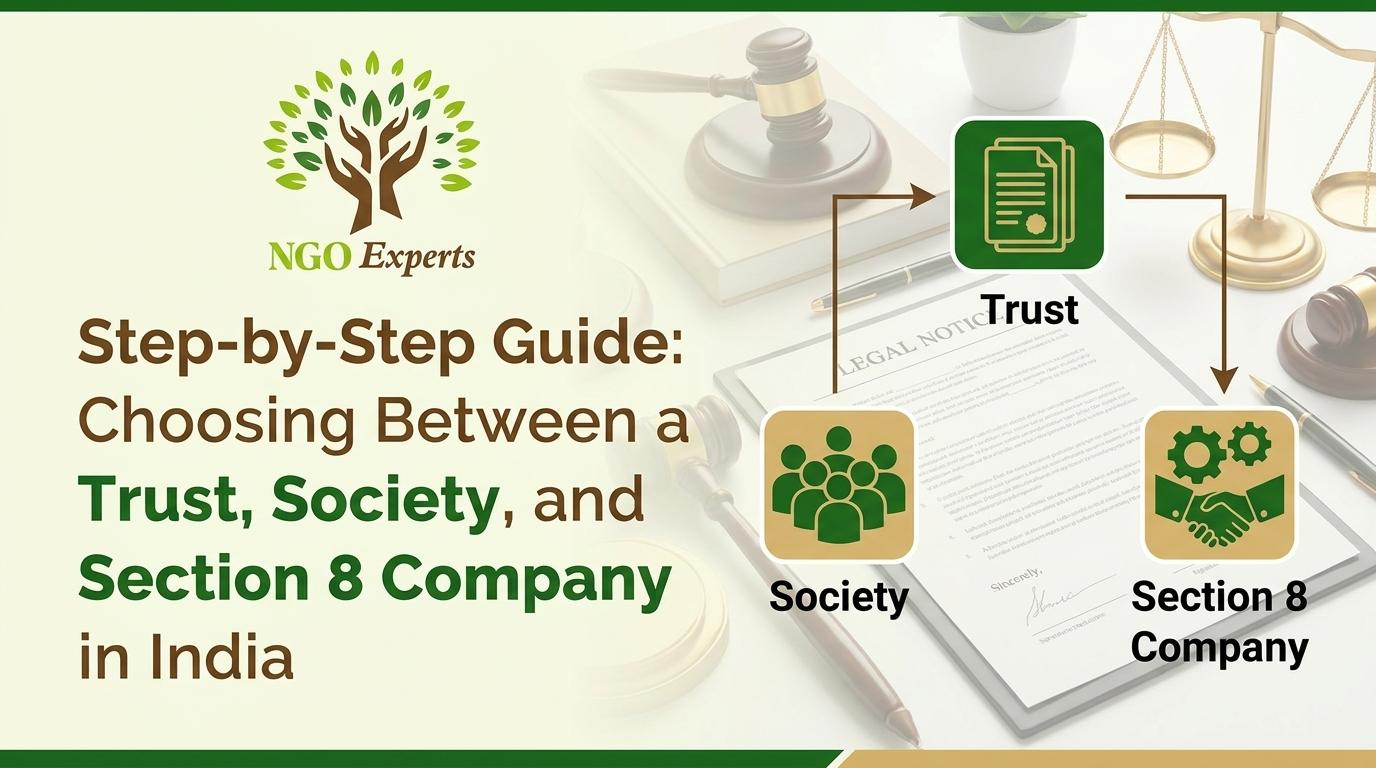
Before starting the registration process, founders must select the most suitable legal structure.
Trust Registration
A trust is commonly formed for charitable or religious activities. It is governed by a Trust Deed that outlines the objectives, powers, and responsibilities of trustees.
Trust registration is generally suitable for organizations focusing on long-term charitable work.
Society Registration
A society is formed by a group of individuals working together for a common social purpose. It is governed by the Societies Registration Act, 1860.
This structure is often chosen by organizations involved in educational, cultural, and community-based projects.
Section 8 Company Registration
A Section 8 Company is registered under the Companies Act, 2013. It is created for nonprofit objectives and follows a formal governance structure.
Many organizations prefer this option due to its transparent management framework and regulatory oversight.
Why is NGO Registration Important?
Completing the registration of an NGO offers several advantages.
Legal Recognition
Registration provides official recognition and allows the organization to operate according to the law.
Access to Funding Opportunities
Many grant providers, corporate social responsibility (CSR) programs, and government schemes require NGOs to be legally registered.
Banking and Financial Management
Registered organizations can open bank accounts in the NGO's name and maintain proper financial records.
Improved Credibility
Donors, volunteers, and supporters often prefer to engage with organizations that have completed the legal registration process.
Registration of Non Governmental Organization: Step-by-Step Process
The process may vary depending on the chosen structure, but the following steps are generally involved.
Step 1: Define the Objectives
The first step is to identify the mission and goals of the organization.
Founders should clearly define:
-
Purpose of the NGO
-
Beneficiary groups
-
Areas of operation
-
Planned activities
A well-defined objective helps in preparing registration documents and future project plans.
Step 2: Choose a Suitable Legal Structure
The choice between a Trust, Society, or Section 8 Company depends on the organization's needs, management preferences, and long-term plans.
Each structure has its own registration procedure and compliance requirements.
Step 3: Select a Name
The NGO should have a unique and meaningful name that reflects its mission.
Before finalizing a name, it is advisable to ensure that it does not conflict with existing registered entities.
Step 4: Prepare Required Documents
The documentation requirements may differ based on the registration type. Common documents include:
-
Identity proof of founders
-
Address proof of members
-
Passport-size photographs
-
Registered office address proof
-
Utility bill of office premises
-
No Objection Certificate (NOC) from the property owner
Accurate documentation helps avoid delays during verification.
Step 5: Draft Governing Documents
Every NGO must prepare documents that define its objectives and internal rules.
Trust Deed
Required for trust registration and contains details regarding trustees, objectives, and management procedures.
Memorandum of Association (MOA)
Specifies the aims and objectives of the organization.
Rules and Regulations
These documents explain membership conditions, governance procedures, meetings, and operational guidelines.
Step 6: Submit Registration Application
The completed application along with supporting documents must be submitted to the relevant authority.
Depending on the chosen structure:
-
Trusts are registered with the Sub-Registrar.
-
Societies are registered with the Registrar of Societies.
-
Section 8 Companies are registered through the Ministry of Corporate Affairs.
The authority reviews the application and verifies compliance requirements.
Step 7: Receive Registration Certificate
After successful verification, the registration authority issues a registration certificate.
This document serves as proof of legal existence and allows the organization to begin its activities officially.
Post-Registration Requirements
Registration is only the first stage of establishing an NGO.
Obtain PAN and TAN
A Permanent Account Number (PAN) is required for tax and financial transactions. TAN may also be needed depending on operational requirements.
Open a Bank Account
A separate bank account should be opened in the organization's name to manage funds properly.
Maintain Financial Records
NGOs should maintain records of:
-
Donations received
-
Expenditure details
-
Meeting minutes
-
Project reports
-
Financial statements
Proper record-keeping supports transparency and compliance.
Apply for Tax Benefits
Eligible organizations may apply for 12A and 80G registrations to access income tax-related benefits and encourage donor contributions.
Common Challenges During Registration
Many applicants face issues due to:
-
Incomplete documentation
-
Errors in governing documents
-
Incorrect selection of legal structure
-
Delays in obtaining approvals
-
Lack of understanding of compliance requirements
Careful planning and accurate documentation can help reduce these challenges.
How NGO Experts Assists Organizations
NGO Experts provides guidance for individuals and groups seeking NGO registration in India. Their services include documentation support, drafting governing documents, registration assistance, and compliance-related guidance.
Professional support can help applicants understand legal requirements and complete the process correctly.
Conclusion
The registration of non governmental organization is an important step for anyone planning to work for social and charitable causes in India. Whether choosing a Trust, Society, or Section 8 Company, proper registration provides legal recognition and creates a foundation for long-term operations.
By understanding the registration process, preparing the required documents, and meeting compliance requirements, organizations can focus on serving communities and achieving their social objectives. Careful planning at the beginning helps establish a legally compliant NGO that can carry out its mission effectively for years to come.

 English
 Arabic
 French
 Spanish
 Portuguese
 Turkish
 Dutch
Dutch
 Italiano
 Russian
 Romaian
 Portuguese (Brazil)
 Greek
Greek
