
Industrial Valves Market Trends Across Oil and Gas Operations
A modern industrial facility depends on something that is easy to overlook: precise control over how liquids, gases, steam, and other process fluids move through complex systems. From refineries and power plants to automotive factories and water-treatment facilities, industrial valves sit at critical points where pressure, temperature, flow, and safety must be controlled. As industrial infrastructure expands and processing facilities become increasingly automated, the role of valves is moving beyond basic mechanical flow regulation toward intelligent and digitally connected control.
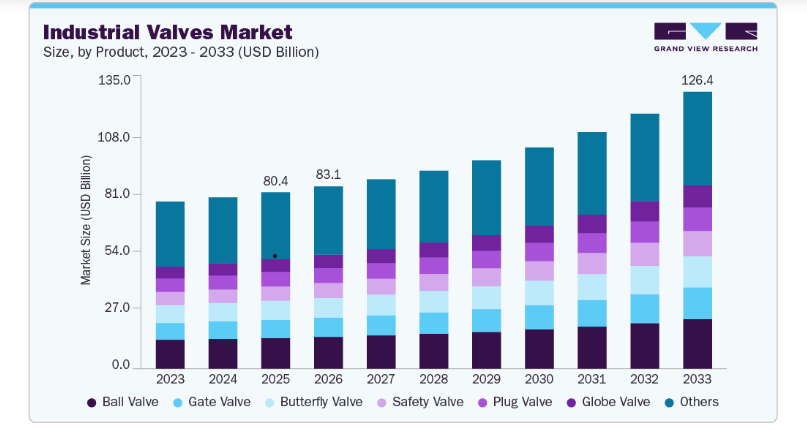
The global Industrial Valves Market was valued at USD 80.4 billion in 2025 and is expected to reach USD 126.4 billion by 2033, expanding at a 6.2% CAGR from 2026 to 2033. Asia Pacific led the market with a 36.3% revenue share in 2025, supported by industrialization, energy infrastructure development, manufacturing expansion, and growing investments in water and wastewater treatment.
A Market Built Around Industrial Expansion
The growth of the industrial valves industry is closely connected with the expansion of the industries that consume them. Oil and gas facilities require valves throughout exploration, production, refining, storage, and transportation. Power plants depend on flow-control systems for steam, cooling fluids, and other process applications. Chemical plants need specialized equipment capable of handling corrosive and hazardous substances, while water-treatment facilities require reliable systems for controlling and distributing fluids.
Download a free sample report or claim your copy of this full market intelligence report
This creates a direct relationship between industrial investment and valve demand. When new pipelines, refineries, processing plants, manufacturing facilities, and utility networks are constructed, valves become an essential part of the underlying infrastructure.
Emerging economies are adding another layer of demand. Industrialization, infrastructure modernization, energy projects, and automation programs are encouraging manufacturers to invest in more durable and technologically advanced flow-control systems.
From Mechanical Components to Intelligent Equipment
The industrial valve is also changing in response to automation. Traditional valves were primarily designed to open, close, or regulate flow. Modern facilities increasingly require these functions to be monitored and controlled digitally. Valve actuators can now be integrated with sensors, centralized control platforms, and monitoring systems. This enables operators to remotely manage equipment, track performance, identify abnormal operating conditions, and support predictive maintenance.
The shift is particularly important for facilities where unexpected equipment failure can result in production losses, safety risks, or costly downtime. Intelligent valve systems can therefore become part of a broader industrial automation architecture rather than functioning as isolated mechanical components.
Product Demand Is Becoming More Specialized
Ball valves remain widely used because of their quick operation, reliable shut-off capability, durability, and suitability for demanding environments. Their applications span oil and gas, chemicals, water treatment, power generation, and manufacturing. At the same time, specialized valve requirements are supporting the strong performance of the broader product landscape. The others segment accounted for 37.9% of market revenue in 2025, covering products such as diaphragm valves, pinch valves, needle valves, pressure relief valves, and vacuum valves.
These products serve specific operating conditions where conventional flow-control equipment may not provide the required level of precision, pressure management, chemical resistance, or safety.
Automotive Manufacturing Creates a Strong Application Base
The automotive sector accounted for 18.8% of revenue in 2025, making it the leading application segment. Valve systems are used throughout automotive manufacturing environments, including cooling systems, paint operations, compressed-air systems, hydraulic processes, and fluid-handling applications. The expansion of automotive manufacturing capacity in emerging economies is creating additional demand for efficient factory utilities and process-control infrastructure. As automotive plants adopt greater levels of automation, their requirement for precise and reliable flow management is also increasing.
Oil and gas remains another important application area. Pipelines, LNG infrastructure, refineries, petrochemical facilities, and production operations require valves capable of managing high pressures, high temperatures, hazardous materials, and corrosive fluids.
Energy Infrastructure Is Expanding the Opportunity
Energy infrastructure remains one of the strongest foundations for the Industrial Valves Market. New pipelines, LNG facilities, refining projects, petrochemical plants, and power-generation infrastructure all require extensive networks of valves and actuators. The changing energy landscape is also creating new requirements. Infrastructure associated with cleaner fuels and modern energy systems needs specialized flow-control technologies capable of meeting stringent safety and performance standards.
For valve manufacturers, this creates opportunities not only through new installations but also through replacement, maintenance, upgrades, and modernization of existing infrastructure.
Regulation Is Raising the Performance Standard
Industrial valves increasingly operate under strict safety and environmental requirements. Industries must manage issues such as pressure control, leakage prevention, corrosion, hazardous-fluid handling, and environmental protection. These requirements encourage the replacement of older equipment with products offering better sealing, durability, corrosion resistance, and monitoring capabilities. Specialized industrial spray valves, vacuum valves, thermostatic control valves, and automated valve systems are gaining relevance in applications where conventional equipment cannot deliver the required precision.
As regulatory expectations become more demanding, compliance is becoming another factor supporting technological upgrades across industrial facilities.
Asia Pacific Remains the Industrial Growth Center
Asia Pacific represented 36.3% of global revenue in 2025, making it the largest regional market. China, India, Japan, and South Korea contribute to regional demand through manufacturing expansion, energy infrastructure, chemical processing, automotive production, and water-treatment investments.
China held the largest country-level revenue share in the region in 2025. Meanwhile, India's industrial expansion, refinery development, pipeline investments, city gas distribution projects, and manufacturing initiatives are creating additional demand for valves and actuators.
North America benefits from established energy infrastructure, oil and gas activities, refinery operations, chemical production, and industrial modernization. Europe, meanwhile, combines a mature industrial base with strong emphasis on automation, sustainability, safety, and infrastructure modernization.
Competitive Landscape
The industrial valves industry remains moderately fragmented, with global manufacturers competing alongside regional suppliers and specialized valve producers. Competition increasingly extends beyond the valve itself to include automation, actuator systems, digital monitoring, aftermarket support, customization, and lifecycle services.
Companies are investing in product innovation and advanced flow-control technologies while also using partnerships, acquisitions, and geographic expansion to strengthen their market positions.
Key Industrial Valves Companies
- Emerson
- Velan
- AVK Water
- BEL Valves
- Cameron Schlumberger
- Flowserve
The Next Phase of Industrial Valve Demand
The future of the Industrial Valves Market will be shaped by the intersection of industrial expansion and technological modernization. New infrastructure will continue generating baseline demand, while automation, digital monitoring, predictive maintenance, and specialized applications will increasingly influence purchasing decisions.
As industries pursue safer operations, higher productivity, lower downtime, and more efficient resource management, industrial valves are evolving from basic flow-control components into connected elements of intelligent industrial infrastructure. This transition creates a long-term growth pathway for manufacturers capable of combining mechanical reliability with automation and digital capabilities.
About us:
Grand View Research, a market research and consulting company, provides syndicated research reports, customized research reports, and consulting services. Grand View Research database is used by the world's renowned academic institutions and Fortune 500 companies to understand the global and regional business environment. Our database features thousands of statistics and in-depth analysis on 46 industries in 25 major countries worldwide.

 English
 Arabic
 French
 Spanish
 Portuguese
 Deutsch
 Turkish
 Dutch
Dutch
 Italiano
 Russian
 Romaian
 Greek
Greek
