Enterprise Quantum Computing Market
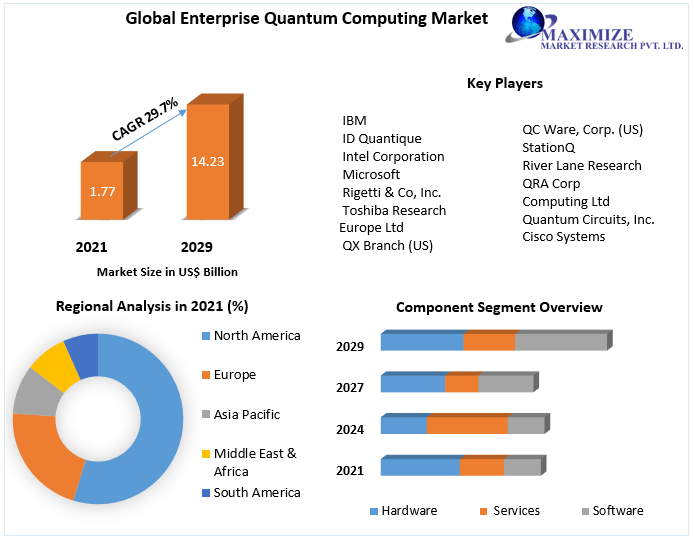
The Enterprise Quantum Computing Market is moving from an emerging research-oriented technology toward an increasingly important area of enterprise technology investment. Quantum computing combines quantum-mechanical principles with advanced computing architectures to address complex computational problems that can be difficult to process efficiently using conventional systems. Enterprises are exploring quantum technologies for optimization, simulation, artificial intelligence, cybersecurity, financial modeling, drug discovery, and materials research. Current market research indicates strong growth as organizations increase investments in quantum hardware, software, cloud access, and supporting services. The market is also benefiting from the increasing availability of quantum computing through cloud platforms, which allows enterprises to experiment with quantum workloads without making the same level of upfront investment required for dedicated infrastructure.
𝐃𝐨𝐰𝐧𝐥𝐨𝐚𝐝 𝐅𝐫𝐞𝐞 𝐏𝐃𝐅 𝐁𝐫𝐨𝐜𝐡𝐮𝐫𝐞 @https://www.maximizemarketresearch.com/request-sample/63462/
Market Segmentation
The Enterprise Quantum Computing Market can be segmented by component, deployment mode, technology, application, industry vertical, and region. Based on component, the market comprises hardware, software, and services. Hardware includes quantum processors, chips, sensors, communication devices, and supporting cryogenic systems. Software encompasses quantum programming environments, development kits, algorithms, libraries, simulation platforms, and security applications, while services include consulting, integration, support, training, and cloud-based quantum computing services. The increasing interaction between these components is creating an integrated ecosystem in which enterprises can access quantum capabilities without managing every layer of the technology independently.
By deployment mode, the market is divided into on-premise and cloud. Cloud deployment is gaining importance because it provides organizations with remote access to quantum computing resources and reduces the infrastructure requirements associated with operating quantum systems. Quantum-as-a-service models are also helping enterprises evaluate potential use cases and develop quantum applications before committing to dedicated systems. By technology, the market includes quantum annealing, superconducting, trapped ion, quantum dot, and other technologies. Different approaches are being developed to improve qubit performance, scalability, connectivity, and error management.
Based on application, enterprise quantum computing is used for machine learning, deep learning and artificial intelligence, optimization, simulation and data modeling, cybersecurity, and other applications. Optimization is particularly relevant to industries dealing with complex combinations of variables, including logistics, manufacturing, financial services, and supply-chain management. Simulation applications are also attracting attention in healthcare, pharmaceuticals, chemicals, and materials research because quantum systems are designed to model certain quantum behaviors more naturally than classical computers.
By industry vertical, the market covers healthcare and life sciences, IT and telecom, manufacturing, BFSI, energy and utilities, aerospace and defense, and other industries. Financial institutions can explore quantum approaches for portfolio optimization, risk analysis, and financial modeling, while pharmaceutical and healthcare organizations are investigating quantum-enabled molecular and drug-related simulations. Manufacturing and logistics companies are examining optimization applications, whereas aerospace and defense organizations have applications involving simulation, optimization, sensing, and cybersecurity.
Growth Drivers
The increasing adoption of cloud computing is a significant growth driver for enterprise quantum computing. Cloud-based access allows organizations to use quantum processors and development environments remotely, lowering the barriers associated with purchasing and maintaining specialized quantum infrastructure. Enterprises can therefore experiment with quantum algorithms, test business use cases, and train technical teams through cloud platforms. This model is particularly relevant while quantum hardware continues to develop toward larger and more fault-tolerant systems.
Another important driver is the growing demand for advanced computational capabilities. Enterprises are generating increasingly complex datasets and attempting to solve optimization, simulation, and modeling problems across multiple business functions. Quantum computing is being investigated as a complementary technology that can work alongside classical high-performance computing rather than simply replace conventional computers. The development of hybrid quantum-classical architectures is consequently becoming an important direction for enterprise adoption. IBM, for example, has identified quantum-centric computing that combines quantum, classical, and other computing resources as a key element of its roadmap.
Investment in quantum technology is also accelerating. Governments, technology companies, research institutions, and specialized quantum firms are increasing funding for processors, error correction, software ecosystems, and manufacturing infrastructure. These investments are aimed at improving the reliability and scalability of quantum systems and moving the industry toward practical enterprise applications.
Competitive Landscape
The competitive landscape includes major technology and quantum-computing companies such as IBM, Google, Microsoft, Amazon Web Services, Intel, D-Wave Systems, Rigetti Computing, Quantinuum, and other specialized quantum technology providers. Competition is occurring across several layers, including quantum processor architecture, cloud access, software development, quantum algorithms, error correction, and enterprise partnerships.
IBM continues to expand its quantum ecosystem through hardware development, software, cloud access, and partnerships. In June 2026, IBM announced plans to invest more than $10 billion over five years in quantum computing, covering research and development, manufacturing scale-up, ecosystem partnerships, capital expenditure, and acquisitions. IBM also stated that its roadmap targets a large-scale fault-tolerant quantum computer in 2029.
Microsoft is pursuing a different hardware approach through its Majorana-based quantum architecture. In 2026, the company introduced its Majorana 2 quantum chip and said its approach is aimed at developing commercially useful quantum systems by 2029. The development has also generated scientific discussion regarding the underlying Majorana technology, illustrating the technical challenges and differing approaches within the competitive landscape.
𝐃𝐨𝐰𝐧𝐥𝐨𝐚𝐝 𝐅𝐫𝐞𝐞 𝐏𝐃𝐅 𝐁𝐫𝐨𝐜𝐡𝐮𝐫𝐞 @https://www.maximizemarketresearch.com/request-sample/63462/
Recent Developments
Recent developments demonstrate increasing efforts to improve quantum hardware, scalability, and enterprise accessibility. In August 2026, IBM announced that it had connected and cooled two modular cryogenic systems, an engineering step toward architectures designed to connect hundreds of quantum chips. The company said the development supports its roadmap toward fault-tolerant quantum computing.
IBM also expanded the performance of its quantum cloud infrastructure in September 2026, making its first Nighthawk r2 QPU available through its quantum computing service. According to IBM, the 120-qubit processor provides substantially higher throughput than its previous Heron platform while maintaining comparable fidelity.
In July 2026, IBM additionally announced that it would provide up to $50 million in quantum-computing access for the U.S. Department of Energy's Genesis Mission and that an IBM project had been selected to accelerate AI-driven scientific discovery.
For full access to the comprehensive strategic report, visit:https://www.maximizemarketresearch.com/market-report/global-enterprise-quantum-computing-market/63462/
Future Outlook
Overall, the Enterprise Quantum Computing Market is being shaped by cloud-based quantum access, hybrid quantum-classical computing, advances in quantum hardware, increasing enterprise experimentation, AI integration, and substantial public and private investment. As quantum processors, software platforms, and error-correction technologies mature, enterprises are expected to continue evaluating practical applications across finance, healthcare, manufacturing, energy, cybersecurity, and other data-intensive industries. At the same time, technical complexity, error rates, infrastructure requirements, talent shortages, and the still-developing commercial ecosystem remain important considerations for broader adoption.


 English
 Arabic
 French
 Portuguese
 Deutsch
 Turkish
 Dutch
Dutch
 Italiano
 Russian
 Romaian
 Portuguese (Brazil)
 Greek
Greek
