
Formaldehyde Market Innovation in Emissions Reduction Technologies
Formaldehyde rarely reaches the final consumer as a standalone product. Instead, its importance is embedded across the industrial value chain. It helps create resins for engineered wood, adhesives for construction materials, treatments for textiles, and formulations used across agriculture, automotive, furniture, healthcare, and other applications. This wide industrial footprint is giving the Formaldehyde Market a relatively diversified demand base even as regulations increasingly influence how the chemical is produced and used.
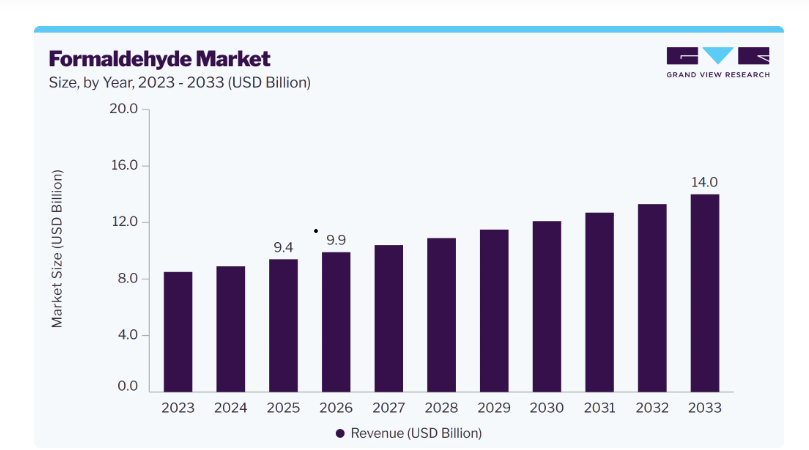
The global formaldehyde market was valued at USD 9.4 billion in 2025 and is projected to reach USD 14.0 billion by 2033, expanding at a 5.2% CAGR from 2026 to 2033. Asia Pacific accounted for more than 55.0% of global revenue in 2025, while Middle East & Africa is expected to register the fastest CAGR during the forecast period.
The Market Begins With Engineered Materials
One of the strongest demand pathways starts with engineered wood. Formaldehyde is an important raw material for producing urea-formaldehyde (UF), phenol-formaldehyde (PF), and melamine-formaldehyde (MF) resins. These resins are widely used in plywood, particleboard, MDF, laminates, and other composite wood products.
As construction activity expands, demand for affordable and durable building materials increases. Prefabricated construction, modular furniture, residential development, and renovation projects further increase the use of engineered wood, creating a corresponding requirement for formaldehyde-based adhesives and resins.
This makes construction one of the most important downstream foundations of the market.
Download a free sample report or claim your copy of this full market intelligence report
The Derivative Landscape Is Driving Product Demand
The market is not defined by formaldehyde alone. Its derivatives determine how the chemical enters different industrial applications.
Urea Formaldehyde
UF accounted for more than 40.0% of revenue in 2025, making it the leading derivative segment. Its applications extend across wood adhesives, construction, textiles, paper, electrical products, agriculture, and foundry sand.
Phenol Formaldehyde
PF is expected to record the fastest CAGR of more than 6.0% during the forecast period. Its strength and durability make it useful in applications requiring robust resin performance.
Melamine Formaldehyde
MF is benefiting from characteristics such as moisture resistance, thermal stability, hardness, scratch resistance, and flame retardancy. These properties support its use across several applications where surface performance and durability are important.
Construction Remains the Core Demand Engine
The building and construction segment generated approximately 35.0% of market revenue in 2025.
This position reflects the extensive use of formaldehyde-derived resins in construction materials. Adhesives based on UF, PF, and MF support the production of engineered wood products that are used in structural and interior applications.
Growth in residential construction is another contributor. Increasing housing development, infrastructure investment, and renovation activity can raise consumption of plywood, particleboard, MDF, laminates, and related products.
The connection is straightforward:
Construction expansion → engineered wood production → resin consumption → formaldehyde demand
Furniture Is Creating a Parallel Growth Channel
Furniture manufacturing represents another important downstream market.
Formaldehyde-based resins are used in composite wood materials incorporated into desks, bed frames, couches, stools, cabinets, and other furniture products. As furniture manufacturing expands, particularly in regions with strong production bases, demand for these materials can increase.
However, furniture also highlights one of the major challenges facing the market: emissions.
Regulatory requirements for composite wood products are encouraging manufacturers to reduce formaldehyde emissions and limit consumer exposure. This is shifting competition toward improved formulations and lower-emission production processes rather than simply higher-volume consumption.
The Market Is Being Pulled in Multiple Directions
Construction and furniture provide the strongest demand foundations, but formaldehyde is also used across a much wider industrial network.
Automotive: resins and materials used in vehicle-related manufacturing applications.
Textiles: treatments that can improve wrinkle and shrink resistance.
Agriculture: applications including soil disinfection, seed treatment, grain preservation, and nitrogen-related fertilizer uses.
Healthcare and personal care: use in selected disinfectant, preservative, and product-manufacturing applications.
Industrial processing: applications spanning adhesives, coatings, electrical products, and specialized chemical formulations.
This diversification reduces the market's dependence on any single downstream industry.
Regulation Is Redefining Product Development
The biggest shift in the industry is not simply about increasing consumption. It is about how formaldehyde is manufactured and incorporated into products.
Health and environmental concerns surrounding formaldehyde emissions have encouraged tighter controls and greater attention to exposure levels. This has increased pressure on manufacturers to develop formulations that maintain required performance while reducing emissions.
For producers, this is creating a technology-driven opportunity. Lower-emission resins, improved catalysts, better process control, and advanced emissions-testing systems are becoming increasingly relevant to the competitive landscape.
Recent industry developments illustrate this transition. Clariant announced deployment of its FAMAX catalyst technology at two Yihua Group formaldehyde plants in China, with the technology designed to improve yield, catalyst life, low-temperature activity, and pressure-drop performance.
Asia Pacific Supplies the Largest Demand Base
Asia Pacific accounted for more than 55.0% of global revenue in 2025.
The region's position reflects its large manufacturing ecosystem and strong demand from construction, automotive, furniture, adhesives, and electrical and electronics industries. China and India are particularly important contributors as industrial capacity and infrastructure continue expanding.
Europe represents another established market, supported by furniture manufacturing, construction applications, and mature chemical industries. Germany is a notable consumer within the region. Meanwhile, Middle East & Africa is projected to achieve the fastest CAGR of more than 8.5%, creating an increasingly important growth opportunity for formaldehyde producers.
Companies Are Competing Beyond Production Capacity
Competition in the Formaldehyde Market is increasingly influenced by technology, production efficiency, product quality, emissions management, and application-specific solutions.
Manufacturers are expanding production capabilities while investing in research and development to improve formulations and operational efficiency. Industry participants are also strengthening their value chains and developing technologies that can address evolving environmental and performance requirements.
Fagus-GreCon's expansion of its formaldehyde emissions-testing capabilities following its acquisition of the DMC business from Bakelite Synthetics illustrates the growing importance of testing and compliance alongside chemical production.
Key Formaldehyde Companies
- Foremark Performance Chemicals
- Hexion
- Georgia-Pacific Chemicals
- Celanese Corporation
- BASF SE
- Capital Resin Corporation
Looking Ahead: Growth With Greater Performance Expectations
The Formaldehyde Market is moving into a phase where demand growth and regulatory expectations will develop simultaneously. Construction, furniture, engineered wood, automotive manufacturing, textiles, agriculture, and other industries will continue creating application opportunities.
At the same time, manufacturers will need to respond to increasing requirements for lower emissions, improved production efficiency, and application-specific performance.
With the market expected to expand from USD 9.9 billion in 2026 to USD 14.0 billion by 2033, the next stage of growth will increasingly depend on the industry's ability to combine established resin demand with technological improvements and more controlled chemical applications.
About us:
Grand View Research, a market research and consulting company, provides syndicated research reports, customized research reports, and consulting services. Grand View Research database is used by the world's renowned academic institutions and Fortune 500 companies to understand the global and regional business environment. Our database features thousands of statistics and in-depth analysis on 46 industries in 25 major countries worldwide.

 English
 French
 Spanish
 Portuguese
 Deutsch
 Turkish
 Dutch
Dutch
 Italiano
 Russian
 Romaian
 Portuguese (Brazil)
 Greek
Greek
