
Healthcare Security and SOC SIEM Consulting in India: Vital Protection
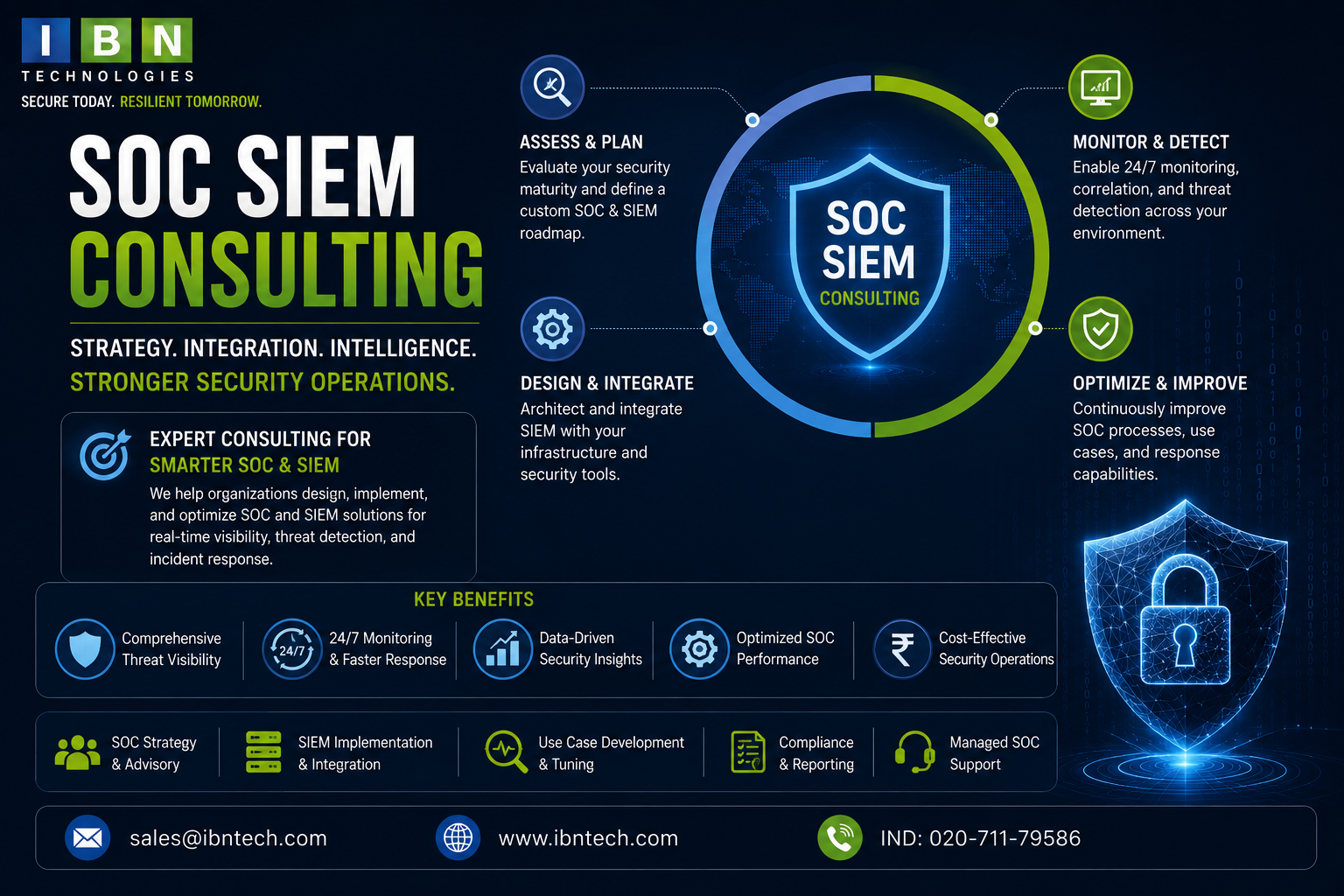
Making Healthcare Security More Connected With SOC SIEM Consulting in India
Healthcare organisations increasingly depend on connected technology to support clinical, administrative, and patient-facing operations.
Digital health applications, cloud environments, internal systems, connected devices, remote access, and business applications can all contribute to a complex technology environment. As these systems become more interconnected, security teams need visibility across the environment rather than isolated monitoring of individual technologies.
This is where soc siem consulting can help healthcare organisations establish a more coordinated security approach.
The objective is not simply to add another security platform. It is to understand which systems require monitoring, how security information should be analysed, and how suspicious activity should move from detection to investigation and response.
For healthcare organisations, this approach also needs to support operational continuity.
What SOC SIEM Consulting Means for Healthcare Security
SOC SIEM consulting helps healthcare organisations align SIEM technology and SOC processes with their security monitoring, threat detection, investigation, response, and operational requirements.
SIEM can bring relevant security information together for analysis, while SOC operations provide continuous monitoring, investigation, escalation, and response coordination.
Consulting helps determine how these capabilities should work within the organisation's existing technology and security structure.
This is important in healthcare because security activity can involve multiple teams, systems, and operational priorities.
Why a SOC Solution Provider Must Understand Healthcare Operations
Healthcare organisations evaluating a soc solution provider should look beyond basic security monitoring capabilities.
A solution needs to fit the organisation's technology environment and operational responsibilities.
A healthcare environment may include applications, cloud infrastructure, endpoints, network systems, authentication services, and other connected technologies. Monitoring requirements can differ significantly depending on how these systems are deployed and used.
The organisation should therefore understand how a provider will support security visibility, alert investigation, incident escalation, reporting, and collaboration with internal teams.
The objective should be a workable security operation rather than a standalone technical service.
Why Healthcare Security Requires Continuous Visibility
Healthcare technology can support important day-to-day activities.
A security event affecting an application, account, network environment, or connected system may therefore require attention beyond the security team.
The challenge is that technology teams may already be responsible for system availability, application support, infrastructure, user access, and other operational tasks.
When security monitoring depends entirely on periodic manual review, important activity may not receive timely attention.
Continuous SOC monitoring can provide ongoing visibility into security events and help identify activity that requires investigation.
The Role of SIEM in a Connected Healthcare Environment
Healthcare organisations can generate security information from multiple technology sources.
SIEM helps centralise relevant logs and security events so that they can be analysed together.
This can help security teams identify relationships between events that might appear insignificant when reviewed independently.
For example, an unusual authentication event may become more relevant when considered alongside other activity involving the same account, application, endpoint, or network environment.
The value comes from combining security information with an appropriate investigation process.
SIEM should therefore be considered part of a wider SOC operating model rather than a standalone monitoring tool.
How SOC SIEM Consulting Supports Healthcare Security Operations
A consulting-led approach can help healthcare organisations address areas such as:
- Security environment assessment
- SIEM planning and event visibility
- Monitoring requirements
- Threat detection
- Alert investigation
- Incident escalation
- Response coordination
- Security reporting
- Operational improvement
The appropriate scope depends on the organisation's technology environment and security objectives.
Why Traditional Security Monitoring Can Become Difficult
Healthcare technology environments can change as applications, infrastructure, users, and services evolve.
This creates an ongoing monitoring challenge.
Internal teams may know their systems well but may not have the capacity to continuously analyse security events across every environment.
At the same time, simply collecting more logs can increase the amount of information that analysts need to review.
A more structured SOC and SIEM approach focuses on useful visibility.
The aim is to identify relevant events, provide context for investigation, and establish clear escalation procedures when activity requires action.
Designing the Right Monitoring Scope
Not every system needs to be monitored in exactly the same way.
Healthcare organisations should first identify their critical technology environments and determine which security information is relevant to their security objectives.
This can include reviewing applications, cloud systems, network environments, endpoints, authentication activity, and other appropriate sources.
The monitoring strategy should then define how events from these environments are collected, analysed, prioritised, and escalated.
Consulting can help organisations establish this scope before expanding or redesigning their SOC and SIEM capabilities.
Evaluating Healthcare SOC and SIEM Capabilities
Healthcare organisations can use a structured assessment when reviewing potential security operating models.
|
Evaluation Area |
Healthcare Consideration |
|
Monitoring Coverage |
Determine which systems and environments require continuous security monitoring |
|
SIEM |
Assess how relevant security information is collected, analysed, and correlated |
|
Threat Detection |
Understand how suspicious activity is identified and investigated |
|
Incident Response |
Review how incidents are escalated and coordinated |
|
Operational Fit |
Consider how security monitoring works alongside healthcare technology teams |
|
Reporting |
Determine whether security findings are communicated clearly to relevant stakeholders |
|
Integration |
Assess compatibility with existing security and technology processes |
|
Scalability |
Consider whether monitoring can adapt as technology environments change |
This helps organisations evaluate the complete operating model rather than focusing on individual security features.
Keeping Security Monitoring From Disrupting Operations
Security processes need to work alongside healthcare operations.
When a suspicious event is detected, security teams may need to coordinate with infrastructure, application, identity, or other technology teams before taking action.
This makes clear escalation processes important.
For example, an event involving an application may require application owners to provide context before response decisions are made.
A managed SOC can support investigation and escalation, but internal teams still need defined responsibilities for affected systems and business decisions.
Consulting can help establish these relationships before an incident occurs.
Incident Response Should Be Built Into the Model
Security monitoring without a defined response process can leave organisations uncertain about what happens after an alert is identified.
Healthcare organisations should establish procedures for investigation, escalation, communication, and response.
The process should clarify:
Who investigates the event?
Who owns the affected system?
Who determines the appropriate technical action?
Who needs to be informed?
How is the incident documented?
A SOC can support several of these activities, but the organisation should retain clear ownership of decisions that affect its systems and operations.
Supporting Healthcare Teams With Better Security Reporting
Security reporting can help bridge the gap between technical security operations and organisational decision-making.
Technical teams may need detailed information about events and investigations.
Management may need a more concise view of security activity, recurring patterns, significant incidents, and areas requiring attention.
A well-designed reporting process can support both audiences.
For healthcare organisations, this can also help demonstrate that security monitoring is being managed as an ongoing operational function rather than as an occasional technical exercise.
Compliance and Security Governance in Healthcare
Security monitoring is only one component of a broader governance framework.
Healthcare organisations should understand the security, privacy, and compliance requirements applicable to their operations and technology environment.
A SOC and SIEM model can support these efforts by improving visibility into security events, investigation activity, incident handling, and reporting.
However, implementing a monitoring service does not automatically establish compliance.
Organisations still need appropriate policies, controls, processes, responsibilities, and governance mechanisms.
This is why consulting should consider the wider operating environment rather than focusing only on SIEM configuration or SOC monitoring.
A Practical Healthcare SOC SIEM Checklist
Before selecting or redesigning a SOC and SIEM approach, healthcare organisations can review the following areas:
- Identify technology environments that require security monitoring.
- Map the primary sources of security logs and events.
- Review current SIEM capabilities and visibility.
- Identify gaps in continuous security monitoring.
- Define how alerts should be investigated and escalated.
- Establish responsibilities between internal teams and SOC operations.
- Review incident response and communication procedures.
- Determine the security information required by management.
- Reassess monitoring requirements when applications or infrastructure change.
This provides a practical foundation for understanding security operations requirements before selecting a service model.
Preparing for Technology Changes in Healthcare
Healthcare organisations continue to adopt and expand digital technologies.
As new applications, cloud services, connected systems, and remote access arrangements are introduced, the security environment changes with them.
A SOC and SIEM strategy should therefore be flexible enough to accommodate these changes.
Regular reviews can help identify whether monitoring coverage remains appropriate and whether new security data sources should be incorporated.
This also helps prevent the initial security design from becoming disconnected from the organisation's current technology environment.
Creating a Security Model That Supports Continuity
Healthcare organisations need technology to remain available and secure while internal teams manage daily operational requirements.
A coordinated SOC and SIEM approach can support this by providing continuous security monitoring and a structured process for investigating suspicious activity.
The goal is not to eliminate every security event.
It is to improve the organisation's ability to see relevant activity, understand potential threats, escalate incidents appropriately, and coordinate response.
This can provide healthcare technology teams with a more consistent security operating foundation.
Moving Toward More Connected Healthcare Security
For healthcare organisations considering soc siem consulting, the key question should not simply be which technology to deploy.
The more important question is how security monitoring, SIEM analysis, threat detection, incident investigation, response, and reporting should work together within the organisation.
A suitable approach should reflect the healthcare environment, internal responsibilities, operational priorities, and applicable governance requirements.
A soc siem consulting strategy can help organisations build that connection by starting with their security requirements and technology environment rather than treating SOC and SIEM as isolated products.
As healthcare becomes increasingly dependent on connected technology, a structured security operation can help organisations maintain better visibility while supporting the continuity and reliability of their digital environment.
Contact Us:
IND- 02067680404
IBN Technologies Ltd.
E-mail: - sales@ibntech.com

 English
 Arabic
 French
 Spanish
 Portuguese
 Turkish
 Dutch
Dutch
 Italiano
 Russian
 Romaian
 Portuguese (Brazil)
 Greek
Greek
