Automotive Blind Spot Detection Market
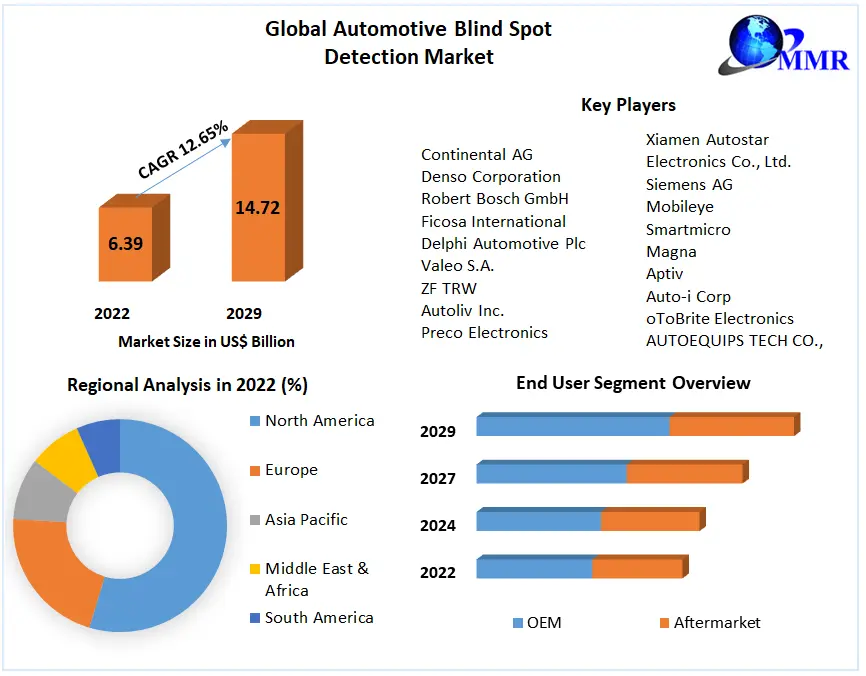
The Automotive Blind Spot Detection Market is expanding as vehicle manufacturers increasingly integrate advanced driver assistance systems (ADAS) to improve driver awareness and reduce collision risks during lane changes, merging, reversing, and maneuvering in congested traffic. Blind spot detection systems use technologies such as radar, ultrasonic sensors, cameras, and, in some applications, LiDAR to identify vehicles, pedestrians, cyclists, and other objects that may not be visible through conventional mirrors. Depending on the system architecture, drivers can receive warnings through visual indicators, audible alerts, steering-wheel vibration, or instrument-cluster and infotainment displays. The technology is also increasingly connected with lane-change assistance, rear cross-traffic alert, and broader automated-driving functions. Recent market research estimates vary considerably because of differences in market scope and segmentation; for example, IMARC valued the global market at USD 6.72 billion in 2025, while Fortune Business Insights estimated USD 10.17 billion for the same year. These differences highlight the importance of defining whether the market includes specific sensor modules, complete BSD systems, or broader ADAS functionality.
𝐃𝐨𝐰𝐧𝐥𝐨𝐚𝐝 𝐅𝐫𝐞𝐞 𝐏𝐃𝐅 𝐁𝐫𝐨𝐜𝐡𝐮𝐫𝐞 @https://www.maximizemarketresearch.com/request-sample/42871/
Key Market Segmentations
Based on technology, the Automotive Blind Spot Detection Market can be segmented into radar sensors, ultrasonic sensors, camera-based systems, LiDAR, and other technologies. Radar-based detection is widely used because radar can identify objects over useful distances and operate in different lighting conditions. Ultrasonic technology is commonly associated with short-range detection and parking-related applications, while camera-based systems use image processing and computer vision to identify surrounding objects. LiDAR can provide detailed environmental information and is increasingly evaluated as part of advanced perception architectures. The market is also moving toward sensor fusion, where data from multiple sensing technologies is combined with software algorithms to improve environmental perception.
By vehicle type, the market is divided into passenger cars and commercial vehicles. Passenger cars currently represent a major application area as manufacturers increasingly incorporate blind spot monitoring into sedans, SUVs, hatchbacks, and premium vehicles. IMARC estimates that passenger cars accounted for 64% of the market in 2025 within its market definition. Commercial vehicles are also becoming an important application because trucks and buses have larger blind zones and operate in environments where interactions with other vehicles, pedestrians, and cyclists can create additional safety challenges.
Based on end user, the market includes original equipment manufacturers (OEMs) and aftermarket providers. OEM-installed systems are increasingly integrated into vehicle electronic architectures during production, allowing BSD functions to work with other ADAS technologies. The aftermarket segment includes retrofit systems, replacement sensors, cameras, electronic modules, and related installation services.
Growth Drivers
One of the principal growth drivers is the increasing emphasis on vehicle and road safety. Blind spots can limit a driver's ability to identify nearby road users, particularly during lane changes and merging. As consumers and regulators place greater emphasis on active safety technologies, manufacturers are incorporating BSD into increasingly broad ranges of vehicles. Market research identifies growing safety awareness and the wider deployment of ADAS as important factors supporting demand.
The expansion of ADAS and vehicle electrification is another important factor. Modern electric and digitally engineered vehicles often use centralized electronic architectures, advanced sensors, and software platforms that facilitate integration of multiple driver-assistance functions. As vehicle manufacturers introduce more connected and software-intensive models, BSD can increasingly operate as part of a wider safety and perception system rather than as an isolated feature. IMARC notes that the transition toward electric and next-generation vehicle platforms is creating additional opportunities for integrated blind spot detection technologies.
Government safety regulations and vehicle-testing programs are also influencing adoption. In Europe, General Safety Regulation requirements have increased the use of advanced safety technologies in new vehicles, while other markets are strengthening ADAS-related standards and assessment procedures. In February 2026, the Automotive Research Association of India launched an ADAS Test City in Pune, a 20-acre facility designed to replicate real-world traffic conditions and evaluate technologies including blind spot detection, automatic emergency braking, and lane-departure warning. Such infrastructure supports the validation and development of ADAS technologies for regional vehicle platforms.
Technological Development
Technological advancement in radar, computer vision, artificial intelligence, and sensor fusion is reshaping the market. Modern radar systems are being developed with greater resolution and richer environmental data, allowing manufacturers to support more sophisticated ADAS functions. In October 2025, Aptiv introduced its Gen 8 radar platform, designed to provide higher-resolution sensing and support machine-learning-driven ADAS applications across driving and parking scenarios.
Another emerging development is the exploration of alternative sensing approaches. In January 2026, Hyundai Motor Company and Kia Corporation announced Vision Pulse, a driver-safety technology using ultra-wideband (UWB) signals to determine the location of nearby objects equipped with compatible UWB modules. The companies stated that the technology is intended to support advanced driver-assistance functions while reducing reliance on some conventional sensing technologies in specific applications.
The radar ecosystem is also expanding geographically. In April 2026, NOVELIC announced its expansion into India, targeting demand for mmWave radar solutions across passenger vehicles, commercial vehicles, and two- and three-wheelers. The company also reported establishing a 60 GHz radar production line in India in collaboration with Sona Comstar.
Regional Outlook
Asia Pacific represents an important market for automotive blind spot detection because of its large vehicle-production base, expanding automotive electronics industry, increasing ADAS adoption, and growing focus on road safety. Recent market estimates differ on the exact regional share because of varying market definitions, but both IMARC and Fortune Business Insights identify Asia Pacific as the leading regional market in their respective studies. North America continues to benefit from advanced vehicle technologies and safety-focused consumer demand, while Europe is strongly influenced by regulatory requirements and established automotive technology suppliers.
Future Outlook
The Automotive Blind Spot Detection Market is expected to continue evolving from a standalone warning feature toward an integrated vehicle-perception and ADAS capability. The increasing use of radar, cameras, AI-based image processing, sensor fusion, and software-defined vehicle architectures is expanding the functionality of blind spot systems. Competition among automotive technology suppliers is therefore increasingly focused on sensing accuracy, system integration, cost efficiency, software capabilities, validation, and compatibility with next-generation vehicle platforms. As vehicle manufacturers expand ADAS availability across passenger and commercial vehicles, blind spot detection is likely to remain an important component of modern automotive safety systems.
𝐃𝐨𝐰𝐧𝐥𝐨𝐚𝐝 𝐅𝐫𝐞𝐞 𝐏𝐃𝐅 𝐁𝐫𝐨𝐜𝐡𝐮𝐫𝐞 @https://www.maximizemarketresearch.com/request-sample/42871/
Competitive Landscape
The Automotive Blind Spot Detection Market is competitive, with established Tier-1 automotive suppliers and sensor technology companies developing radar-, camera-, ultrasonic-, and sensor-fusion solutions
Key Players are:
1. Continental AG
2. Denso Corporation
3. Robert Bosch GmbH
4. Ficosa International
5. Delphi Automotive Plc
6. Valeo S.A.
7. ZF TRW
8. Autoliv Inc.
9. Preco Electronics
10. Xiamen Autostar Electronics Co., Ltd.
11. Siemens AG
12. Mobileye
13. Smartmicro
14. Magna
15. Aptiv


 English
 Arabic
 Spanish
 Portuguese
 Deutsch
 Turkish
 Dutch
Dutch
 Italiano
 Russian
 Romaian
 Portuguese (Brazil)
 Greek
Greek
