Recycled Asphalt Market
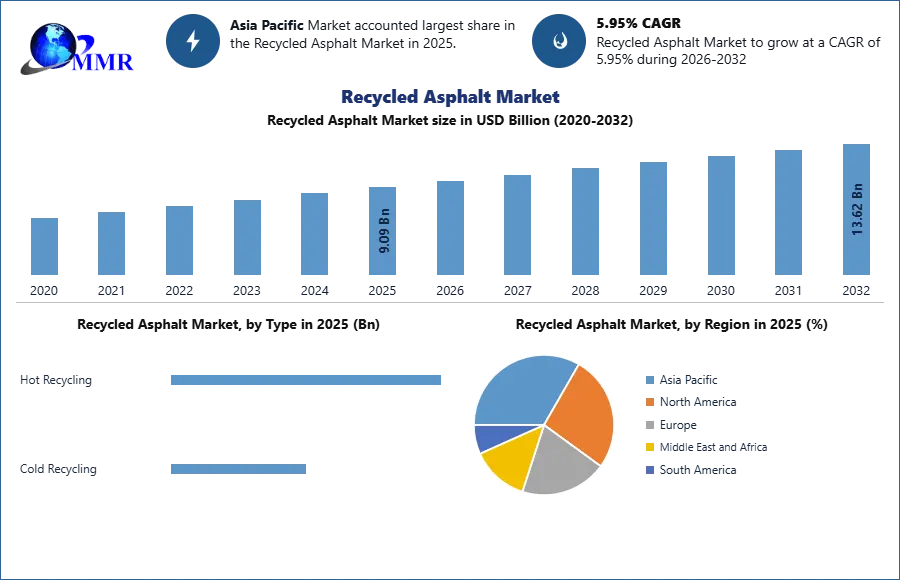
The global Recycled Asphalt Market is gaining momentum as governments, construction companies, infrastructure developers, and road authorities increasingly focus on sustainable road construction, resource conservation, and cost-efficient pavement rehabilitation. Recycled asphalt, also known as reclaimed asphalt pavement (RAP) in many applications, is produced by recovering existing asphalt pavement, processing the reclaimed material through milling, crushing, sizing, and stabilization, and incorporating it into new pavement or other construction applications. The growing emphasis on reducing construction waste, limiting the consumption of virgin aggregates and bitumen, and lowering the environmental impact associated with conventional asphalt production is creating favorable conditions for market expansion. According to Maximize Market Research, the global Recycled Asphalt Market was valued at USD 9.09 billion in 2025 and is expected to reach USD 13.62 billion by 2032, expanding at a CAGR of 5.95% during 2026–2032.
𝐃𝐨𝐰𝐧𝐥𝐨𝐚𝐝 𝐅𝐫𝐞𝐞 𝐏𝐃𝐅 𝐁𝐫𝐨𝐜𝐡𝐮𝐫𝐞 @https://www.maximizemarketresearch.com/request-sample/103882/
Recycled Asphalt Market Segmentation
The Recycled Asphalt Market is segmented based on type, application, functional layer, end-use industry, and region. By type, the market is divided into hot recycling and cold recycling. Hot recycling involves heating reclaimed asphalt materials before or during their incorporation into a new asphalt mixture. The method is widely used for pavement rehabilitation because it can be performed through single- or multiple-pass operations and can reduce transportation and material-handling requirements when recycling is conducted at the project site. The hot recycling segment is projected to maintain significant demand throughout the forecast period. Cold recycling, meanwhile, processes asphalt materials without extensive heating and can reduce energy consumption and the requirement for virgin materials. Its ability to reuse a substantial portion of existing pavement makes it an increasingly attractive approach for road maintenance and rehabilitation projects.
Based on application, the market includes hot-mix asphalt, temporary driveways and roads, road aggregate for unpaved roadways, interlocking bricks, and other applications. Hot-mix asphalt remains an important application because reclaimed asphalt can be incorporated into new pavement mixtures, reducing dependence on virgin aggregate and asphalt binder. Recycled asphalt is also used extensively as patch material for potholes and pavement maintenance. Meanwhile, road aggregate for unpaved roadways is expected to provide substantial growth opportunities because recycled asphalt can supply aggregate material while reducing the need for newly mined resources.
By functional layer, the market is categorized into surface layer, base layer, and structural layer. Recycled asphalt can be incorporated at different pavement levels depending on project specifications, material characteristics, traffic requirements, and engineering standards. Surface-layer applications require appropriate material quality and performance characteristics, while base and structural applications provide opportunities for greater utilization of reclaimed materials in road construction and rehabilitation.
Based on end-use industry, the market covers construction companies, government and municipal authorities, infrastructure developers, and other end users. Government and municipal authorities represent an important demand base because public road networks require continuous resurfacing, maintenance, and rehabilitation. Infrastructure developers and construction companies are also increasingly evaluating recycled asphalt to manage material costs and meet sustainability objectives.
Growing Focus on Sustainable Road Construction
The increasing focus on sustainable infrastructure is one of the primary growth drivers for the Recycled Asphalt Market. Conventional asphalt production requires energy-intensive processes and relies on virgin aggregates and petroleum-derived materials. Repeated production and transportation of new asphalt can contribute to energy consumption, greenhouse gas emissions, and depletion of natural resources.
Recycling existing pavement provides an alternative approach by recovering useful asphalt and aggregate materials that would otherwise require disposal or additional processing. Recycled asphalt can therefore reduce demand for virgin raw materials while supporting circular construction practices. The growing adoption of circular-economy principles across the infrastructure sector is encouraging road authorities and contractors to increase the use of reclaimed pavement materials.
Reduction in Construction Costs
Cost efficiency is another important factor supporting market growth. Recycled asphalt can reduce the requirement for newly produced asphalt mixtures, virgin aggregates, and transportation of raw materials. Because reclaimed materials are already available from existing pavements, their use can reduce material procurement requirements for selected road construction and rehabilitation projects.
Cold recycling can provide additional economic benefits because it reduces the energy required for heating asphalt materials. According to the MMR assessment, appropriately timed cold recycling can reduce maintenance expenses by approximately 30% to 50% compared with conventional milling and filling methods, while also reducing virgin material requirements, transportation, construction time, and landfill demand.
Increasing Road Infrastructure Development
The continued development and modernization of road infrastructure is creating a large addressable market for recycled asphalt. Existing highways, urban roads, bridges, parking areas, and other paved surfaces require regular resurfacing and rehabilitation as traffic volumes and pavement deterioration increase. Instead of disposing of removed pavement materials, contractors can process and reuse them in new construction.
Rapid urbanization in emerging economies is also increasing investment in roads and transportation infrastructure. As governments seek to expand road networks while controlling construction expenditure and environmental impacts, recycled asphalt provides an opportunity to combine infrastructure development with resource efficiency.
Rising Adoption of Advanced Recycling Technologies
Technological development is improving the quality and efficiency of asphalt recycling processes. Modern recycling plants can process reclaimed pavement more efficiently and produce materials with more consistent characteristics. Improvements in crushing, screening, heating, mixing, stabilization, and quality-control technologies are allowing asphalt producers to increase the proportion of reclaimed materials used in pavement mixtures.
Plant manufacturers are also working toward higher recycling ratios. MMR notes that newly designed recycling plants can currently achieve reclaimed asphalt ratios of up to approximately 60%, while companies are developing and testing systems capable of processing significantly higher proportions of recycled asphalt. These developments could expand the use of reclaimed materials in applications where performance requirements have historically limited recycling rates.
Recycled Asphalt and Urban Sustainability
Recycled asphalt can also contribute to broader urban sustainability objectives. Asphalt surfaces can contribute to heat accumulation in urban areas because conventional dark pavement absorbs solar radiation. Recycled and regenerated pavement materials can offer different surface characteristics, potentially reducing heat absorption in certain applications. The growing focus on urban heat management, resource efficiency, waste reduction, and environmentally responsible construction is consequently creating additional interest in recycled pavement solutions.
North America Recycled Asphalt Market
North America has historically represented a major market for recycled asphalt because of established pavement recycling practices, extensive highway infrastructure, and regulatory support for reclaimed materials. Several U.S. states, including Minnesota, Missouri, North Carolina, Ohio, Oregon, Texas, and Georgia, permit recycled asphalt in paving mixes. Wider acceptance of reclaimed materials by transportation departments and road authorities is creating opportunities for contractors and asphalt producers to expand recycling operations.
The region also benefits from a mature asphalt production and road maintenance ecosystem. The large installed road network creates a consistent supply of reclaimed pavement material, while infrastructure rehabilitation programs provide recurring demand for asphalt mixtures. Increased attention to material costs and carbon emissions is further encouraging contractors to evaluate higher recycled-content pavement solutions.
Asia Pacific Recycled Asphalt Market
Asia Pacific is expected to experience strong growth during the forecast period, supported by infrastructure development, urbanization, road construction, and increasing awareness of sustainable construction materials. According to MMR, Asia Pacific is projected to register a 6.3% CAGR during the forecast period.
China, India, Japan, South Korea, Australia, and Southeast Asian economies are investing in transportation infrastructure, creating opportunities for recycled asphalt technologies. Fluctuating oil prices and the comparatively lower cost of recycled raw materials can further encourage asphalt recycling. Collaboration among asphalt producers, road owners, contractors, roofing companies, and recycling-plant manufacturers is also supporting technological development across the region.
Europe and Other Regional Markets
Europe is benefiting from environmental policies, circular-economy objectives, infrastructure modernization, and efforts to reduce construction waste. Road authorities and contractors are increasingly examining ways to increase reclaimed material content while maintaining pavement performance and compliance with engineering requirements.
The Middle East and Africa provide opportunities through highway construction, urban development, and infrastructure investment, while South America is supported by road rehabilitation and increasing interest in resource-efficient construction. Regional adoption, however, depends on recycling infrastructure, technical standards, availability of reclaimed pavement, project economics, and government policies.
Recent Developments in the Recycled Asphalt Market
Recent developments are increasingly focused on improving recycling efficiency, increasing reclaimed asphalt content, and applying digital technologies to asphalt mix design. A January 2026 industry review highlighted advances in hot recycling and the integration of machine learning into recycled asphalt mixture design, with the objective of optimizing mix performance while enabling higher reclaimed asphalt content.
Governments and infrastructure organizations are also implementing projects that incorporate recycled materials into road construction and maintenance. In December 2025, the Odisha Government and NHAI announced the commercial scaling of the Capital Region Ring Road, a 110-km project associated with the use of segregated municipal waste and recycled asphalt. In August 2025, Andhra Pradesh launched the Ecofix Pilot Project, which uses a composite involving steel slag and recycled tar for pothole repairs. In June 2025, a pilot project in West Bengal explored plastic-mixed recycled bitumen for road repair and maintenance in the Salt Lake area. These developments illustrate the broader movement toward incorporating recycled and waste-derived materials into infrastructure projects.
𝐃𝐨𝐰𝐧𝐥𝐨𝐚𝐝 𝐅𝐫𝐞𝐞 𝐏𝐃𝐅 𝐁𝐫𝐨𝐜𝐡𝐮𝐫𝐞 @https://www.maximizemarketresearch.com/request-sample/103882/
Competitive Landscape
The Recycled Asphalt Market is competitive, with companies focusing on recycling technologies, asphalt production, aggregates, infrastructure construction, pavement rehabilitation, and material innovation. Key companies identified in the market include CRH plc, Holcim Group, Colas Group, CEMEX S.A.B. de C.V., Heidelberg Materials, Vulcan Materials Company, Martin Marietta Materials, Eurovia, Granite Construction Incorporated, Balfour Beatty plc, Kiewit Corporation, Oldcastle Materials, Eiffage Infrastructures, Strabag SE, Skanska AB, Downer Group, Tarmac Trading Limited, Lafarge Canada, KWS Group, Astec Industries Inc., Wirtgen Group, Shell plc, Sinopec, Owens Corning, Dow Inc., Cherry Companies, Pavement Recycling Systems Inc., Gallagher Asphalt Corporation, and BoDean Company Inc.
Competition is increasingly shaped by investments in advanced recycling plants, higher reclaimed-material ratios, pavement-performance optimization, digital monitoring, and sustainable construction solutions. Companies are also collaborating with public agencies and infrastructure developers to demonstrate the economic and environmental benefits of recycled asphalt.
For full access to the comprehensive strategic report, visit:https://www.maximizemarketresearch.com/market-report/global-recycled-asphalt-market/103882/
Future Outlook
The outlook for the Recycled Asphalt Market remains positive as governments and construction companies seek to balance infrastructure development with environmental and cost objectives. The combination of road rehabilitation requirements, rising construction material costs, resource conservation goals, waste reduction initiatives, and advances in recycling technology is expected to support continued market expansion. The global market is projected to reach USD 13.62 billion by 2032, growing at a 5.95% CAGR from 2026 to 2032.
The future development of the market will depend on higher recycling rates, improvements in pavement-performance testing, advanced processing technologies, supportive government standards, and greater integration of digital tools into mix design and quality control. As infrastructure owners increasingly adopt circular construction practices, recycled asphalt is expected to remain an important material for sustainable road construction, maintenance, resurfacing, and pavement rehabilitation worldwide.


 English
 Arabic
 French
 Spanish
 Portuguese
 Deutsch
 Turkish
 Italiano
 Russian
 Romaian
 Portuguese (Brazil)
 Greek
Greek
