
Matcha Tea Market Outlook: Functional Beverages Create New Growth Opportunities
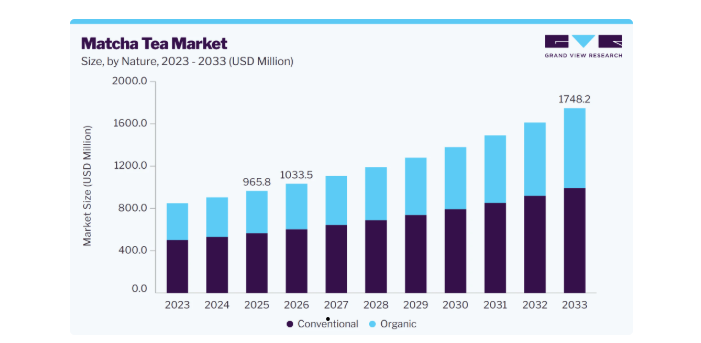
The global matcha tea market was valued at USD 965.8 million in 2025 and is projected to reach USD 1,748.2 million by 2033, expanding at a 7.8% CAGR from 2026 to 2033. Growing consumer interest in natural, plant-based, and functional beverages is strengthening demand for matcha across beverages, food products, supplements, and foodservice.
Matcha’s antioxidant content, natural caffeine, and association with sustained energy and wellness are making it increasingly attractive to health-conscious consumers. Rising awareness of Japanese tea culture, clean-label products, and premium beverage experiences is further supporting market expansion.
Key Highlights
Asia Pacific dominated the Matcha Tea Market with a 51.2% revenue share in 2025, while Middle East & Africa is expected to record the fastest growth during 2026–2033. Conventional matcha accounted for 58.6%, powder held 59.1%, and unflavored/regular matcha represented 63.6% of the market in 2025. Online distribution is projected to grow at a 10.6% CAGR, while RTD matcha is expected to expand at 9.7%.
Wellness Trends Are Turning Matcha Into a Functional Beverage
Consumers are increasingly moving away from highly processed and sugar-heavy beverages toward products associated with natural ingredients and functional benefits. Matcha fits this shift through its combination of naturally occurring caffeine, catechins, and L-theanine.
Its positioning as a source of sustained energy and focus has expanded its appeal among professionals, students, fitness consumers, and wellness-focused audiences. The broader growth of functional beverages is therefore creating new consumption occasions beyond traditional tea drinking.
Health-Conscious Consumption
↓
Growing Demand for Functional Beverages
↓
Rising Matcha Adoption in Daily Routines
↓
Expansion Across Cafés, Food, RTD & Supplements
↓
Global Matcha Tea Market Growth
Clean-Label and Plant-Based Preferences Expand the Consumer Base
The growing preference for organic, natural, vegan, and minimally processed products is supporting matcha consumption. Consumers increasingly look for beverages with recognizable ingredients and fewer artificial additives.
Organic matcha is particularly positioned to benefit from this trend. The organic segment is projected to grow at an 8.4% CAGR from 2026 to 2033, reflecting rising interest in sustainable cultivation, clean-label products, and premium wellness beverages.
Download a free sample report or claim your copy of this full market intelligence report
Product Innovation Is Moving Matcha Beyond Traditional Tea
Matcha is increasingly being incorporated into lattes, smoothies, desserts, bakery products, supplements, and ready-to-drink beverages. Flavored variants such as vanilla, chocolate, berry, coconut, honey, and spiced matcha are helping brands reach consumers who may find traditional matcha's earthy flavor too intense.
RTD products are another important growth avenue. Their convenience allows consumers to access matcha without preparing the traditional beverage, making the ingredient more relevant to fast-paced lifestyles.
SEGMENT SPOTLIGHT
Nature: Conventional Leads, Organic Gains Momentum
Conventional matcha accounted for 58.6% of revenue in 2025, supported by affordability, availability, and familiarity. Organic matcha, meanwhile, is gaining traction among consumers prioritizing sustainable and clean-label products.
Product: Powder Remains the Core Format
Powder held the largest product share at 59.1% in 2025. Its versatility allows matcha to be used in beverages, bakery products, confectionery, dairy alternatives, supplements, and foodservice applications.
Type: Unflavored Matcha Maintains Consumer Preference
Unflavored/regular matcha held 63.6% of revenue in 2025, reflecting demand for authentic taste and minimally processed products. Flavored matcha is nevertheless expanding the market by offering more accessible taste profiles.
Price Range: Mid-Range Dominates
The mid-range segment represented 45.9% of revenue in 2025, balancing affordability with perceived quality. Premium matcha is expected to grow at an 8.5% CAGR, supported by interest in ceremonial-grade products and authentic Japanese origins.
Distribution: Online Channels Are Accelerating
Offline channels held 64.5% of market revenue in 2025, supported by supermarkets, specialty stores, and tea retailers. Online distribution is expected to grow faster at 10.6% CAGR, helped by social media marketing, influencer engagement, subscriptions, and direct-to-consumer models.
Regional Growth Reflects Both Tradition and New Consumer Demand
Asia Pacific remained the largest regional market with a 51.2% share in 2025, supported by established tea cultures and growing wellness consumption. China held the largest country share in the market.
North America is experiencing growing demand as cafés and foodservice operators introduce matcha-based beverages to health-conscious consumers. In the U.S., matcha is increasingly associated with wellness, clean-label consumption, and Japanese-inspired beverage culture.
Europe accounted for 17.3% of revenue in 2025, with demand supported by organic and premium beverage trends. Germany held the largest European country share at 22.2%. Meanwhile, Middle East & Africa is emerging as a high-growth region as cafés and specialty beverage outlets expand matcha offerings.
Key Companies
- Nestlé S.A.
- Tata Global Beverages Ltd.
- Lipton Teas and Infusions
- The AOI Tea Company
Conclusion
The matcha tea market is evolving from a traditional tea category into a broader wellness and functional beverage opportunity. Demand for natural energy, clean-label ingredients, plant-based products, convenient formats, and premium experiences is creating multiple growth pathways. Powdered and unflavored matcha continue to provide a strong foundation, while organic, flavored, RTD, premium, and online offerings are expanding the market's reach. As matcha becomes increasingly integrated into cafés, food products, supplements, and everyday wellness routines, product innovation and sourcing quality will remain important areas of competition.
About us:
Grand View Research, a market research and consulting company, provides syndicated research reports, customized research reports, and consulting services. Grand View Research database is used by the world's renowned academic institutions and Fortune 500 companies to understand the global and regional business environment. Our database features thousands of statistics and in-depth analysis on 46 industries in 25 major countries worldwide.

 English
 French
 Spanish
 Portuguese
 Deutsch
 Turkish
 Dutch
Dutch
 Italiano
 Russian
 Romaian
 Portuguese (Brazil)
 Greek
Greek
