
Botanical Extract Market Set to Surpass USD 22.061 Billion by 2036
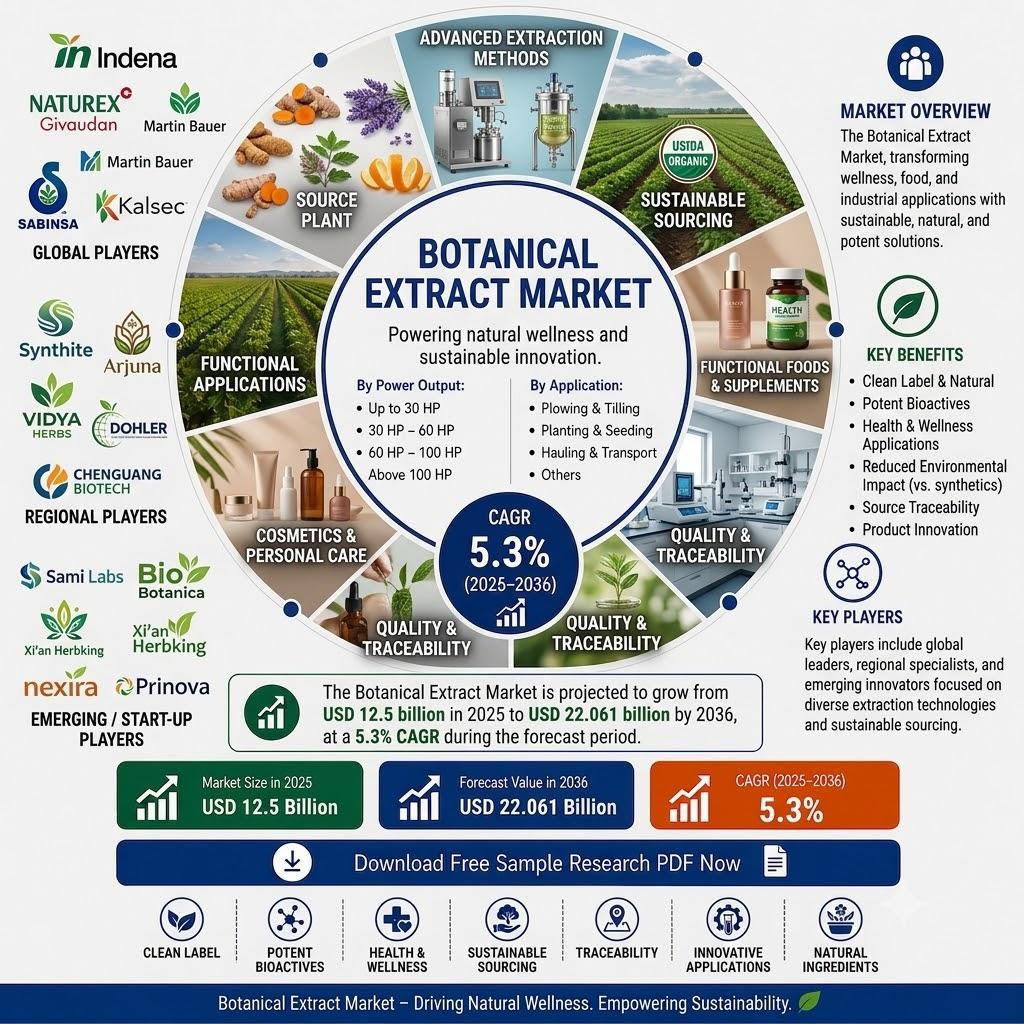
The global Botanical Extract Market is valued at USD 12.5 billion in 2025 and is projected to reach USD 22.061 billion by 2036, expanding at a 5.3% CAGR from 2026 to 2036, according to Fact.MR analysis. The market is gaining demand as nutraceutical manufacturers, food companies, pharmaceutical suppliers, and cosmetic formulators increasingly use concentrated plant-derived bioactive ingredients.
The market is expected to add USD 8.899 billion in incremental opportunity between 2026 and 2036. India and China are emerging as important production and consumption markets, while demand for clinically documented extracts is creating higher-value opportunities beyond commodity botanical powders.
Get detailed market forecasts, competitive benchmarking, and pricing trends: https://www.factmr.com/connectus/sample?flag=S&rep_id=8982
Clinical Evidence and Standardisation Reshape Botanical Extract Demand
The shift toward standardised botanical ingredients is becoming a defining feature of the market. Fact.MR analysis indicates that clinically documented branded extracts can command prices 3 to 10 times higher than generic equivalents, while cosmetic-grade extracts supported by clinical efficacy documentation can achieve premiums of 5 to 15 times over food-grade alternatives.
Fact.MR is a market research company that provides industry analysis, forecasting, and primary and secondary research across global markets.
Nutraceuticals account for 37.6% of application demand. Botanical extracts are used across capsules, tablets, powders, gummies, and liquid supplement formats. The global dietary supplement market exceeded USD 170 billion in 2024, creating a broad application base for standardised botanical ingredients.
Clean-label reformulation is another demand driver. Food manufacturers are using botanical extracts as natural flavouring, colouring, and functional ingredients as they reduce reliance on synthetic additives.
The cosmetic sector is also expanding its use of plant-derived bioactives. Fact.MR estimates that cosmetic industry demand for these ingredients is growing at 8% to 10% annually, supported by formulations positioned around natural-origin ingredients and clinically supported skin benefits.
Herbal Extracts Hold the Largest Product Share
Herbal extracts account for 31.8% of the product segment. The category includes turmeric, ashwagandha, green tea, ginseng, and milk thistle extracts, which are standardised around specific bioactive marker compounds.
Powder form represents 45.3% of form demand. Its flexibility across supplement, food, and ingredient manufacturing supports broad commercial use.
Solvent extraction accounts for 41.2% of extraction technology demand. Ethanol and ethyl acetate extraction remain widely used because the methods can support high-volume production and scale from laboratory operations to industrial facilities.
Supercritical CO2 extraction is expanding at a faster pace. The technology produces solvent-free extracts and can support premium positioning, with such extracts commanding reported price premiums of 30% to 60%.
India and China Strengthen Their Production Positions
India is the fastest-growing country market in the Fact.MR forecast, with a projected CAGR of 7.0% between 2026 and 2036. Pharmexcil data cited in the research places India's botanical extract industry at more than USD 3 billion in 2024.
India has more than 8,000 medicinal plant species and over 1,000 extract manufacturers, with manufacturing activity concentrated in Bangalore, Hyderabad, and Kerala. India's botanical extract exports exceeded USD 2 billion in 2024, with the USA and Europe identified as primary destinations.
China follows with a projected 6.5% CAGR. Its traditional Chinese medicine modernisation programme is supporting development of standardised extract products with reproducible bioactive compound profiles.
The USA remains a major revenue market, generating USD 4.982 billion in 2025. Japan contributes USD 0.632 billion, while South Korea accounts for USD 0.417 billion, according to Fact.MR's country-level analysis.
Quality Control and Regulatory Compliance Remain Key Challenges
Botanical raw material variability continues to affect standardisation. Growing conditions, harvest timing, post-harvest handling, and species identification can alter bioactive compound concentrations between batches.
Manufacturers may require HPLC, mass spectrometry, and DNA barcoding to verify composition and authenticity. Fact.MR estimates that advanced testing associated with adulteration and species identification can add USD 500 to USD 2,000 per batch in quality assurance costs.
Regulatory requirements also vary substantially between markets. An ingredient accepted as a dietary ingredient in the USA may require Novel Food authorisation in Europe and separate regulatory approvals in China, Japan, or India. The research estimates that this regulatory fragmentation can extend market entry timelines by 12 to 36 months per jurisdiction.
Branded Botanical Ingredients Create Higher-Value Opportunities
The market is moving from conventional herb processing toward precision-standardised ingredient manufacturing. Fact.MR analysis identifies clinical documentation, proprietary extraction processes, and defined bioactive concentrations as important elements of premium botanical positioning.
Indena holds approximately 10.0% of global market revenue, according to the supplied Fact.MR analysis. Naturex (Givaudan), Martin Bauer, Sabinsa, Synthite, Arjuna, Vidya Herbs, and other companies compete across different quality and cost segments.
Recent developments include Indena's expansion of phytosome technology in 2025, Sabinsa's publication of clinical results for a tetrahydrocurcuminoid product, Naturex's expanded clean-label botanical colour range in 2026, and Synthite's expansion of supercritical CO2 extraction capacity at its Kolenchery facility in Kerala in 2025.
The research identifies the growing gap between commodity botanical materials and clinically documented standardised extracts as a central commercial opportunity. Companies investing in extraction optimisation, bioactive standardisation, and clinical evidence can participate in higher-value ingredient segments.
To View Top Reports
https://social.mytamam.com/blogs/41051/High-Temperature-Brake-Line-Couplings-Market-Forecast-USD-1-4
https://net-pals.com/blogs/36793/High-Temperature-Brake-Line-Couplings-Market-Set-to-Reach-USD
https://uddokta64.com/blogs/8116/High-Temperature-Brake-Line-Couplings-Market-Projected-to-Hit-USD
https://acmingle.com/blogs/21128/High-Temperature-Brake-Line-Couplings-Market-Expected-to-Reach-USD
About Fact.MR
Fact.MR is a market research and consulting company providing industry intelligence, market forecasting, competitive analysis, and strategic insights across global business sectors. Its research combines primary interviews, secondary research, industry data, company information, and proprietary forecasting models to assess market trends and opportunities.

 English
 Arabic
 French
 Spanish
 Deutsch
 Turkish
 Dutch
Dutch
 Italiano
 Russian
 Romaian
 Portuguese (Brazil)
 Greek
Greek
