
Marine Scrubber Systems Market to Gain USD 8.1 Billion by 2036
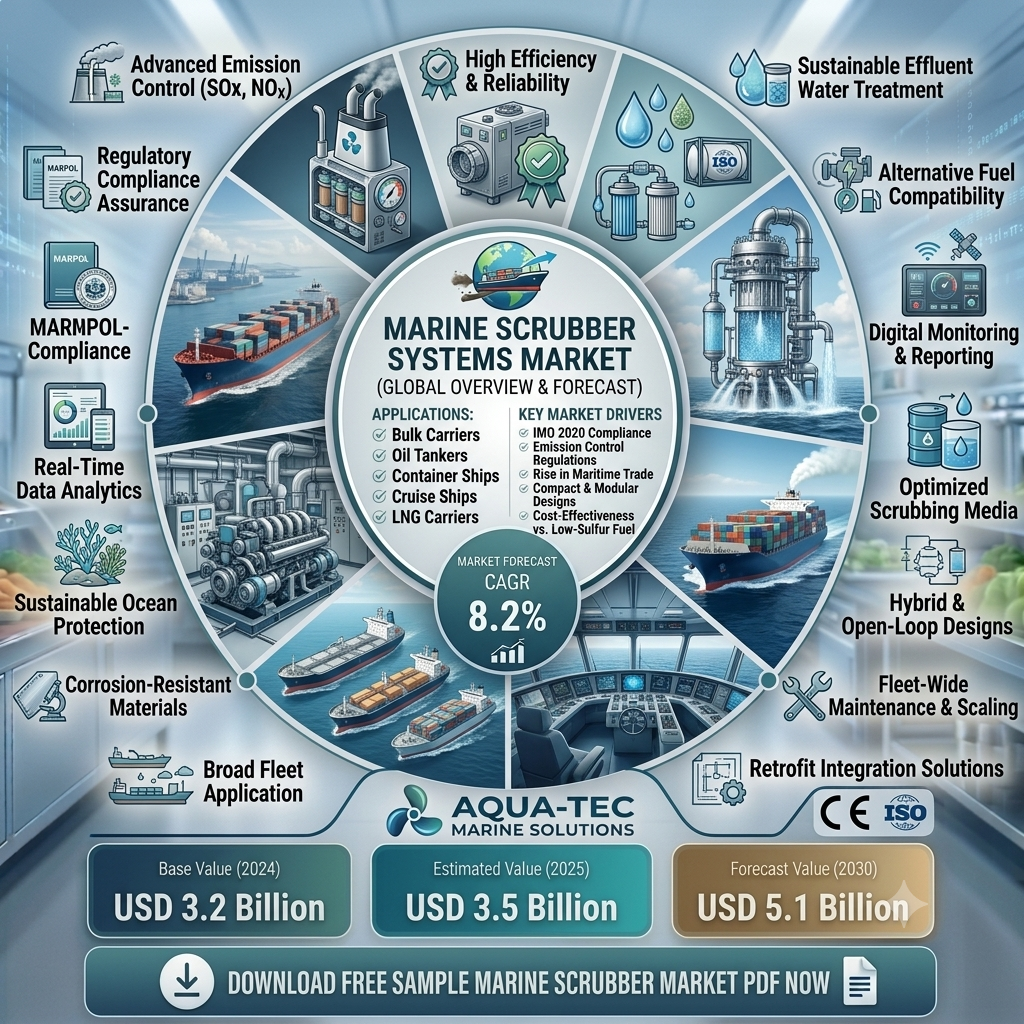
Rockville, MD., September 21, 2026 — The Marine Scrubber Systems Market is projected to reach USD 14.8 billion by 2036, rising from USD 6.7 billion in 2026 at a 8.2% CAGR, according to Fact.MR. The market was valued at approximately USD 6.2 billion in 2025, creating an absolute dollar opportunity of USD 8.1 billion between 2026 and 2036.
The market is being shaped by fuel-cost differences, sulfur-emission compliance, and expanding Emission Control Areas (ECAs). Fact.MR reports that scrubber payback periods can range from one to three years when vessel operators benefit from the price difference between heavy fuel oil (HFO) and very low sulfur fuel oil (VLSFO).
Get detailed market forecasts, competitive benchmarking, and pricing trends: https://www.factmr.com/connectus/sample?flag=S&rep_id=3055
Wet Scrubber Systems Hold 32.8% Share
Wet marine scrubber systems account for 32.8% of product type share in 2026, according to Fact.MR. Cargo shipping vessels represent 71.4% of application demand, with container ships, bulk carriers, and tankers forming the primary installation categories.
Marine scrubber systems remove sulfur oxides from vessel exhaust and support compliance with IMO MARPOL Annex VI sulfur-emission limits. The market includes wet systems with open-loop, closed-loop, and hybrid configurations, along with dry scrubber systems.
Fact block: Alfa Laval AB is a marine scrubber systems supplier that provides the PureSOx hybrid scrubber platform and retrofit installation solutions. Fact.MR estimates that Alfa Laval AB holds approximately 28.4% market share, supported by its hybrid platform, compact designs, and retrofit installation partnerships.
Hybrid systems are receiving greater specification attention as vessel operators face different discharge rules across ports. Fact.MR states that more than 100 ports globally have restricted or banned open-loop scrubber discharge, increasing the need for systems that can switch operating modes.
Fuel Price Differences Support Scrubber Procurement
Shambhu Nath Jha, Principal Consultant at Fact.MR, said, “The marine scrubber systems market is driven by a simple economic equation: the fuel cost savings from running heavy fuel oil through a scrubber versus purchasing compliant low-sulfur fuel generate payback within one to three years for most vessel classes.”
Fact.MR identifies HFO-to-VLSFO price spreads above USD 100 to USD 150 per metric ton as an important economic threshold for scrubber procurement. The report notes that vessels consuming more than 20 metric tons of fuel daily can find the payback case compelling.
The Mediterranean ECA expansion, effective in 2025, has also widened the fleet exposed to sulfur-emission compliance requirements. New-build vessels increasingly incorporate scrubber-ready designs with allocated space, weight margins, and piping interfaces.
Jha added, “The competitive shift is toward hybrid systems that offer open-loop efficiency in open seas and closed-loop compliance in restricted ports.”
Installation cost remains a constraint. Fact.MR estimates that a marine scrubber installation can cost between USD 2 million and USD 10 million per vessel. Compact modular designs are addressing another procurement issue by targeting reductions in vessel downtime from 30 days to under 15 days.
China Leads Country Growth at 11.5%
China is projected to record the fastest country-level growth at 11.5% CAGR through 2036, followed by Germany at 11.1% and South Korea at 10.7%. France and the United Kingdom are projected to grow at 9.8% and 9.5%, respectively.
China's growth is linked to shipbuilding activity and scrubber integration in new-build vessels. South Korean shipyards also represent an important installation channel, while European demand is supported by ECA enforcement in the North Sea, Baltic, and Mediterranean regions.
The competitive landscape includes Alfa Laval AB, Wartsila, Yara Marine Technologies, CR Ocean Engineering, Clean Marine AS, Panasia, DuPont, Langh Tech, Saacke, and Valmet. Fact.MR reports that Wartsila and Alfa Laval introduced scrubber technology enhancements in 2025, while Yara Marine Technologies expanded Asian shipyard partnerships in 2026.
The report also identifies carbon capture integration as an emerging opportunity for marine scrubber systems. Methanol and dual-fuel LNG vessels represent additional installation channels as multi-fuel fleets require exhaust treatment technologies.
Top Reports:
https://social.mytamam.com/blogs/41084/Anti-Glare-Coating-Market-Worth-USD-5-2-Billion-by
https://zeuspage.org/blogs/57480/Anti-Glare-Coating-Market-to-Hit-USD-5-2-Billion
https://kaamkaaziclub.com/read-blog/54175
https://net-pals.com/blogs/36872/Anti-Glare-Coating-Market-Set-to-Reach-USD-5-2
About Fact.MR
Fact.MR is a market research and consulting firm providing industry analysis, market forecasts, competitive assessments, and strategic intelligence across global markets. Its research combines secondary research, primary interviews, demand-side analysis, pricing assessment, and forecast modelling.

 Arabic
 French
 Spanish
 Portuguese
 Deutsch
 Turkish
 Dutch
Dutch
 Italiano
 Russian
 Romaian
 Portuguese (Brazil)
 Greek
Greek
