
Flywheel Energy Storage Systems Market Demand for UPS Applications
The flywheel energy storage systems market is entering a period of increasing relevance as electricity networks, industrial facilities, data centers, and renewable energy projects require fast and reliable power management. Flywheel Energy Storage System (FESS) can provide rapid charge and discharge, high cycling capability, long operating life, and low maintenance requirements, making them particularly suitable for applications requiring high-power, short-duration energy storage.
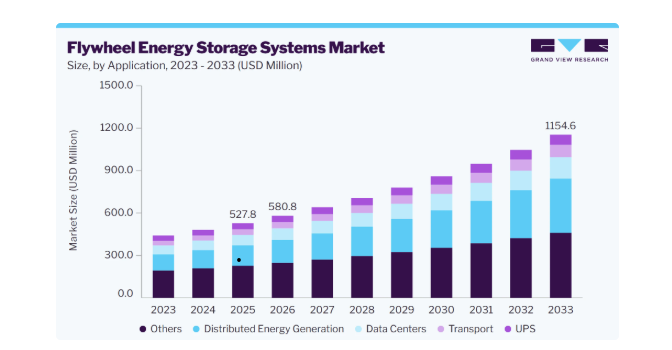
The global flywheel energy storage systems market was valued at USD 527.8 million in 2025 and is projected to grow from USD 580.8 million in 2026 to USD 1,154.6 million by 2033, expanding at a CAGR of 10.3% from 2026 to 2033. North America accounted for the largest revenue share of 77.7% in 2025, while growing renewable energy deployment and grid modernization are creating opportunities across other regions.
Key Highlights
The Flywheel Energy Storage Systems Market is being supported by rising demand for grid stability, renewable energy integration, uninterrupted power supply, and resilient infrastructure. Distributed energy generation represented a 27.2% market share in 2025, while North America remained the largest regional market. Increasing investments in AI-oriented data centers are also creating new requirements for rapid-response backup and power-quality solutions, strengthening the role of FESS alongside conventional energy storage technologies.
Download a free sample report or claim your copy of this full market intelligence report
Grid Modernization → Demand for Rapid-Response Storage
The growing penetration of solar and wind power is changing the requirements of modern electricity grids. Renewable generation can fluctuate depending on weather and operating conditions, increasing the need for technologies capable of responding quickly to variations in supply and demand. Flywheel systems can rapidly inject or absorb electricity, supporting frequency regulation, voltage management, and grid stabilization. Their ability to withstand frequent charge-discharge cycles without the same type of degradation associated with conventional batteries makes them particularly relevant for applications involving repeated short-duration power events.
As utilities modernize electricity infrastructure and renewable generation becomes a larger component of power systems, the flywheel energy storage systems market is gaining opportunities in grid-support applications.
Reliability → UPS and Critical Infrastructure Adoption
Reliable electricity is essential for data centers, factories, commercial facilities, transportation systems, and other critical infrastructure. Even short power interruptions or voltage fluctuations can disrupt operations and create significant financial losses.
Flywheel-based UPS solutions can respond rapidly to power disturbances, providing temporary backup while supporting continuity of operations. This capability is particularly relevant in locations where grid infrastructure is less reliable and in facilities where maintaining consistent power quality is critical. The growing importance of resilient infrastructure is therefore expanding the application landscape for FESS beyond conventional grid services.
Distributed Energy Generation → Localized Power Resilience
Distributed energy generation accounted for 27.2% of the flywheel energy storage systems market in 2025. Producing electricity closer to the point of consumption can improve resilience while reducing some of the inefficiencies and infrastructure requirements associated with centralized generation.
Flywheel systems can complement distributed energy resources by providing rapid backup and supporting power quality. Their role becomes especially valuable in facilities exposed to severe weather events or other disruptions, where maintaining electricity availability is essential.
AI Data Centers → A New Opportunity for Flywheel Systems
The rapid expansion of AI and high-performance computing infrastructure is creating substantial requirements for reliable, high-quality electricity. Data centers cannot afford frequent interruptions because even brief power disturbances can affect computing workloads and operational continuity.
This is creating an emerging opportunity for the flywheel energy storage systems market. FESS can provide rapid-response backup and power conditioning while supporting high-frequency cycling requirements. As data-center infrastructure expands, flywheels may increasingly be deployed alongside other backup and energy-management technologies to address different stages of power protection.
Cost and Complexity → The Remaining Challenge
Despite their operational advantages, flywheel systems can face barriers related to initial investment and mechanical complexity. Designing and deploying high-speed rotating systems requires specialized engineering, safety considerations, and supporting infrastructure.
This can make adoption more challenging when customers compare FESS with established battery technologies. Continued improvements in system design, manufacturing, deployment models, and overall economics will therefore influence how widely flywheel technology is adopted across new applications.
Renewable Integration → Expanding Application Potential
The combination of renewable energy expansion and grid modernization is creating a favorable environment for fast-response storage. Solar and wind projects require complementary technologies that can respond quickly to fluctuations in electricity generation.
Flywheels offer a distinct value proposition where rapid response and frequent cycling are more important than long-duration energy storage. This positions FESS as a complementary technology within a broader energy-storage ecosystem rather than a direct replacement for every battery-based application.
Regional Expansion → North American Leadership Meets Global Adoption
North America dominated the flywheel energy storage systems market with a 77.7% revenue share in 2025. Strong demand for UPS solutions, grid modernization, renewable integration, and reliable power infrastructure supports regional adoption. The U.S. held the largest country-level share in the region.
Europe is benefiting from renewable energy integration and industrial applications, with Germany representing an important market because of its engineering and automotive industries. The UK is also emphasizing grid stability and renewable integration, creating opportunities for rapid-response energy storage.
Asia Pacific is expanding as industrialization, electricity demand, renewable deployment, and energy-storage investment increase. China, Japan, India, and South Korea are exploring flywheel technology for grid stability and power-management applications. Japan is additionally benefiting from technological developments focused on efficiency and durability. Central and South America are developing opportunities around energy resilience and grid stability, while the Middle East and Africa are seeing potential from renewable integration and the expansion of data centers requiring uninterrupted power.
Key Flywheel Energy Storage Systems Companies
- Langley Holdings plc
- Amber Kinetics, Inc.
- Stornetic GmbH
- Energiestro
- Active Power
- Beacon Power
These companies are contributing to the competitive development of FESS through solutions targeting UPS, grid stabilization, distributed energy generation, and other high-power applications.
Conclusion
The flywheel energy storage systems market is developing around a specific need within the changing power ecosystem: rapid, reliable, and repeatable energy response. Renewable integration, grid modernization, distributed generation, UPS requirements, and data-center expansion are creating applications where the technology's operating characteristics can provide significant value. As power systems become more dynamic and critical infrastructure demands greater resilience, continued technological development and broader commercial deployment could expand the role of flywheel systems within the global energy-storage landscape.
About us:
Grand View Research, a market research and consulting company, provides syndicated research reports, customized research reports, and consulting services. Grand View Research database is used by the world's renowned academic institutions and Fortune 500 companies to understand the global and regional business environment. Our database features thousands of statistics and in-depth analysis on 46 industries in 25 major countries worldwide.

 English
 Arabic
 French
 Spanish
 Portuguese
 Deutsch
 Turkish
 Dutch
Dutch
 Italiano
 Russian
 Romaian
 Greek
Greek
