
How Are AI Data Centers Creating Growth Opportunities for Liquid Cooling?
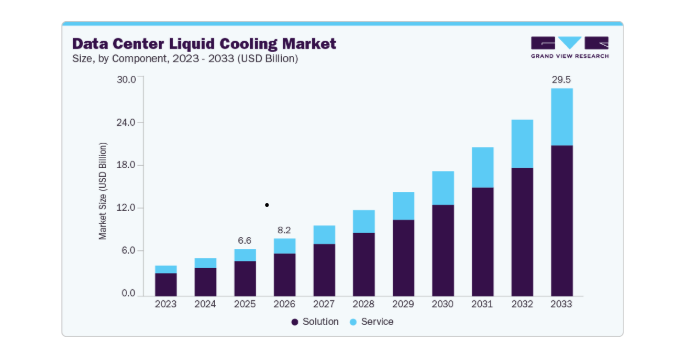
The Data Center Liquid Cooling Market is expanding rapidly as artificial intelligence, machine learning, high-performance computing, and cloud infrastructure increase the amount of heat generated inside modern data centers. Next-generation GPUs, AI accelerators, and high-density servers are placing greater thermal demands on facilities, creating limitations for conventional air-cooling systems.
The global Data Center Liquid Cooling Market was valued at USD 6.7 billion in 2025 and is projected to reach USD 29.5 billion by 2033, growing at a 20.1% CAGR from 2026 to 2033. North America accounted for the largest revenue share of 35.6% in 2025, while Asia Pacific is expected to record the fastest growth during the forecast period.
Key Highlights
The market is being shaped by rapidly increasing computing density, AI and HPC deployment, hyperscale data center expansion, and the need for more efficient thermal management. The solution segment accounted for 74.5% of revenue in 2025, while the IT segment represented the leading end-use category. Direct liquid cooling, cold plate cooling, hyperscale infrastructure, and specialized installation and maintenance services are becoming increasingly important as data center operators prepare for more demanding workloads.
Why Is AI Increasing Demand for Liquid Cooling?
Artificial intelligence is changing the thermal profile of modern data centers. AI training and inference workloads depend heavily on GPUs, AI accelerators, and other high-performance processors that generate concentrated heat during continuous operation. Traditional air cooling can become increasingly difficult to manage as rack densities rise. High-density AI infrastructure can create localized hotspots and place greater pressure on airflow systems. Liquid cooling provides a more efficient method of transferring heat away from processors, allowing operators to support demanding workloads while maintaining thermal stability.
The increasing deployment of AI infrastructure by enterprises, cloud providers, hyperscale operators, and research organizations is therefore becoming one of the strongest growth factors for the market.
What Is Making Hyperscale Data Centers Important to Market Growth?
Hyperscale data centers are becoming major consumers of advanced thermal management technologies. These facilities operate at enormous scale and increasingly support AI model training, cloud-native applications, big data analytics, and other compute-intensive workloads.
As computing capacity expands, operators need cooling infrastructure that can accommodate higher rack densities without compromising reliability. Liquid cooling can help facilities manage thermal loads more effectively while supporting greater computing capacity within available space.
Colocation facilities are also contributing to demand as enterprises increasingly rely on external data center infrastructure instead of building and operating their own facilities.
Download a free sample report or claim your copy of this full market intelligence report
Which Cooling Technologies Are Gaining Attention?
Direct liquid cooling is becoming particularly important for high-density computing because it transfers heat directly from processors or other heat-generating components. This approach can support environments where rack power densities are significantly higher than those traditionally handled through air cooling. Cold plate cooling is another important technology. Modern processors increasingly use advanced packaging, chiplets, stacked dies, and high-bandwidth memory, creating complex thermal patterns. Cold plates can be designed to target these heat concentrations more precisely.
Immersion cooling represents another developing opportunity. In immersion systems, servers or components are placed directly into thermally conductive dielectric fluids, allowing heat to be removed efficiently from high-density computing equipment.
Why Is the Solution Segment Leading the Market?
The solution segment accounted for 74.5% of revenue in 2025. Data center operators are increasingly seeking integrated cooling solutions instead of purchasing individual components separately. These solutions can combine cooling hardware, control systems, monitoring technologies, integration capabilities, and other infrastructure into coordinated architectures. This can simplify deployment and reduce the complexity associated with designing liquid cooling systems for high-density environments.
As AI infrastructure becomes more complex, demand for integrated and scalable cooling solutions is expected to remain strong.
How Are Installation and Maintenance Services Evolving?
Liquid cooling systems require specialized expertise for deployment, monitoring, maintenance, and optimization. This is creating opportunities for service providers alongside equipment manufacturers. The installation and deployment segment led the service category in 2025 as AI and GPU cluster deployments accelerated. Specialized teams can support the installation of piping systems, coolant distribution units, rack-level infrastructure, and other liquid-cooling components.
Maintenance and support are also becoming more technology-driven. Sensors can continuously monitor fluid temperature, pressure, flow rates, and pump performance. These operational signals can support predictive maintenance strategies and help operators identify potential problems before they result in downtime.
What Role Are Hyperscale and Edge Data Centers Playing?
Hyperscale data centers dominated the data center category in 2025 because of their extensive use of high-density computing infrastructure. The increasing deployment of AI clusters and data-intensive cloud services is creating substantial thermal management requirements.
At the other end of the infrastructure spectrum, edge data centers are emerging as another growth opportunity. Edge computing brings processing closer to end users to support applications such as 5G, autonomous systems, industrial IoT, smart cities, and augmented or virtual reality.
Because edge facilities can operate in space-constrained environments, efficient thermal management can become particularly important.
How Is the IT Industry Influencing Demand?
The IT segment held the largest revenue share by end use in 2025. Digital transformation, virtualization, containerized applications, cloud computing, and real-time data processing are increasing computational requirements across enterprise infrastructure.
Higher server densities can generate additional thermal loads, creating demand for cooling systems that can maintain stable operating conditions. Liquid cooling can help reduce thermal limitations and support higher-performance computing infrastructure.
Healthcare is another emerging application area. AI-powered medical imaging, genomics, drug discovery, predictive diagnostics, and personalized medicine increasingly rely on GPU and HPC infrastructure, creating additional requirements for advanced cooling.
What Is Limiting Wider Adoption of Liquid Cooling?
High implementation costs remain one of the major challenges facing the Data Center Liquid Cooling Market. Liquid cooling infrastructure can require specialized engineering, installation expertise, monitoring systems, and modifications to existing facilities.
Integration is another challenge. Many existing data centers were originally designed around air cooling, meaning operators may need phased implementation strategies to introduce liquid cooling without disrupting ongoing operations.
The technical complexity of managing fluids, pumps, piping, heat exchangers, and cooling distribution systems can also increase operational requirements. These factors may slow adoption among facilities where workloads do not yet justify the additional investment.
Where Is the Market Growing the Fastest?
North America: North America accounted for 35.6% of global revenue in 2025, making it the leading regional market. Strong investments in AI, cloud computing, hyperscale infrastructure, and high-performance computing are creating substantial demand for advanced cooling technologies. The U.S. led the North American market in 2025.
Europe: European adoption is strongly connected with energy efficiency and sustainability objectives. Data center operators are increasingly looking for technologies that can reduce energy consumption while supporting growing computing requirements. Liquid cooling is therefore gaining attention as facilities address both performance and environmental considerations.
Asia Pacific: Asia Pacific is expected to record the highest CAGR from 2026 to 2033. Expanding digital infrastructure, cloud adoption, AI deployment, and data center construction across India, China, Japan, and South Korea are supporting regional demand. The growing use of AI and HPC workloads is particularly important as operators across the region build infrastructure capable of supporting increasingly dense computing environments.
What Does the Future Look Like for the Data Center Liquid Cooling Market?
The future of the Data Center Liquid Cooling Market is closely connected with the increasing power requirements of modern computing. AI, HPC, cloud infrastructure, hyperscale facilities, and emerging edge applications are all increasing the importance of efficient thermal management.
As rack densities continue to rise, data center operators will increasingly evaluate cooling technologies based on performance, scalability, energy efficiency, reliability, and integration requirements. Direct liquid cooling, cold plate systems, immersion cooling, and advanced service models are therefore expected to remain important areas of market development through 2033.
About us:
Grand View Research, a market research and consulting company, provides syndicated research reports, customized research reports, and consulting services. Grand View Research database is used by the world's renowned academic institutions and Fortune 500 companies to understand the global and regional business environment. Our database features thousands of statistics and in-depth analysis on 46 industries in 25 major countries worldwide.

 English
 Arabic
 French
 Spanish
 Portuguese
 Deutsch
 Turkish
 Dutch
Dutch
 Italiano
 Russian
 Romaian
 Portuguese (Brazil)
