
Centralized Refrigeration Systems Market Forecast: USD 57.64 Billion by 2036 as Commercial Facilities Modernize Refrigeration
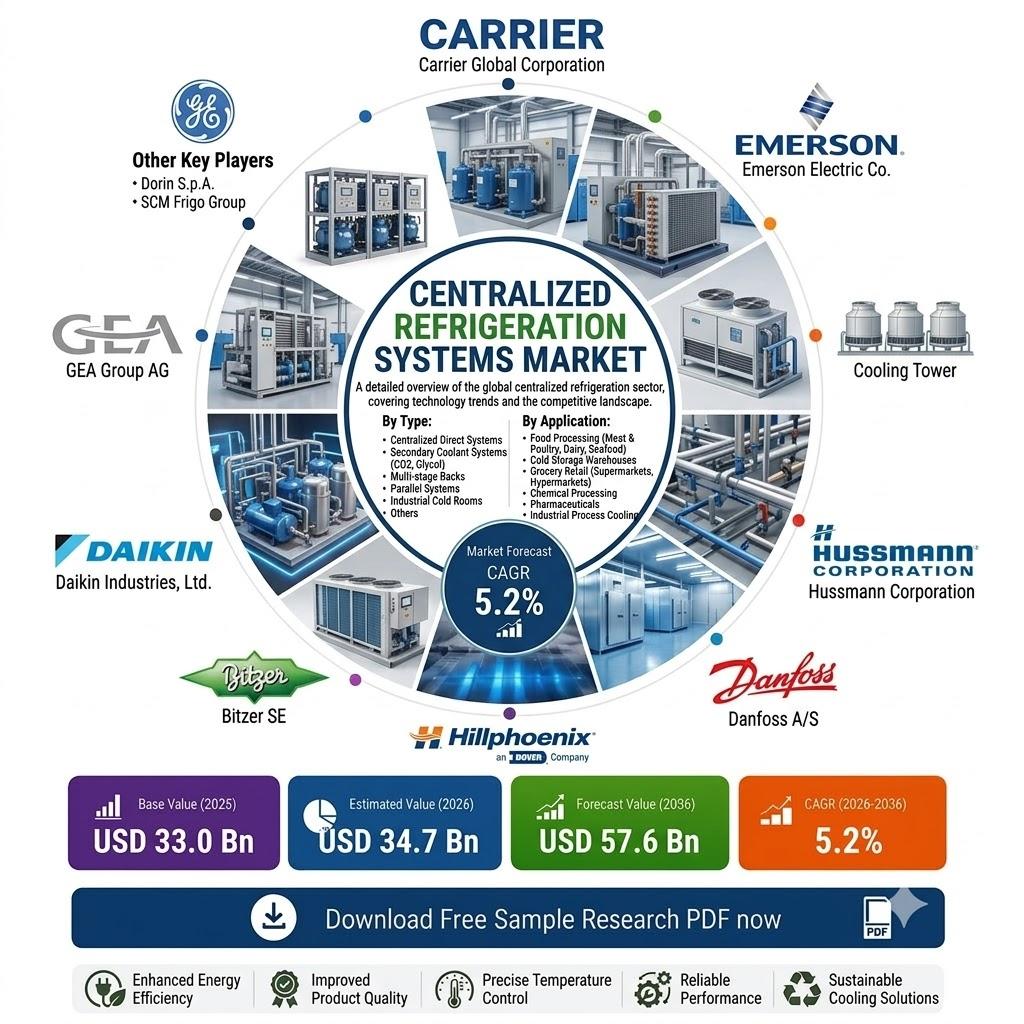
The global centralized refrigeration systems market is estimated at USD 33.0 billion in 2025 and is projected to reach USD 57.64 billion by 2036, expanding at a 5.2% CAGR during the forecast period, according to Fact.MR analysis.
Centralized refrigeration systems use a central compressor plant connected through piping networks to serve multiple refrigerated zones. These systems are used across food retail, cold storage, food processing, pharmaceutical applications, refrigerated display cases, blast freezers, and process cooling operations.
Get detailed market forecasts, competitive benchmarking, and pricing trends: https://www.factmr.com/connectus/sample?flag=S&rep_id=11712
The market is undergoing a significant technology transition as regulations and procurement priorities shift away from high-global-warming-potential HFC refrigerants. The Kigali Amendment and EU F gas regulation are supporting the move toward natural refrigerants, including carbon dioxide (CO2), ammonia (NH3), and propane.
The market is expected to reach approximately USD 34.72 billion in 2026, creating an absolute dollar opportunity of USD 22.92 billion between 2026 and 2036.
Food Retail and Cold Chain Investment Support Demand
Expansion of organized food retail in emerging economies is creating new procurement opportunities for centralized refrigeration. Supermarket and hypermarket construction in India, China, and Southeast Asia requires systems capable of serving multiple refrigerated display cases and temperature-controlled areas from a central plant.
Cold chain infrastructure is another important demand driver. Distribution hubs, warehouses, food processing facilities, and pharmaceutical storage operations require centralized refrigeration to support temperature-sensitive products.
Regulatory changes are also influencing purchasing decisions. Kigali Amendment HFC phase-down requirements and EU F gas regulation are creating a replacement cycle for systems using high-GWP synthetic refrigerants.
Energy efficiency is becoming another procurement consideration. Variable-speed compressors, heat recovery, intelligent defrost management, and centralized monitoring are being incorporated into refrigeration systems to improve energy performance.
Natural Refrigerants Gain Ground
Natural refrigerant refrigeration systems are expected to account for 38.9% of the refrigerant type segment in 2026. CO2 transcritical systems lead among natural alternatives, while ammonia and propane serve specific industrial and smaller-format applications.
CO2 transcritical refrigeration is emerging as a defining product trend. The technology uses carbon dioxide (R744) as the refrigerant and eliminates the use of high-GWP synthetic refrigerants.
Northern Europe has established a strong installed base of CO2 transcritical systems, particularly in food retail. Adoption is also expanding into Southern Europe, North America, Japan, and Australia as technology improvements address performance requirements in warmer climates.
Ejectors, parallel compression, and adiabatic gas coolers are helping extend the operating range of CO2 systems. These technologies are particularly relevant in regions where ambient temperatures can exceed 35°C.
Compressor Rack Systems Remain a Major Product Segment
Compressor rack refrigeration systems are expected to account for 34.7% of the product segment in 2026. Rack systems combine multiple compressors on a common frame and can serve medium- and low-temperature circuits throughout food retail stores.
Their centralized configuration supports maintenance, piped refrigerant distribution, and integration with building management systems. Heat recovery can also be used for store heating and hot water production.
Automatic refrigeration control systems are projected to represent 41.6% of the control system segment in 2026, reflecting the growing role of centralized monitoring and energy optimization.
Asia Pacific Shows Strong Country-Level Growth
India is projected to record a 6.5% CAGR between 2026 and 2036, supported by organized food retail expansion, cold chain development, and supermarket and hypermarket construction.
China follows with a projected 6.2% CAGR, supported by cold chain infrastructure investment, food retail modernization, and increasing CO2 system adoption in northern climate zones.
Japan is expected to expand at 4.7%, while Germany and the United States are projected to record CAGRs of 4.5% and 4.3%, respectively.
Europe maintains the largest CO2 transcritical installed base, supported by regulatory requirements and food retail sustainability commitments. North America is seeing demand from supermarket refrigeration replacement, cold storage expansion, and increasing natural refrigerant specifications.
Technology and Cost Remain Key Considerations
Higher acquisition costs for CO2 transcritical systems compared with HFC alternatives remain a constraint, particularly in warm climates where additional equipment may be required.
The availability of skilled technicians for natural refrigerant installation and maintenance is another challenge in emerging markets.
At the same time, technology improvements are creating opportunities. CO2 system enhancements, refrigeration heat recovery, and IoT-enabled monitoring can support improved operating economics and create opportunities for recurring service activities.
Shambhu Nath Jha, Principal Consultant at Fact.MR, stated: “The centralized refrigeration systems market is being reshaped by the natural refrigerant transition, which is the most significant technology shift since the CFC phase out.”
Competitive Landscape
The competitive environment includes Carrier Global Corporation, Hussmann Corporation, Bitzer SE, Emerson Climate Technologies, GEA Group, Danfoss, Daikin Industries, Dorin, Hillphoenix (Dover), and SCM Frigo.
Carrier Global Corporation holds approximately 16% market share, according to Fact.MR analysis, supported by its commercial refrigeration portfolio, CO2 transcritical product line, and global food retail customer base.
Recent industry developments include Carrier's continued CO2 transcritical platform expansion, Danfoss's multi-ejector technology deployment for warm-climate CO2 applications, and Hussmann's continued rollout of CO2 transcritical systems across North American food retail.
Report Scope
The Fact.MR study covers the centralized refrigeration systems market across 30+ countries and examines product, refrigerant type, system configuration, cooling capacity, control system, and regional markets.
The research methodology combines secondary research, primary interviews, and forecast modelling. The study draws on 120+ secondary sources, benchmarks 45+ company product portfolios, and includes 25+ primary interviews with manufacturers, food retailers, cold chain operators, and refrigeration contractors.
Top Trending Reports:
https://www.openpr.com/news/4502313/waterjet-cutting-machines-enter-a-new-phase-of-industrial
https://www.openpr.com/news/4502316/industrial-engine-market-outlook-why-power-reliability
https://www.openpr.com/news/4502327/industrial-battery-chargers-market-enters-strategic-growth
https://www.openpr.com/news/4502333/underwater-robots-move-from-niche-exploration-tools
About (Fact.MR)
(Fact.MR) provides market research and forecasting across global industries. Its research combines market data, primary interviews, secondary research, and forecasting models to assess market size, competitive positioning, technology trends, and growth opportunities.

 English
 Arabic
 French
 Spanish
 Portuguese
 Deutsch
 Turkish
 Dutch
Dutch
 Russian
 Romaian
 Portuguese (Brazil)
 Greek
Greek
