
Managed SIEM Providers Can Change How Healthcare Teams Handle Security
Why Healthcare Security Needs More Than Basic Monitoring
Healthcare organizations increasingly depend on digital systems to support everyday operations.
Clinical applications, administrative systems, connected infrastructure, employee accounts, patient-facing services, and other technology platforms can generate a continuous stream of security-related events.
The challenge is not simply having those events available. Security teams need to determine which activity matters, which patterns deserve investigation, and how significant events should move through the organization's security process.
Managed SIEM providers can support this requirement by centralizing security information and providing operational monitoring around events generated across relevant technology environments.
For healthcare organizations in India, this can be especially useful when internal IT teams have to balance security responsibilities with the wider demands of maintaining business-critical technology.
A managed approach can provide additional operational support without making SIEM management an entirely internal responsibility.
What a SOC Solution Provider Adds to Healthcare Security
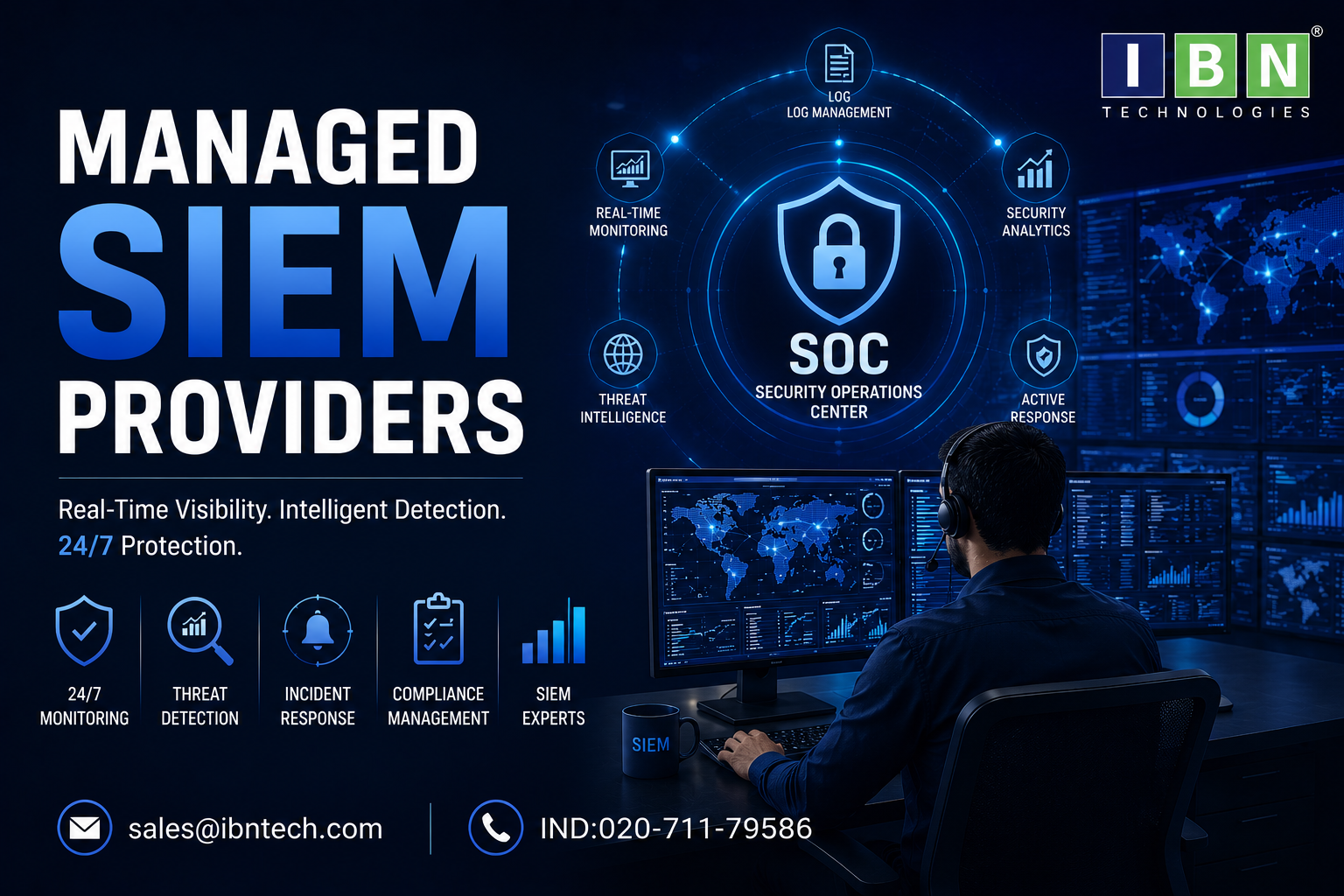
A soc solution provider can bring together security monitoring, alert analysis, investigation, and escalation capabilities around an organization's security environment.
The distinction between the SIEM and SOC functions is important.
SIEM technology helps collect and correlate security events.
SOC operations provide the people and processes needed to monitor those events and investigate activity that may require attention.
For healthcare organizations, the combination can create a more structured security-monitoring workflow.
A suspicious login, for example, may not be meaningful by itself. But when it is associated with unusual access activity, unexpected privilege changes, or other abnormal behavior, it can become more relevant for investigation.
The objective is to provide context rather than simply generate notifications.
Healthcare Technology Creates a Visibility Challenge
Healthcare environments can contain a mixture of traditional and modern technology.
Some systems may be tightly integrated into daily operations, while others may be managed separately or operate on different technology platforms.
This can make centralized security visibility difficult.
When security events remain distributed across multiple systems, analysts may have to examine several sources to understand what happened.
A SIEM can help consolidate relevant information.
However, effective monitoring still depends on deciding what information should be collected, how it should be correlated, and how alerts should be handled.
This is where operational support becomes important.
A managed service can help healthcare organizations establish a monitoring process that continues beyond the initial SIEM deployment.
The Difference Between Visibility and Understanding
Security visibility means having access to relevant information.
Security understanding means being able to interpret that information in context.
The distinction matters.
A healthcare IT environment may generate thousands of routine events every day. Authentication activity, application access, system changes, network connections, and administrative actions can all create records.
Most of those events may not represent threats.
The challenge is identifying patterns that deserve attention without overwhelming security teams with unnecessary alerts.
Managed monitoring can help establish processes for filtering, prioritizing, investigating, and escalating relevant activity.
This can allow internal teams to focus more closely on events that require organizational decisions.
How a Managed SIEM Model Works in Practice
The exact configuration depends on the healthcare organization's environment, but the process can be understood through several stages.
Security Data Collection
Relevant systems generate logs and security events.
The organization first needs to identify which sources provide useful security information and how those sources should be incorporated into the monitoring environment.
Event Correlation
Related events can be analyzed together.
Correlation can help reveal patterns that may not be apparent when each event is reviewed independently.
Alert Analysis
Potentially significant activity is reviewed according to established monitoring logic and priorities.
This stage helps separate routine events from activity that warrants deeper investigation.
Investigation
Security analysts examine available information and context to determine what may have occurred.
The investigation process should account for legitimate operational activity so that unusual does not automatically mean malicious.
Escalation
When an event meets predefined criteria, it can be escalated to the appropriate internal stakeholders.
Clear responsibilities are important because the monitoring team may identify the event while the organization's own personnel retain authority over business or operational decisions.
Why Healthcare Teams May Consider a Managed Model
Healthcare IT teams often have to support technology that cannot simply be treated as another back-office system.
Availability and reliability can be important operational considerations.
At the same time, security monitoring requires specialized knowledge and ongoing attention.
Maintaining a SIEM environment internally can involve:
- Log-source management
- Detection configuration
- Alert monitoring
- Investigation
- False-positive tuning
- Reporting
- Escalation management
- Ongoing monitoring adjustments
For an organization with limited security resources, handling every part internally can increase operational pressure.
A managed model can provide an additional security operations layer while allowing internal IT personnel to retain control over their technology environment.
What Healthcare Organizations Should Examine Before Engagement
Choosing a managed SIEM arrangement should begin with the organization's actual security environment.
Understand the Technology Landscape
Healthcare leaders should first identify the systems that require monitoring.
This provides a foundation for discussing data sources, visibility requirements, and security priorities with a service provider.
Define Sensitive Areas
Not every system carries the same level of business importance.
Organizations should identify technology environments where unusual activity could have particularly significant consequences.
This helps inform monitoring priorities.
Establish Clear Escalation Paths
A security service should have defined procedures for escalating important findings.
Healthcare organizations should know who receives an escalation, what information is included, and which internal team is responsible for the next action.
Assess Reporting Requirements
Security stakeholders may require different levels of information.
Technical teams may need detailed event information, while management may require a concise view of significant activity and security trends.
Reporting should accommodate these operational needs.
Review Service Adaptability
Healthcare environments can change as applications, infrastructure, users, and technology services evolve.
Monitoring should be reviewed whenever meaningful changes affect the organization's security visibility.
A Practical Healthcare SIEM Checklist
Before moving toward managed SIEM, healthcare organizations can consider:
- Identify critical technology environments
- Map available security logs and event sources
- Determine which activity requires closer monitoring
- Define security alert priorities
- Establish investigation procedures
- Document incident escalation responsibilities
- Review reporting expectations
- Determine how monitoring changes will be handled
- Assess internal and external security responsibilities
- Review applicable security and data-protection obligations
The purpose of this checklist is not to prescribe one monitoring architecture. It helps organizations establish the questions that should be answered before service implementation.
Protecting Security Visibility Without Creating More Noise
More monitoring does not automatically mean better monitoring.
If an organization collects every possible event without considering relevance, security teams may face excessive data volumes.
The result can be alert fatigue.
A better approach is to identify meaningful sources and establish monitoring logic around events that can provide useful security signals.
Detection should also be reviewed over time.
A healthcare organization's normal activity can change. New applications may be introduced, access patterns can evolve, and infrastructure may be modified.
Security monitoring needs to reflect those changes.
This makes ongoing tuning an important part of managed SIEM operations.
Security Monitoring and Healthcare Governance
Healthcare organizations should consider security monitoring as part of their wider information-security and data-protection framework.
The exact obligations applicable to an organization depend on its operations, systems, data, contractual arrangements, and relevant Indian requirements.
Centralized security information can support investigations and provide greater visibility into activity across monitored systems.
However, deploying SIEM does not automatically establish compliance.
Organizations should identify the requirements applicable to their specific environment and determine what security controls, monitoring, records, and processes are necessary.
Where ISO/IEC 27001 is relevant, security monitoring can form part of a broader information-security management approach.
The monitoring service should therefore be aligned with organizational governance rather than implemented as a standalone technical project.
The Importance of Clear Ownership
One of the most important aspects of managed security monitoring is defining who owns each decision.
A service provider may identify and investigate suspicious activity.
The internal healthcare organization may then need to decide whether operational changes, access restrictions, incident-response actions, or other measures are required.
Without clear ownership, even a well-detected security event can become difficult to manage.
Before service implementation, organizations should establish escalation criteria and responsibilities.
This creates a more predictable connection between external monitoring and internal decision-making.
Making Security Monitoring More Sustainable
A managed SIEM service can be useful when healthcare organizations need broader security visibility but want to avoid placing every monitoring responsibility on internal IT personnel.
The strongest approach is not necessarily the one that produces the greatest volume of security data.
It is the one that provides relevant visibility, meaningful analysis, clear escalation, and a sustainable operating process.
Regular reviews can help organizations identify monitoring gaps, adjust detection logic, and account for changes in their technology environment.
This turns SIEM from a deployment exercise into an ongoing security capability.
Contact Us:
IND- 02067680404
IBN Technologies Ltd.
E-mail: - sales@ibntech.com

 English
 Arabic
 Spanish
 Portuguese
 Deutsch
 Turkish
 Dutch
Dutch
 Italiano
 Russian
 Romaian
 Portuguese (Brazil)
 Greek
Greek
