
What Role Does AI Play in Smart Retail Market Development?
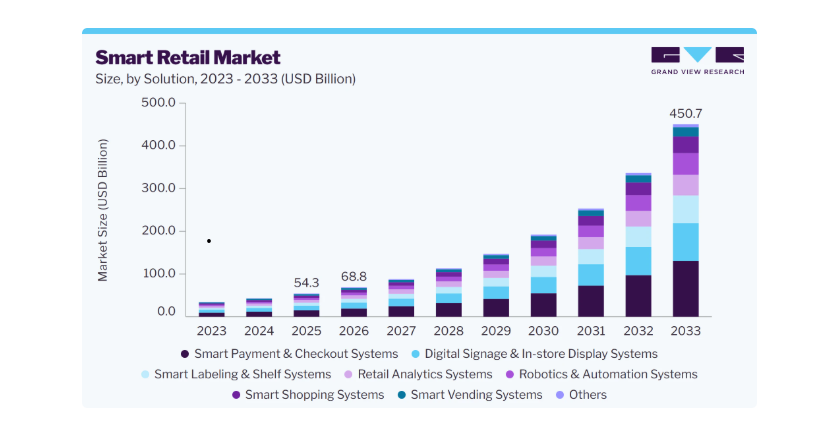
The Smart Retail Market is rapidly changing the way retailers operate stores, manage inventory, interact with customers, and process transactions. Valued at USD 54.3 billion in 2025, the market is projected to reach USD 450.7 billion by 2033, expanding at a 30.8% CAGR from 2026 to 2033. The growth reflects increasing investments in artificial intelligence, IoT, smart payment systems, computer vision, retail analytics, robotics, and omnichannel technologies.
Key Highlights
The Smart Retail Market is projected to grow from USD 68.8 billion in 2026 to USD 450.7 billion by 2033, supported by a 30.8% CAGR. North America held the largest regional share at 33.9% in 2025, while Asia Pacific is expected to record the fastest growth. Smart payment and checkout systems represented 27.5% of the solution segment, AI & ML accounted for 22.2% of the technology segment, and inventory and merchandise management represented 23.7% of applications. Apparel and accessories held the largest offering share, while the U.S. remained the largest country-level market.
Why Is Artificial Intelligence Becoming Central to Smart Retail?
Artificial intelligence is becoming one of the most important technologies supporting smart retail because retailers need to make faster decisions from increasingly large volumes of customer and operational data. AI and machine learning can support demand forecasting, personalized recommendations, dynamic pricing, fraud detection, customer behavior analysis, and inventory optimization.
Retailers are also experimenting with AI-powered virtual assistants and intelligent shopping tools that can help customers find products, compare alternatives, and receive personalized recommendations. These capabilities can make shopping more relevant while helping retailers improve engagement and conversion.
The integration of generative AI is creating another layer of opportunity. In January 2026, Honeywell partnered with Google Cloud and 66degrees to launch an AI-enabled Smart Shopping Platform designed to assist shoppers with product discovery and alternatives while supporting retail efficiency.
How Are IoT Technologies Changing Physical Stores?
IoT is making physical stores more measurable and connected. Smart shelves, RFID systems, beacons, sensors, and electronic shelf labels can provide retailers with real-time information about inventory, product movement, customer activity, and store conditions.
This connectivity can improve inventory accuracy and reduce the time required for manual monitoring. Retailers can identify low-stock products, track merchandise movement, and obtain more detailed information about shopping behavior.
The value of IoT becomes even greater when it is connected with AI and analytics platforms. Instead of simply collecting information, retailers can use that information to identify patterns and support operational decisions.
Download a free sample report or claim your copy of this full market intelligence report
What Role Does Inventory Management Play in Smart Retail?
Inventory and merchandise management accounted for 23.7% of the market in 2025, making it the leading application segment. Inventory accuracy directly affects product availability, customer satisfaction, operating costs, and revenue.
Retailers are using RFID, smart shelves, IoT sensors, AI-based forecasting, and electronic shelf labels to improve visibility into inventory levels. These technologies can support automated replenishment, reduce stockouts, identify discrepancies, and improve merchandising decisions.
How Are Mobile Technologies Supporting Omnichannel Shopping?
Mobile technologies are helping retailers connect online and offline experiences. Mobile POS systems, retailer applications, digital wallets, QR payments, loyalty programs, and location-based services give customers more ways to interact with retailers.
A shopper can use a mobile application to check product availability, receive personalized recommendations, access loyalty benefits, or complete a transaction. Retailers can simultaneously use mobile data to understand customer preferences and improve promotional strategies.
This convergence between physical and digital retail is strengthening the development of omnichannel commerce and encouraging retailers to invest in technologies that provide consistent experiences across different touchpoints.
Why Are Retailers Investing in Robotics and Automation?
Retailers are increasingly using robotics to handle repetitive activities and improve store productivity. Inventory-scanning robots, autonomous cleaning systems, shelf-monitoring technologies, and customer service robots can support employees while improving operational visibility.
The robotics and automation systems segment is expected to register the highest growth among solution categories. Labor constraints, increasing store complexity, and the need for faster inventory management are encouraging retailers to explore automation.
Which Retail Applications Are Expected to See Strong Growth?
Customer experience and personalization is expected to register the highest growth among applications. Retailers are increasingly looking for ways to provide recommendations, promotions, and interactions based on individual customer preferences.
AI recommendation engines, customer analytics, computer vision, digital signage, mobile applications, and loyalty platforms can help retailers create more personalized experiences. These tools can also help retailers understand how customers interact with stores and digital platforms.
Where Is the Smart Retail Market Growing the Fastest?
North America dominated the market with a 33.9% revenue share in 2025, supported by advanced retail infrastructure, strong adoption of omnichannel strategies, and investment in AI, analytics, and automation.
The U.S. accounted for the largest country-level share. Retailers are increasingly implementing AI-powered recommendation systems, robotics, customer analytics, and automated inventory solutions.
Europe is also expanding as retailers combine digital transformation with traceability, sustainability, and consumer-protection requirements. Technologies such as IoT monitoring and digital traceability are becoming increasingly relevant across retail supply chains.
Asia Pacific is expected to register the fastest CAGR from 2026 to 2033. High smartphone penetration, expanding e-commerce, digital infrastructure, and mobile-first consumer behavior are supporting adoption. Japan is increasingly interested in robotics and automation, while China's highly integrated digital ecosystem is supporting smart payments, AI-driven retail, and connected commerce.
What Challenges Could Limit Smart Retail Adoption?
High implementation costs remain an important challenge. Smart retail ecosystems can require significant investment in hardware, software, cloud infrastructure, connectivity, integration, and employee training. Smaller retailers may therefore face greater barriers to adoption.
Data privacy and cybersecurity are also important considerations. Smart retail technologies can process customer information, transaction data, behavioral patterns, and location-related information. Retailers need appropriate security and governance frameworks to maintain customer trust while using these technologies.
What Does the Future of Smart Retail Look Like?
The future of smart retail is likely to be defined by deeper integration rather than isolated technology adoption. AI can analyze data generated by IoT devices, mobile platforms, payment systems, inventory technologies, and customer interactions. Retailers can then use those insights to automate decisions and personalize experiences.
As the market moves toward its projected USD 450.7 billion value by 2033, the distinction between physical and digital retail is expected to become increasingly blurred. Connected stores, intelligent inventory systems, frictionless checkout, personalized engagement, and automated operations will continue shaping the next generation of retail.
About us:
Grand View Research, a market research and consulting company, provides syndicated research reports, customized research reports, and consulting services. Grand View Research database is used by the world's renowned academic institutions and Fortune 500 companies to understand the global and regional business environment. Our database features thousands of statistics and in-depth analysis on 46 industries in 25 major countries worldwide.

 English
 Arabic
 French
 Portuguese
 Deutsch
 Turkish
 Dutch
Dutch
 Italiano
 Russian
 Romaian
 Portuguese (Brazil)
 Greek
Greek
