
Natural Fiber Composites Market Growth Prospects for Sustainable Product Development
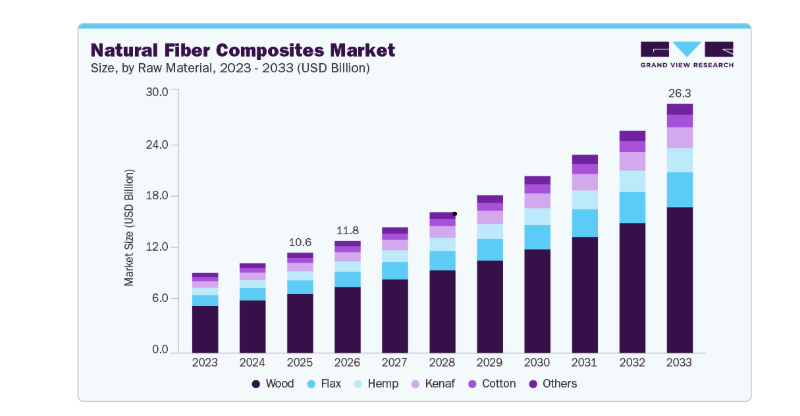
The global Natural Fiber Composites Market is entering a strong growth phase as manufacturers across automotive, construction, consumer goods, and other industries look for materials that can combine functional performance with lower environmental impact. The market was valued at USD 10.6 billion in 2025 and is projected to reach USD 26.3 billion by 2033, expanding at a 12.1% CAGR from 2026 to 2033. North America accounted for the largest revenue share at 48.4% in 2025, while Asia Pacific is projected to record the fastest growth at a 13.9% CAGR during the forecast period.
Natural fiber composites are gaining attention because renewable materials such as wood, hemp, jute, kenaf, sisal, bamboo, and flax can provide useful mechanical and insulation properties while supporting sustainability objectives. Their growing use reflects a broader shift in material selection, where manufacturers increasingly consider environmental impact, weight reduction, recyclability, and resource efficiency alongside conventional performance requirements.
Sustainability Focus → Rising Demand for Natural Fiber Composites
The strongest momentum in the natural fiber composites market comes from increasing environmental awareness. Consumers and industries are seeking alternatives to materials associated with higher environmental burdens, encouraging manufacturers to explore bio-based and renewable composite solutions.
Government regulations are also influencing this transition. Environmental standards related to emissions, plastics, waste management, and sustainable manufacturing are encouraging companies to reconsider material choices. Automotive and construction manufacturers, in particular, are exploring natural fiber composites for applications where lightweight construction, insulation, and sustainability can be combined.
Download a free sample report or claim your copy of this full market intelligence report
Natural fiber composites also provide manufacturers with an opportunity to balance performance and cost. Compared with certain synthetic reinforcement materials, natural fibers can offer advantages related to availability, weight, and renewable sourcing. Continued development in fiber treatment, resin systems, and processing technologies is further improving their suitability for demanding applications.
Material Selection → Wood Maintains Its Market Position
Wood-based materials represented 58.8% of the market in 2025, supported by their availability, cost-effectiveness, renewable characteristics, and mechanical properties. Their established use in construction and automotive applications provides a strong foundation for continued demand.
At the same time, hemp is emerging as a particularly dynamic material category. The hemp segment is projected to grow at a 12.9% CAGR, supported by its strength, low weight, and sustainability characteristics. Its potential application across automotive, construction, and other industries creates additional opportunities for manufacturers seeking alternatives to conventional reinforcement materials.
Matrix Development → Performance Meets Sustainability
Inorganic compounds accounted for 41.8% of market revenue in 2025, reflecting their thermal stability and mechanical strength. These characteristics make them useful for applications where durability and performance remain critical.
Natural polymers, however, are expected to expand at a faster 12.5% CAGR. Their biodegradability and compatibility with natural fibers align closely with the broader movement toward renewable material systems. As manufacturers search for more sustainable composite formulations, natural polymer matrices could become increasingly important.
Manufacturing Evolution → Compression Molding Leads
Compression molding accounted for 76.4% of revenue in 2025, making it the dominant technology segment. Its ability to support high-volume production, consistent quality, and efficient manufacturing of complex components has contributed to its widespread use.
Injection molding is projected to grow at a 12.8% CAGR, reflecting increasing demand for precise and complex components. Faster cycle times and design flexibility can make injection molding attractive as natural fiber composite applications expand beyond conventional product categories.
Construction Demand → New Applications Continue to Expand
Construction represented the largest application segment in 2025. Natural fiber composites can provide thermal insulation and support sustainable construction objectives, making them relevant to projects increasingly focused on environmentally responsible material selection.
Sporting goods are projected to register the fastest growth during the forecast period. Lightweight and durable characteristics can make natural fiber composites suitable for sporting equipment while also appealing to manufacturers and consumers interested in reducing environmental impact.
Regional Expansion → North America Leads While Asia Pacific Accelerates
North America held the largest revenue share of 48.4% in 2025. Strong manufacturing capabilities, established composite industries, environmental awareness, and demand from automotive and construction applications continue to support regional adoption. The U.S. remains an important market, with manufacturers increasingly exploring natural fiber composites for automotive components, building materials, and consumer products.
Europe represents another mature market, supported by environmental regulations, circular economy initiatives, automotive manufacturing, and research activity. Germany plays an important role because of its automotive and engineering base, with continued interest in lightweight and bio-based material technologies.
Asia Pacific is expected to record the fastest growth, with a 13.9% CAGR from 2026 to 2033. China, India, and Japan benefit from natural fiber availability and expanding automotive and construction industries. Growing industrialization and investments in sustainable manufacturing are creating additional opportunities for composite producers.
Latin America and the Middle East & Africa remain developing markets. Construction activity, agricultural resources, and increasing sustainability awareness provide opportunities, although processing infrastructure and technical capabilities can influence the pace of adoption.
Competitive Landscape → Innovation Becomes a Key Differentiator
The natural fiber composites market features a combination of established manufacturers and specialized innovators. Companies are focusing on material development, sustainability improvements, production expansion, and application-specific solutions to respond to increasing demand from automotive, construction, and other industries.
Key Natural Fiber Composites Companies
Key companies identified in the market include Flexform SpA, Procotex, TECNARO GMBH, and UPM, among others. TECNARO focuses on bio-based composite materials derived from renewable resources, while Trex Company develops composite decking and outdoor products using recycled material streams.
Natural Fiber Composites Market Outlook
The future of the natural fiber composites market will depend on how effectively manufacturers overcome performance limitations associated with moisture resistance, durability, consistency, and certain high-performance requirements. Synthetic composites remain important substitutes where maximum mechanical performance is required. However, improvements in fiber treatment, hybrid composites, natural polymers, and processing technologies are gradually broadening the application potential of NFCs.
With the market projected to rise from USD 11.8 billion in 2026 to USD 26.3 billion by 2033, sustainability-driven material substitution, lightweighting requirements, regulatory pressure, and technological innovation are expected to remain central to market development.
About us:
Grand View Research, a market research and consulting company, provides syndicated research reports, customized research reports, and consulting services. Grand View Research database is used by the world's renowned academic institutions and Fortune 500 companies to understand the global and regional business environment. Our database features thousands of statistics and in-depth analysis on 46 industries in 25 major countries worldwide.

 English
 Arabic
 French
 Spanish
 Portuguese
 Deutsch
 Turkish
 Dutch
Dutch
 Italiano
 Romaian
 Portuguese (Brazil)
 Greek
Greek
