
US Infertility Testing Market Forecast 2026–2034: Industry Trends & Insights
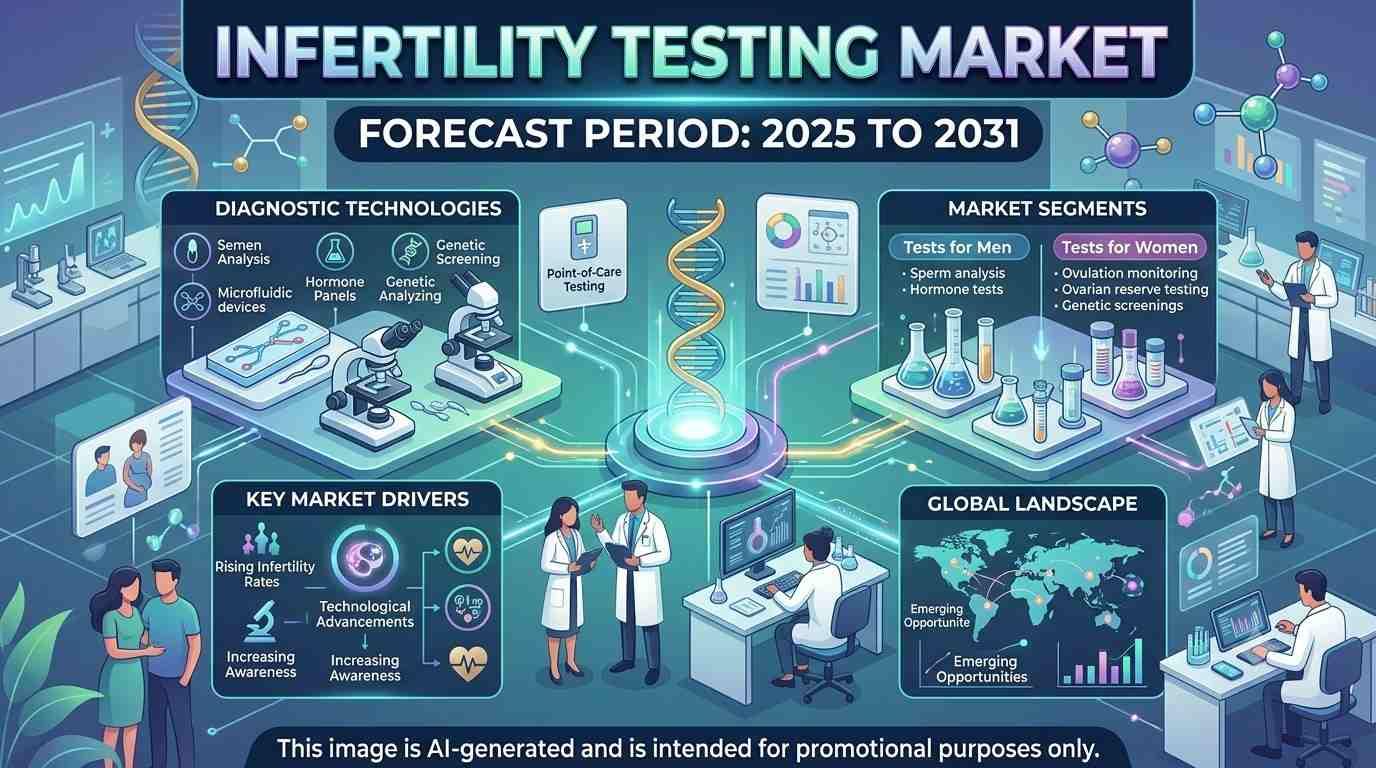
The US infertility testing market is expanding as awareness of fertility health increases and more individuals and couples seek early diagnosis and personalized reproductive care. The market includes diagnostic approaches such as ovulation testing, hormone testing, semen analysis, ovarian reserve assessment, imaging procedures, and genetic testing. Growing demand for fertility evaluation is supported by delayed childbearing, increasing use of assisted reproductive technologies, and broader access to fertility clinics and specialized diagnostic services.
The Infertility Testing Market size is expected to reach US$ 871.3 million by 2031 from US$ 494.7 million in 2024. The market is anticipated to register a CAGR of 8.6% during 2025–2031.
What is driving the market?
Increasing prevalence of lifestyle-related reproductive disorders, higher maternal and paternal age, and growing awareness of fertility preservation are the primary growth drivers. Diagnostic providers and clinics are rapidly adopting advanced testing modalities, including genetic screening, hormonal profiling, and digital home-testing kits. Health organizations, fertility clinics, and direct-to-consumer healthcare platforms are seeking rapid, highly accurate diagnostic solutions that optimize treatment planning without creating unnecessary physical or financial strain on patients.
The market is evolving from basic hormone testing to comprehensive, precision-driven reproductive diagnostics. Manufacturers and laboratories are investing in multi-target biomarker panels, non-invasive semen analysis systems, next-generation sequencing (NGS) for carrier screening, and automated point-of-care testing platforms. Fragmented diagnostic standards across developing regions, high costs associated with specialized genetic testing, and emotional stigma remain key market constraints.
Which region leads?
North America leads the market, accounting for an estimated 36%–40% share in 2025, supported by high healthcare expenditure, well-established fertility clinics, early adoption of advanced diagnostic technologies, and favorable reimbursement policies.
Asia Pacific is the fastest-growing region with a projected CAGR of 8.2%–9.1%. Growth is driven by expanding healthcare access, rising disposable incomes, changing social dynamics, and growing medical tourism for assisted reproductive technology (ART). China and India present significant opportunities due to high population bases, rising awareness of reproductive health, and government-backed healthcare modernization efforts. Europe holds an estimated 26%–30% share, supported by structured public healthcare coverage for fertility evaluations and proactive reproductive health policies.
Which segment leads?
By test type, Hormone Testing (including FSH, LH, AMH, and testosterone testing) is the leading segment, representing an estimated 42%–46% of market revenue in 2025. Its dominant position is driven by its essential role as a first-line diagnostic evaluation for both female and male factor infertility. The segment is forecast to maintain steady growth with a CAGR of 7.0%–7.8% through 2033.
By end user, Fertility Centers & Specialty Clinics leads with an estimated 48%–52% share in 2025, reflecting high patient volume for specialized diagnostic procedures like hysterosalpingography (HSG) and advanced sperm analysis. Home-testing Kits & Digital Diagnostics is identified as a high-growth segment, projecting an estimated 8.8%–9.6% CAGR, driven by rising consumer demand for privacy, convenience, and app-connected ovulation and sperm tracking devices.
Which companies are prominent?
The competitive landscape highlights Thermo Fisher Scientific Inc., Roche Diagnostics, Abbott Laboratories, Siemens Healthineers, bioMérieux SA, Beckman Coulter (Danaher Corporation), Merck KGaA, Fujirebio, CooperSurgical Inc., and Hamilton Thorne Ltd. as prominent market participants.
These companies compete across automated immunoassay platforms, genetic testing kits, microfluidic semen analysis devices, and point-of-care fertility monitors. Strategic differentiation increasingly depends on assay sensitivity, testing speed, integration with digital health software, clinical accuracy, and scalable production capabilities.
What is changing in 2026?
The market is shifting toward at-home, digital, and multi-marker fertility solutions. Diagnostic profiles increasingly integrate genetic screening, microbiome profiling, and artificial intelligence (AI)-assisted sperm and egg quality assessments. Regulatory bodies are standardizing direct-to-consumer fertility tests to ensure clinical validity and actionable outcome metrics.
Diagnostic providers are accelerating the deployment of rapid microfluidic assays, integrated hormone-tracking wearables, and comprehensive preconception screening panels. Healthcare decisions are increasingly reliant on holistic fertility data, driving collaboration between diagnostic developers, reproductive endocrinologists, and digital health platforms.
What are the major investment opportunities?
The strongest opportunities lie in AI-powered diagnostic algorithms, point-of-care testing devices, advanced male fertility diagnostics, and scalable genetic screening technologies. Investment in rapid, high-throughput testing systems and automated lab workflows can significantly reduce diagnostic turnaround times and lower per-test operational costs.
Additional opportunities exist in direct-to-consumer fertility tracking platforms, home semen collection and preservation kits, and non-invasive endometrial receptivity testing. Subscription-based digital ovulation monitoring models and strategic partnerships with employer-sponsored healthcare programs create recurring revenue streams as diagnostic accessibility scales globally.
Emerging markets across Asia Pacific and Latin America offer high-value expansion opportunities due to expanding private healthcare spending and rising demand for fertility services. Investors should prioritize platforms combining clinical accuracy, user convenience, competitive pricing, and regulatory readiness.
The Insight Partners provides comprehensive syndicated and tailored market research services in the healthcare, technology, and industrial domains. Renowned for delivering strategic intelligence and practical insights, the firm empowers businesses to remain competitive in ever-evolving global markets.
• Email: sales@theinsightpartners.com
• Website: theinsightpartners.com
• Phone: +1-646-491-9876

 English
 Arabic
 French
 Spanish
 Portuguese
 Turkish
 Dutch
Dutch
 Italiano
 Russian
 Romaian
 Portuguese (Brazil)
 Greek
Greek
