
Battery Recycling Market Analysis of Lead-Acid and Lithium-Ion Batteries
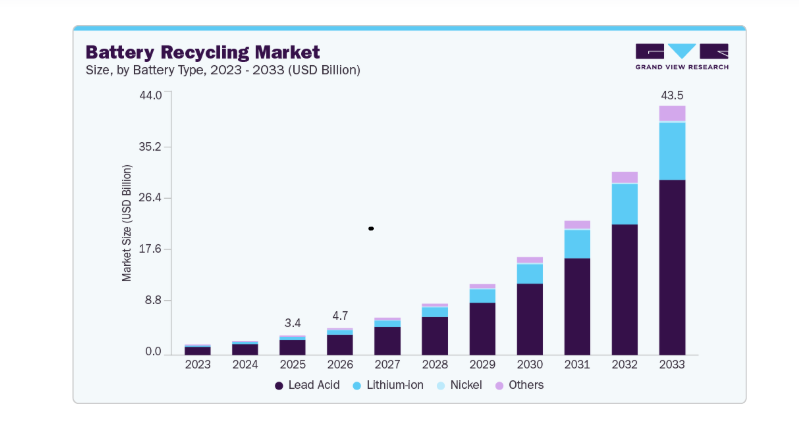
The Battery Recycling Market was valued at USD 3.4 billion in 2025 and is projected to reach USD 43.5 billion by 2033, registering a 37.7% CAGR from 2026 to 2033. Growing electric vehicle adoption, renewable energy storage, consumer electronics, and battery manufacturing are increasing the volume of batteries and manufacturing scrap requiring collection and recycling.
Battery recycling is also becoming important for recovering critical materials such as lithium, cobalt, nickel, and lead. Regulatory developments, extended producer responsibility programs, and technological improvements are supporting the development of more circular battery supply chains.
Key Highlights
The Battery Recycling Market is projected to grow from USD 3.4 billion in 2025 to USD 43.5 billion by 2033, at a 37.7% CAGR. Asia Pacific held the largest share at 41.7% in 2025 and is expected to record the fastest growth at 38.8% CAGR. Manufacturing scrap accounted for 55.2%, while lead-acid batteries held the largest battery-type share at 77.5%. Pyrometallurgy led recycling methods with a 45.6% share, while lithium-ion batteries and automotive sources represent major growth opportunities.
Electric Vehicles Are Reshaping Battery Recycling Demand
The growing adoption of electric vehicles is creating a larger future stream of lithium-ion batteries for recycling. Battery manufacturing also generates scrap during electrode production, cell assembly, and quality-control processes.
Electric Vehicle Adoption
↓
Higher Battery Production
↓
Growing Manufacturing Scrap and Used Batteries
↓
Greater Need for Collection and Recycling
↓
Recovery of Valuable Battery Materials
The automotive source segment is projected to grow at a 42.3% CAGR from 2026 to 2033, reflecting the increasing importance of vehicle batteries in future recycling volumes.
Download a free sample report or claim your copy of this full market intelligence report
Critical Material Recovery Is Becoming a Strategic Priority
Battery recycling provides an additional source of lithium, cobalt, nickel, manganese, lead, and other materials used across battery technologies. Recovering these resources can help diversify material supply while supporting closed-loop battery manufacturing.
As electrification increases demand for critical materials, recycling companies and battery manufacturers are increasingly focusing on technologies that can recover valuable materials efficiently and return them to productive use.
Manufacturing Scrap Creates an Immediate Recycling Opportunity
Manufacturing scrap represented 55.2% of the Battery Recycling Market in 2025, making it the largest source segment. Defective cells, electrode materials, and other production waste can provide recyclers with relatively consistent feedstock.
The expansion of global battery manufacturing capacity is expected to increase the availability of such scrap, creating opportunities for recycling companies to integrate their operations more closely with battery producers.
Lead-Acid Batteries Continue to Support Market Development
Lead-acid batteries accounted for 77.5% of the market in 2025. Their established use in automobiles, industrial systems, and backup power applications has created mature collection and recycling networks.
Recovered lead can be returned to battery manufacturing, allowing the material to circulate through multiple product lifecycles. At the same time, lithium-ion recycling is creating new growth opportunities as electrification expands.
Lithium-Ion Recycling Is Becoming a Major Growth Opportunity
The lithium-ion battery segment is projected to register a 43.9% CAGR from 2026 to 2033. Increasing EV production, consumer electronics usage, and stationary energy storage are expanding the underlying battery base.
Different lithium-ion chemistries and cell designs can require specialized recycling processes. Investments in technologies capable of recovering lithium, nickel, cobalt, and manganese are therefore becoming increasingly important.
Recycling Technologies Are Advancing
Pyrometallurgy held the largest share among recycling methods at 45.6% in 2025. The process can handle different battery materials through high-temperature treatment.
Hydrometallurgy, meanwhile, is expected to grow at a 41.3% CAGR through 2033. Its ability to selectively recover valuable metals makes it relevant to the growing demand for high-quality recycled battery materials. Direct recycling is also gaining attention for its potential to preserve valuable battery components.
Regulations and Producer Responsibility Are Strengthening the Market
Environmental regulations and extended producer responsibility programs are encouraging improvements in battery collection, transportation, recycling, and traceability. These measures are supporting the development of formal recycling infrastructure.
However, high capital requirements, diverse battery chemistries, processing complexity, and safe transportation remain important challenges. Damaged lithium-ion batteries also require specialized handling because of fire and thermal risks.
Regional Growth Is Closely Connected With Battery Manufacturing
Asia Pacific accounted for 41.7% of global market revenue in 2025 and is expected to remain the fastest-growing regional market. Strong battery manufacturing, EV production, electronics, and energy storage industries provide a substantial feedstock base.
North America is expanding through EV adoption and battery manufacturing investments, while Europe continues to emphasize battery recycling and circular-economy practices. Latin America is gradually developing its recycling ecosystem, with the Middle East and Africa representing emerging opportunities.
Key Companies
- American Battery Technology Company
- Aqua Metals
- Call2Recycle
- Cirba Solutions
- East Penn Manufacturing Co.
Companies are focusing on recycling capacity, collection networks, recovery technologies, material quality, and strategic partnerships to strengthen their positions within the evolving battery recycling ecosystem.
Conclusion
The Battery Recycling Market is becoming an important part of the global battery supply chain rather than simply a waste-management activity. Rising EV adoption, expanding battery manufacturing, critical-material demand, regulatory support, and technological advances are creating opportunities across collection, processing, and material recovery.
With the market projected to reach USD 43.5 billion by 2033, efficient recovery and reintegration of valuable battery materials will remain central to the industry's long-term development.

 English
 Arabic
 French
 Spanish
 Portuguese
 Deutsch
 Turkish
 Dutch
Dutch
 Italiano
 Russian
 Portuguese (Brazil)
 Greek
Greek
