
Conveyor Systems Market Outlook for High-Speed Fulfillment
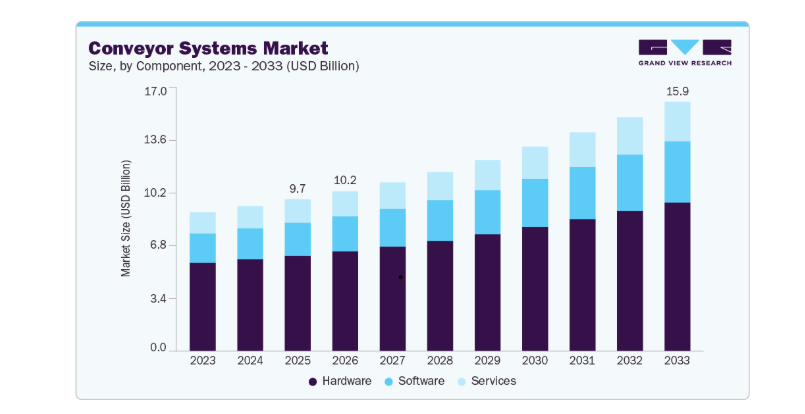
What does an online order have in common with a car assembled inside a modern factory? Both depend on something that most customers never see: controlled material movement. Behind every efficient warehouse and production line is a system that decides how products, components, cartons, pallets, and raw materials move. As factories and distribution centers become faster and more automated, that movement becomes increasingly difficult to manage manually. The Conveyor Systems Market is benefiting from this shift.
The global market was valued at USD 9.7 billion in 2025 and is projected to reach USD 15.9 billion by 2033, growing at a 6.6% CAGR between 2026 and 2033. Asia Pacific represented 40.0% of global revenue in 2025.
Key Highlights
Hardware remains the largest component, accounting for 62.8% of market revenue in 2025, while belt conveyors and unit-load systems continue to dominate their respective categories. Fully automated operation is the leading mode, and manufacturing remains the largest end-use environment. Software, however, is becoming an increasingly important growth layer because modern conveyors need to communicate with robots, warehouse management systems, sensors, and other automation infrastructure.
Why Does Automation Need Conveyors?
Automation creates a coordination problem. Imagine a robotic arm preparing to pick a component while the required part is still several meters away. Or imagine an automated packaging machine receiving products irregularly. The machinery may be highly advanced, but the production process cannot operate efficiently if material movement is inconsistent.
Download a free sample report or claim your copy of this full market intelligence report
Conveyors solve this coordination challenge by creating predictable movement.
Production demand increases
↓
Material flow becomes more complex
↓
Manual transportation creates delays and inconsistency
↓
Automated conveyors standardize movement
↓
Sensors and software begin controlling the flow
↓
Factories and warehouses become more connected
That is the structural reason conveyor demand is growing alongside automation.
What Is Driving Warehouse Demand?
The answer is largely tied to e-commerce. Online retail has transformed warehouses into high-speed processing environments. Products must be picked, sorted, consolidated, packed, and dispatched with increasing accuracy.
A conveyor system can connect these activities into one continuous material flow. Instead of workers transporting every package between different stations, automated equipment can move items according to predefined routes and priorities.
That makes the conveyor particularly valuable when order volumes become too large for manual handling to remain efficient.
Can Conveyors Actually Become “Smart”?
They already are becoming more connected. Modern conveyor systems can incorporate sensors, controllers, software, and communication technologies that allow operators to monitor performance and identify changing operating conditions. This is supporting predictive maintenance and more responsive material-flow management.
The evolution is therefore not simply mechanical.
Traditional conveyor: move the product
Connected conveyor: move, monitor, communicate, adjust
This difference is becoming increasingly important as factories and warehouses pursue digital transformation.
Why Does the Type of Load Matter?
A carton moving through an e-commerce warehouse is very different from crushed mineral material moving through a mining facility. Unit-load conveyors are designed around individual products, packages, cartons, or pallets. They are particularly relevant to distribution centers and fulfillment operations.
Bulk-load systems address continuous movement of large quantities of materials such as minerals and aggregates. Their importance increases in environments where the material itself is the load rather than a discrete package. The difference explains why conveyor technology continues to diversify even as automation becomes more widespread.
Why Are Belt Conveyors Still Dominant?
Belt conveyors remain widely used because they can handle many different products and operating conditions. Their flexibility makes them relevant across manufacturing, logistics, warehousing, food and beverage, and other industrial settings.
Their role is also changing through technology integration. Sensors can track movement, automated controls can regulate speed, and software can coordinate the conveyor with other machines. This means the familiar belt conveyor is becoming part of a more intelligent system.
Could Overhead Conveyors Solve a Factory-Space Problem?
For some operations, yes. Floor space is expensive and operationally important. When materials are moved overhead, production areas can remain clearer, workers can move more freely, and some manual lifting activities can be reduced.
This is one reason overhead conveyors are projected to be among the faster-growing conveyor types. Their value comes not only from transportation but also from how they change the physical organization of a workplace.
What Happens Inside a Fully Automated Warehouse?
A parcel can move through several stages without being manually carried from one station to the next.
An order is released → the required item enters the handling system → the package is transported to the appropriate location → sorting equipment directs it onward → packing takes place → the finished shipment moves toward dispatch.
Every one of those transitions creates an opportunity for optimization.
This is why conveyor software is becoming increasingly relevant. It can coordinate routing, prioritize movement, integrate with warehouse systems, and help maintain a stable flow even when order patterns change.
Why Is Manufacturing Still the Largest End Use?
Factories have always needed material movement, but the scale and complexity of modern production have changed the requirement.
Automotive plants, electronics facilities, food-processing operations, pharmaceutical manufacturing, and other industries need materials to reach the right point in the production cycle without interruption. The integration of IoT devices, sensors, and data analytics is strengthening this requirement because smart factories depend on real-time visibility across production processes. Conveyors are increasingly becoming one of the physical layers through which that visibility is created.
What Is Happening Across Asia Pacific?
Asia Pacific accounted for 40.0% of global conveyor systems revenue in 2025 and is projected to remain both the largest and fastest-growing regional market. Its regional market is projected to reach USD 6.86 billion by 2033, growing at 7.6% CAGR.
China's manufacturing scale and e-commerce infrastructure provide an important source of demand, while India, Japan, South Korea, and other markets are expanding automation and logistics capabilities.
Europe is progressing through smart manufacturing and sustainability-focused modernization, while North America continues to invest in food, pharmaceuticals, automotive, aerospace, warehousing, and logistics automation.
What Will the Next Conveyor Look Like?
It may still look like a belt or roller system from a distance. The difference will be what happens around it.
Sensors will monitor it. Software will coordinate it. Robots will interact with it. Warehouse systems will send instructions to it. Maintenance teams will receive information from it.
That is the real transformation underway in the conveyor systems market. The physical machine remains essential, but its value is increasingly determined by how intelligently it can operate inside a connected industrial environment.
About us:
Grand View Research, a market research and consulting company, provides syndicated research reports, customized research reports, and consulting services. Grand View Research database is used by the world's renowned academic institutions and Fortune 500 companies to understand the global and regional business environment. Our database features thousands of statistics and in-depth analysis on 46 industries in 25 major countries worldwide.

 English
 Arabic
 French
 Spanish
 Portuguese
 Deutsch
 Turkish
 Dutch
Dutch
 Italiano
 Romaian
 Portuguese (Brazil)
 Greek
Greek
