
Coating Additives Market Growth Driven by Sustainable Formulation Demand
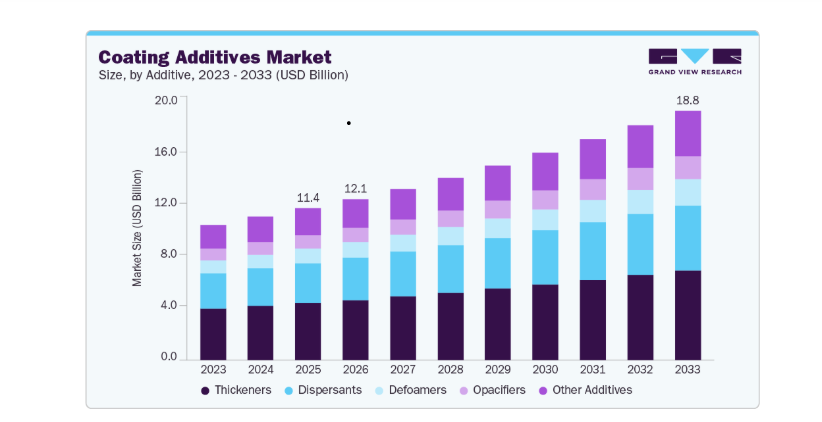
A coating may appear to be a simple protective or decorative layer, but its final performance depends on a complex formulation in which even relatively small quantities of additives can influence viscosity, dispersion, surface quality, durability, and application behavior. This is becoming increasingly important as coating manufacturers move toward formulations that must satisfy two requirements at the same time: stronger performance and lower environmental impact. The global Coating Additives Market was valued at USD 11.4 billion in 2025 and is projected to reach USD 18.8 billion by 2033, expanding at a CAGR of 6.5% from 2026 to 2033. Asia Pacific accounted for 35.9% of global revenue in 2025 and is expected to remain the fastest-growing regional market.
The interesting part of this growth is not simply the rising volume of coatings being produced. It is the changing formulation logic behind them. Manufacturers are increasingly expected to reduce VOC emissions, limit hazardous chemistry, use more sustainable raw materials, and still deliver coatings that can withstand weathering, chemicals, abrasion, UV exposure, and demanding industrial conditions. This creates a direct formulation chain: environmental pressure → formulation redesign → greater dependence on specialized additives → higher-value coating systems.
When sustainability becomes a formulation problem
The transition toward water-based, low-VOC, high-solid, powder, and bio-based coatings is changing the role of additives. Water-based systems held the largest formulation share at 45.5% in 2025, but replacing solvent-based chemistry with water does not automatically guarantee the same application and performance characteristics. Formulators still need to control viscosity, pigment dispersion, wetting, foam, leveling, film formation, and surface appearance.
This is where coating additives become increasingly important. Thickeners, dispersants, wetting agents, defoamers, opacifiers, adhesion promoters, slip modifiers, and anti-settling agents allow manufacturers to adjust specific characteristics without redesigning the entire coating system. The additive therefore becomes more than a supporting ingredient; it becomes a formulation tool for balancing performance with regulatory requirements.
Thickeners represented the largest additive segment, with a 37.6% revenue share in 2025. Their importance comes from their ability to control viscosity and flow while helping coatings maintain uniformity during storage and application. Their use across architectural, automotive, and industrial formulations is particularly relevant as manufacturers continue to develop water-based and low-VOC products.
Download a free sample report or claim your copy of this full market intelligence report
Performance is moving from the surface to the formulation
The growing importance of additives can also be understood through the industries using coatings. In construction, architectural coatings need durability, weather resistance, visual consistency, and efficient application. In automotive manufacturing, coatings must provide scratch resistance, corrosion protection, UV stability, and surface quality. Industrial equipment and infrastructure require protection against chemicals, abrasion, moisture, and demanding operating conditions.
The same coating cannot necessarily deliver all these characteristics without formulation adjustments. Additives help bridge that gap. Pigment dispersion → controlled rheology → improved application → uniform film formation → longer-lasting surface performance represents a formulation pathway that is becoming increasingly important across end-use industries.
Architectural coating additives accounted for 53.5% of the application market in 2025, reflecting the scale of construction, renovation, and infrastructure-related demand. General industrial finishes also remain important because manufacturers increasingly require coatings that extend equipment life while improving corrosion resistance, chemical stability, and surface consistency.
Automotive and OEM coatings, wood finishes, marine coatings, and other industrial applications add another layer of demand because each requires a different combination of performance characteristics. As coating specifications become more application-specific, demand is shifting toward additives capable of solving particular formulation challenges rather than simply improving coatings in a general sense.
The next growth opportunity is not necessarily a new coating
One of the notable characteristics of the coating additives market is that innovation can happen without completely replacing an existing coating technology. Instead, manufacturers can improve an established formulation by introducing a more efficient additive system.
This creates opportunities for multifunctional additives that can address several requirements simultaneously. A formulation may need better dispersion while also requiring improved surface appearance, lower foam, stronger adhesion, or enhanced durability. Multifunctional technologies can potentially simplify formulations and reduce the amount of individual additives required.
At the same time, raw material volatility remains a challenge. Specialty chemical manufacturers are exposed to fluctuations in petrochemical-derived feedstocks, energy costs, and the availability of chemical intermediates. Regulatory scrutiny adds another layer of complexity because additives themselves increasingly need to demonstrate environmental and safety compatibility.
The competitive environment is therefore evolving around formulation expertise as much as manufacturing scale. Large chemical companies benefit from global production networks, application laboratories, technical expertise, and broad portfolios, while regional manufacturers are expanding their capabilities in high-growth markets.
Asia Pacific is shaping the industry's next phase
Asia Pacific represented 35.9% of the global coating additives market in 2025 and is expected to remain the fastest-growing region through 2033. The region combines large construction and manufacturing industries with expanding automotive production, infrastructure investment, and growing demand for sustainable coating systems.
China is particularly significant because of its extensive coatings manufacturing base and strong demand from construction, automotive, and industrial applications. The move toward water-based and low-VOC formulations is increasing the importance of additives that can maintain formulation performance while meeting environmental expectations.
North America and Europe are following a somewhat different pathway, with regulatory pressure and sustainability commitments playing a major role in formulation development. In North America, demand for low-VOC and high-performance systems across construction, automotive, and industrial applications is supporting additive adoption. Europe is seeing increasing attention toward bio-based, biodegradable, low-toxicity, and environmentally compliant additive technologies.
Across these regions, the direction is similar even when the market conditions differ: regulation → reformulation → additive innovation → performance optimization.
Companies are competing through formulation capabilities
The competitive landscape includes major chemical companies such as BASF SE, Altana AG, DOW Inc., Nouryon, and Evonik Industries AG. These companies operate across different additive technologies and serve applications spanning architectural, automotive, industrial, wood, marine, and protective coatings.
BASF, for example, has a broad coating-additives portfolio covering functions such as rheology control, dispersion, defoaming, wetting, corrosion protection, and surface modification. The wider competitive landscape is characterized by product development, technical collaboration, application-specific solutions, and investment in sustainable formulation technologies.
The market is therefore not simply expanding because more coatings are being produced. It is expanding because the definition of a high-quality coating is changing. A modern coating increasingly has to be durable, efficient, compliant, sustainable, and suitable for increasingly specialized applications. Additives sit at the center of that transition, making the coating additives market an important part of the broader evolution of paints and coatings.
About us:
Grand View Research, a market research and consulting company, provides syndicated research reports, customized research reports, and consulting services. Grand View Research database is used by the world's renowned academic institutions and Fortune 500 companies to understand the global and regional business environment. Our database features thousands of statistics and in-depth analysis on 46 industries in 25 major countries worldwide.

 English
 Arabic
 French
 Spanish
 Portuguese
 Deutsch
 Turkish
 Dutch
Dutch
 Russian
 Romaian
 Portuguese (Brazil)
 Greek
Greek
