
Managed SOC Service Providers: Essential Security for Indian Healthcare
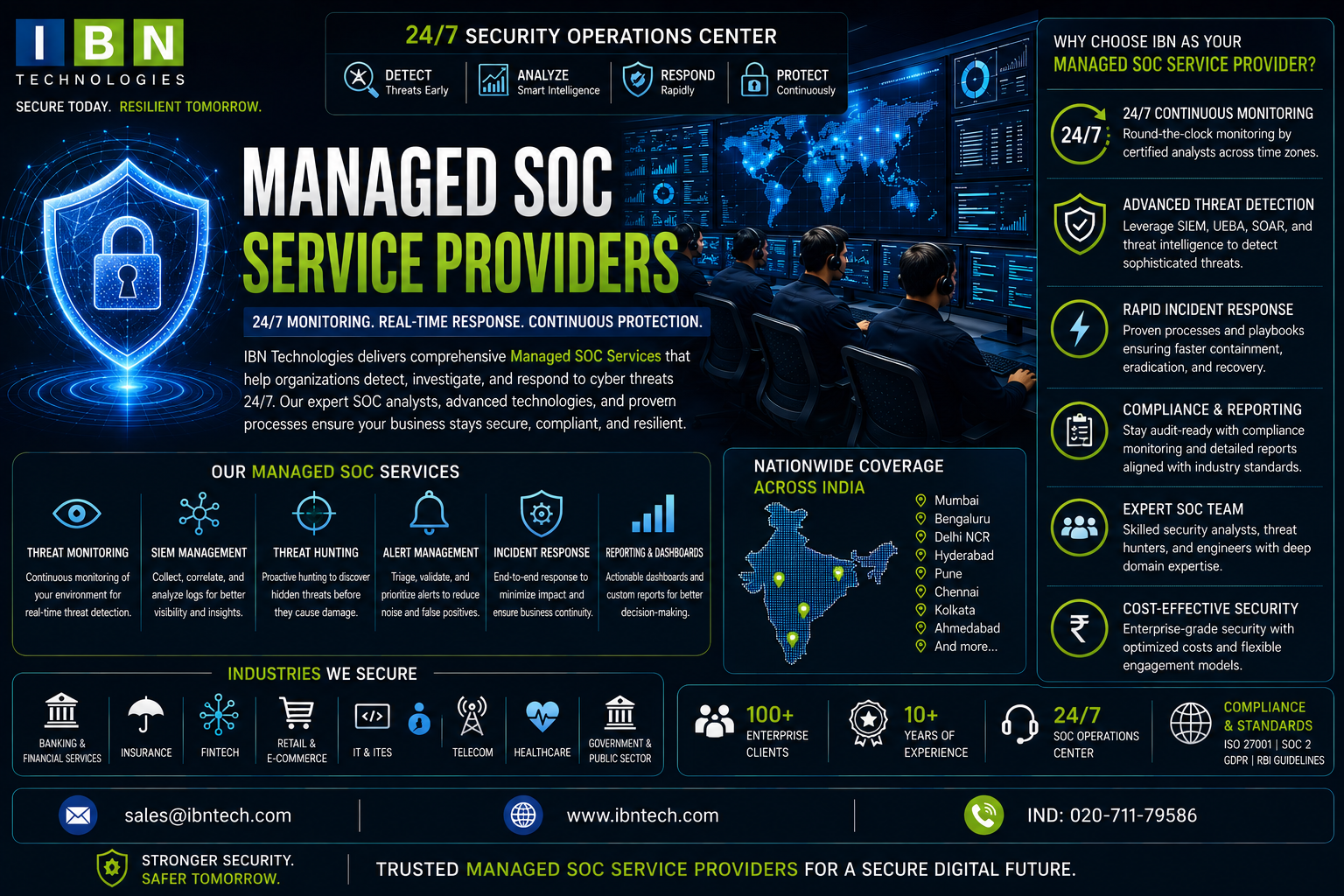
How Healthcare Organisations Can Build Better Security Readiness With Managed SOC
Healthcare organisations increasingly depend on digital systems to support clinical, administrative, and patient-facing operations. Hospitals, diagnostic centres, healthcare providers, and related organisations may operate applications, connected devices, cloud platforms, employee endpoints, patient portals, and other technology environments.
This connectivity creates an important security challenge. A suspicious event affecting one system may require investigation because it could have implications for other connected resources.
In this environment, managed soc service providers can help healthcare organisations establish a more structured approach to security monitoring, threat detection, alert investigation, and incident response.
The objective is not simply to monitor technology. It is to improve an organisation's readiness to recognise potentially harmful activity and respond through defined security processes.
Why Healthcare Security Readiness Matters in India
Healthcare organisations manage technology that supports important business and operational functions. When digital systems become unavailable or compromised, the impact can extend beyond an isolated IT issue.
Security teams therefore need visibility into relevant events and a practical process for handling suspicious activity.
A managed SOC provides security monitoring and operational support that can help healthcare organisations identify, investigate, prioritise, and escalate potentially significant security events.
This makes security operations an ongoing capability rather than an activity performed only after an incident occurs.
The Essential Connection Between Monitoring and Incident Readiness
Security Visibility Should Lead to Action
Monitoring alone does not automatically create security readiness.
A healthcare organisation may receive alerts from endpoint protection, network security technologies, applications, identity systems, and other platforms. Without a clear process for reviewing these alerts, important events may be difficult to prioritise.
This is where a soc as a service provider can support a more organised operating model.
Instead of treating every notification equally, SOC operations can help examine security events, identify relevant patterns, investigate suspicious activity, and escalate incidents according to predefined procedures.
The result is a clearer connection between detection and response.
How Managed SOC Service Providers Can Support Healthcare Operations
Healthcare organisations can use managed SOC capabilities to strengthen several areas of their security operations.
Ongoing Security Monitoring
Continuous monitoring can help organisations maintain awareness of security activity across agreed technology environments.
Threat Detection
Security teams can use monitored events to identify activity that may require investigation, helping bring potentially significant behaviour to attention.
Alert Investigation
Investigation provides context around security alerts. This can help distinguish routine activity from events that warrant further action.
Incident Escalation
Clear escalation procedures establish what happens when an event reaches a defined level of concern.
Security Reporting
Regular reporting can help technical teams and management understand security activity, recurring issues, investigations, and areas requiring attention.
Together, these functions can contribute to a more structured healthcare security process.
Protecting Connected Healthcare Environments
Healthcare technology environments can contain many interconnected components.
For example, a healthcare organisation may operate patient-facing applications alongside employee systems, cloud services, internal infrastructure, and connected technology.
An unusual authentication event on one system may initially appear isolated. However, additional security activity could provide context that makes the event more significant.
A managed SOC can help investigate related security signals and escalate findings through an agreed process.
This approach is particularly useful when internal teams need additional monitoring and investigation capacity.
A Healthcare Scenario: Responding to Suspicious Account Activity
Imagine a healthcare employee account showing unusual authentication behaviour outside its expected pattern.
The first alert does not necessarily prove that an account has been compromised.
A structured SOC process can examine relevant information, investigate the activity, look for related security events, and determine whether escalation is appropriate.
If the activity requires action, the managed SOC can communicate the relevant findings to designated internal stakeholders according to the agreed incident process.
This helps healthcare organisations move from alert → investigation → escalation rather than allowing alerts to remain isolated notifications.
What Healthcare Organisations Should Check Before Selecting a Managed SOC
Healthcare leaders should evaluate a managed SOC according to operational requirements rather than focusing only on the number of features advertised.
Important considerations include:
- Which healthcare systems and technology environments will be monitored?
- How will security alerts be prioritised?
- What information is provided during an investigation?
- How are potentially serious incidents escalated?
- Who is responsible for taking response actions?
- What reporting will management receive?
- How will monitoring change when new systems are introduced?
- How will the organisation review recurring security events?
Clear answers to these questions can help establish realistic expectations before implementation.
Building Incident Readiness Into Everyday Security Operations
Incident readiness should not begin when a serious security event occurs.
Healthcare organisations can prepare by documenting escalation paths, identifying responsible teams, establishing communication procedures, and defining how significant security events should be handled.
A managed SOC can operate within this framework by providing monitoring and investigation support.
The organisation remains responsible for broader security governance and decisions, while the SOC contributes operational visibility and security analysis.
This division of responsibility should be documented clearly.
Managed SOC and Healthcare Security Governance
Indian healthcare organisations need to consider security as part of broader technology and organisational governance.
Managed SOC operations can support security governance by creating more consistent monitoring, investigation, reporting, and escalation processes.
However, SOC services should not be viewed as a substitute for other cybersecurity controls.
Security policies, access management, vulnerability management, employee awareness, backup practices, and broader risk-management activities continue to play important roles in an organisation's overall security posture.
The SOC is one component within that larger framework.
A Practical Readiness Checklist for Healthcare Teams
Healthcare organisations reviewing their security operations can focus on:
- Define critical technology environments that require monitoring.
- Document security alert escalation procedures.
- Establish internal responsibilities for incident response.
- Review monitoring coverage whenever technology environments change.
- Maintain clear communication channels for significant incidents.
- Analyse recurring security events to identify operational patterns.
- Review SOC reporting regularly with relevant stakeholders.
- Test whether security teams understand their responsibilities during an incident.
These practices can help turn security monitoring into a repeatable operational capability.
Making Security Readiness a Continuous Process
Healthcare cybersecurity cannot depend entirely on reacting after a security incident has already developed.
Organisations need ongoing visibility, defined investigation processes, and clear escalation responsibilities to improve their ability to handle suspicious activity.
Managed soc service providers can support this approach by providing structured security monitoring, threat detection, alert investigation, and incident response support.
For Indian healthcare organisations, the goal should be a security operations model that works alongside existing technology and governance processes while remaining adaptable as digital healthcare environments continue to evolve.
Contact Us:
IND- 02067680404
IBN Technologies Ltd.
E-mail: - sales@ibntech.com

 English
 French
 Spanish
 Portuguese
 Deutsch
 Turkish
 Dutch
Dutch
 Italiano
 Russian
 Romaian
 Portuguese (Brazil)
 Greek
Greek
